
“We Shouldn’t Have Done That” — The Tragedy of Laika, the First Dog That Was Sent to Space

In October 1957, a small stray dog from Moscow’s cold streets became an unlikely participant in history. Laika weighed just over 10 pounds when scientists chose her for a mission that would make her famous worldwide. Yet this fame came at the ultimate price. Her story reveals uncomfortable truths about sacrifice, ethics, and humanity’s pursuit of progress during the Space Race, and even the researchers who sent her into space later admitted they regretted that choice.
The Cold War Space Race Begins

Following World War II, the United States and the Soviet Union entered a tense competition for technological supremacy. Space exploration became the ultimate proving ground for each nation’s capabilities. When the Soviets launched Sputnik 1 in October 1957, the world’s first artificial satellite, it shocked Americans and intensified the rivalry. Soviet leader Nikita Khrushchev wanted another spectacular achievement to celebrate the Bolshevik Revolution’s 40th anniversary.
Why Scientists Chose a Dog

Soviet researchers believed stray dogs made ideal test subjects for space experiments. These animals had already survived harsh Moscow winters and crowded streets, proving their resilience. Scientists also preferred dogs over monkeys because they were easier to train. Female strays were specifically selected because of their smaller size and reportedly calmer temperaments. Laika, originally named Kudryavka meaning “Little Curly,” was among several dogs rescued from the streets for this purpose.
The Mission’s True Purpose

Sputnik 2 launched on November 3, 1957, designed to prove a living creature could survive space travel’s extreme conditions. Scientists wanted data on how launch forces, weightlessness, and increased radiation affected biological organisms. However, from the very beginning, engineers knew the technology to safely return spacecraft to Earth didn’t exist yet. Laika’s mission was always intended to be one-way, a fact that sparked immediate ethical concerns worldwide.
Brutal Training Methods

Laika endured weeks of harsh preparation alongside other candidate dogs, Albina and Mushka. Experimenters confined them in extremely cramped spaces for days, simulating the tiny capsule conditions. Reports indicate this confinement caused the dogs to stop normal bodily functions, even with laxatives, and their mental health deteriorated significantly. They also endured centrifuge tests mimicking launch forces and loud continuous noises. These procedures allegedly caused their heart rates to double and blood pressure to spike.
The Final Selection

Researcher Vladimir Yazdovsky ultimately chose Laika over Albina just over a week before launch. Albina had recently given birth to puppies and had reportedly won the affections of her handlers. Both dogs underwent surgery to have monitoring devices implanted in their bodies to track vital signs during the flight. Despite knowing Laika’s fate, Yazdovsky brought her home to play with his children before the mission. He later said he wanted to do something nice for her.
Three Days of Waiting

Scientists placed Laika inside Sputnik 2’s capsule three days before launch. The launch site in Baikonur was so bitterly cold that workers connected a heater to keep her container warm. The capsule was equipped with enough gelatinized food for seven days, though engineers never expected her to survive that long. Before closing the hatch, one technician recalled kissing her nose and wishing her safe travels, knowing she wouldn’t survive the journey.
Launch Day: November 3, 1957

At liftoff, Laika’s respiration increased to between three and four times her normal rate. Her heart rate jumped from 103 beats per minute to 240 during the intense acceleration, more than double her resting rate. She was strapped into a harness with chains that restricted her to sitting, standing, or lying down in the cramped capsule. The 11-pound dog couldn’t even turn around. G-forces reached five times the normal gravity levels.
The Tragic Truth Revealed Decades Later

For years, Soviet officials claimed Laika survived for several days before being euthanized with poisoned food as planned. However, in 2002, Russian scientist Dimitri Malashenkov revealed the truth at a conference. Laika actually survived only about five to seven hours after liftoff before dying of overheating and panic. The satellite’s thermal control system failed when the core didn’t separate properly, and temperatures inside soared above 100 degrees Fahrenheit.
A Terrified, Lonely Death
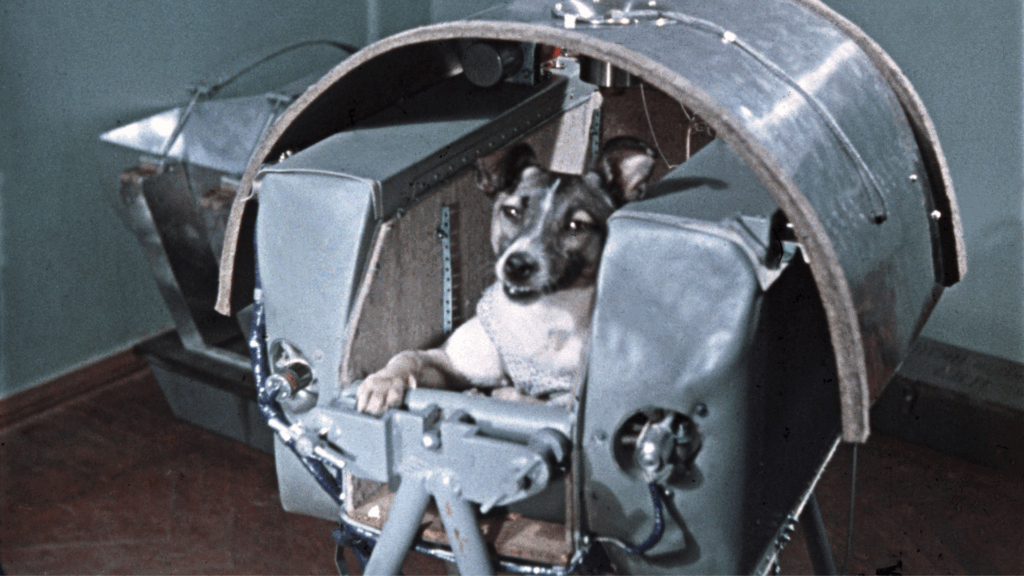
The monitoring devices surgically implanted in Laika’s body transmitted her final moments. Her elevated heart rate never fully returned to normal during her brief time in weightlessness. The combination of extreme stress, overheating, and fear proved fatal within hours. She died alone, terrified, and in severe distress, orbiting Earth in a metal coffin. The mission provided limited scientific value since the life-support system failed so quickly after launch.
Her Body’s Final Journey

Although Laika died just hours into the flight, her body continued circling Earth. The Sputnik 2 satellite completed 2,570 orbits over five months. On April 14, 1958, the spacecraft finally disintegrated during re-entry into Earth’s atmosphere. People around the world watched as it streaked across the sky like a shooting star. For many, it served as a fiery memorial to the small dog who never asked to become part of history.
Global Reaction and Protests
The mission sparked immediate international debate about animal treatment in scientific research. In the United Kingdom, the National Canine Defence League called on dog owners to observe a minute’s silence each day Laika remained in space. The Royal Society for the Prevention of Cruelty to Animals received numerous protests even before the launch announcement finished. However, Cold War tensions and the space race’s political importance often overshadowed these ethical concerns.
A Scientist’s Regret

Oleg Gazenko, one of the mission’s leading scientists, eventually expressed profound regret about sending Laika into space. “The more time passes, the more I’m sorry about it. We shouldn’t have done it.” Decades after the mission, he acknowledged the sacrifice wasn’t worth the limited data gained and that they shouldn’t have proceeded. His admission highlighted growing awareness that the experiment’s scientific value didn’t justify the animal’s suffering and death.
Why the Rushed Timeline Proved Fatal

Soviet Premier Khrushchev demanded the mission launch by November 7, 1957, giving engineers less than four weeks to design and build the spacecraft. This impossible deadline meant proper safety systems couldn’t be developed or tested adequately. Insufficient time to perfect life-support systems resulted directly from intense political pressure. The rush to achieve a propaganda victory over America cost Laika her life and compromised the mission’s scientific integrity.
Legacy in Modern Animal Research

Laika’s story remains relevant today because approximately 48,000 dogs undergo experimentation annually in U.S. laboratories alone. Many animals still endure painful procedures for research that sometimes yields questionable results. However, awareness of animal welfare has grown significantly since 1957. Modern regulations require ethical review committees, proper veterinary care, and justification for using animals instead of alternatives. Space agencies now prioritize minimizing animal distress in experiments.
Scientific Progress Without Animal Sacrifice

Organizations like PETA successfully campaigned to end several NASA experiments involving animals in recent decades. In 1996, they stopped the Bion experiment that would have subjected monkeys to invasive procedures before space launch. The National Institutes of Health recently shifted funding priorities toward non-animal research methods and human-relevant alternatives. These changes demonstrate growing recognition that scientific advancement doesn’t require animal suffering when better options exist.
Understanding the Space Race Context

During the 1950s and 1960s, the Cold War drove both superpowers to achieve space milestones at any cost. Public opinion focused heavily on political victories rather than ethical considerations. Animal welfare concerns seemed secondary to proving technological superiority over rival nations. However, this historical context doesn’t excuse the decisions made. Examining past mistakes helps society develop more ethical approaches to scientific research and space exploration today.
Remembering Laika Today

In 2008, a small monument depicting Laika standing atop a rocket was unveiled near the Moscow military research facility that prepared her flight. She also appears on the Monument to the Conquerors of Space in Moscow. Numerous countries issued commemorative stamps featuring her image. These memorials honor her unwilling sacrifice while serving as reminders of humanity’s ethical responsibilities. Her story appears in books, documentaries, and museums worldwide.
The Ongoing Ethical Debate

Laika’s mission raises fundamental questions about using animals for human benefit that remain unresolved. Some argue her sacrifice contributed to human space exploration, enabling safer missions that eventually put people on the Moon. Others contend the rushed experiment’s minimal scientific value and certain fatal outcome made it inexcusable. The European Union’s 2009 ban on animal testing for cosmetics demonstrates evolving ethics. These discussions continue shaping research policies today.
Lessons From a Small Dog’s Story

More than 60 years later, Laika’s story still resonates because it represents a broader pattern of treating animals as disposable tools. Her entire life—from Moscow’s streets to dying alone in space—was marked by human exploitation. Yet her legacy has contributed to important changes in animal welfare standards and research ethics. Remembering Laika means committing to better choices, questioning whether progress justifies suffering, and honoring all creatures who never consented to sacrifice.
PetsFanatic Team
Pet Care Expert & Content Creator
Passionate about sharing knowledge and tips for better pet care. Writing about everything from pet health to training techniques.