
Rescuers Airlift Horse Stranded Around 7200 Feet Up in California Backcountry After Bucking Rider
The Tevis Cup is one of the most demanding endurance rides in the country, sending 102 rider and horse teams across 100 miles of California backcountry near Lake Tahoe with a 24-hour time limit. During this year’s race, one horse bucked its rider and disappeared into the rugged terrain of the Granite Chief Wilderness. The rider was found quickly and was uninjured, but the horse was nowhere in sight. What followed was a race against time, elevation, and dense mountain brush to bring the animal home safely.
Ground Teams Search for More Than Two Hours

Rescuers from the Nevada County Sheriff’s Humane Emergency Animal Rescue Team, known as HEART, immediately began tracking the horse using a GPS beacon attached to its saddle. For over two hours, ground crews pushed through steep and unforgiving terrain trying to reach the animal. Despite their effort and determination, the landscape proved too difficult to navigate on foot. As the search stretched on, rising temperatures made the situation more urgent, since responders did not know when the horse had last been able to drink water.
Why Rescuers Turned to the Sky

With ground access ruled out and time working against them, HEART made the call to request aviation support. Within an hour, the Butte County Sheriff’s Office helicopter was overhead and searching the mountainside. Using the GPS coordinates, the flight crew located the horse in just three minutes of air time from the incident command post. The horse appeared alive and alert, which was a relief to everyone involved, but reaching him safely would require a far more complex operation than a simple flyover.
Trapped in a Thicket No One Could Reach on Foot

The horse was found deep within a dense stand of manzanita, a thick and woody shrub common to California mountainsides, at an elevation of roughly 7,200 feet. The terrain made a ground-based extraction essentially impossible. Rescuers had to evaluate the surrounding elevation and the helicopter’s performance limits before settling on a plan. The solution involved inserting a specialized veterinary team directly onto the mountainside by air, since there was no other way to reach the horse in time.
A Veterinary Team Flies in to Help
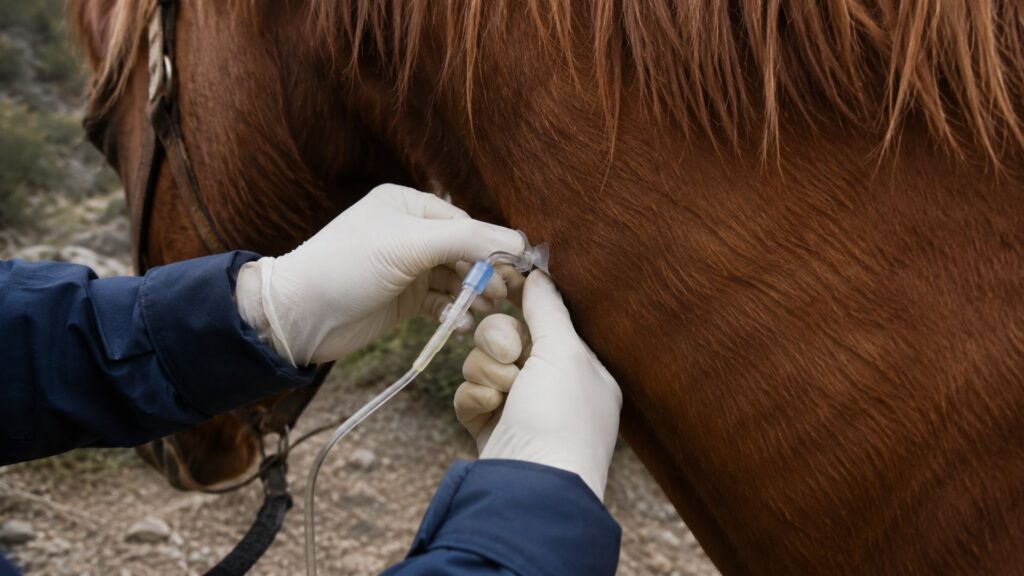
The first helicopter insertion carried the University of California, Davis Equine Medical Strike Team to the horse’s location. Their job was to assess his physical condition, provide fluids to address dehydration, and administer sedation to keep him calm for what would be a delicate and unusual journey down the mountain. Preparing a large animal for aerial transport is a precise task, and the veterinary team needed to work carefully in tough terrain while keeping both themselves and the horse safe.
Setting Up a Second Site for the Handoff

Because of the elevation and the limits of the aircraft, rescuers could not simply fly the horse straight back to base. Instead, they had to establish a separate receiving location where a second team would be ready to take over once the horse arrived. The helicopter flew back to transport this receiving crew into position. Coordinating multiple sites, teams, and flight paths added another layer of complexity to an already delicate rescue effort happening in real time.
Lifting a Horse by Helicopter Harness
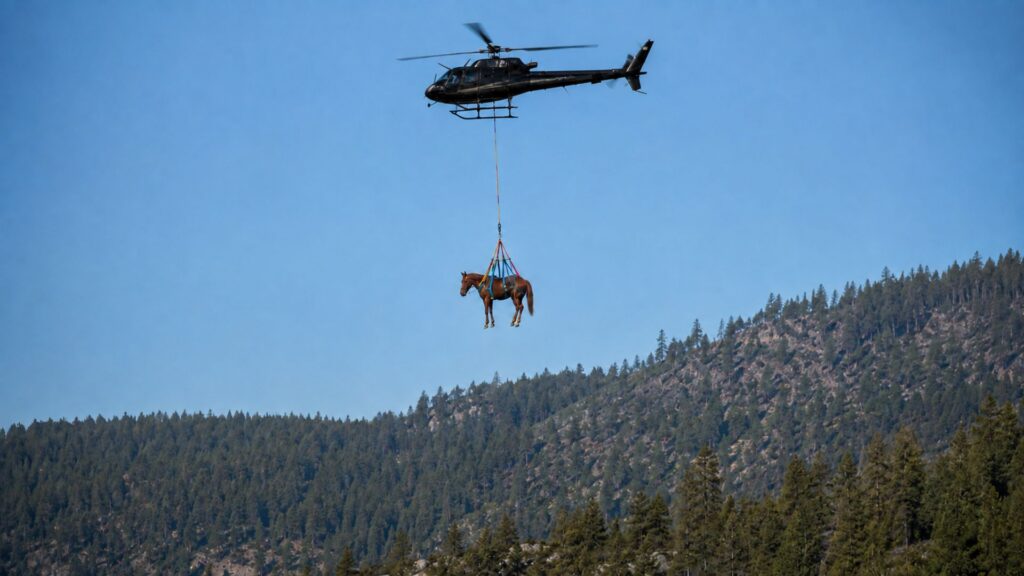
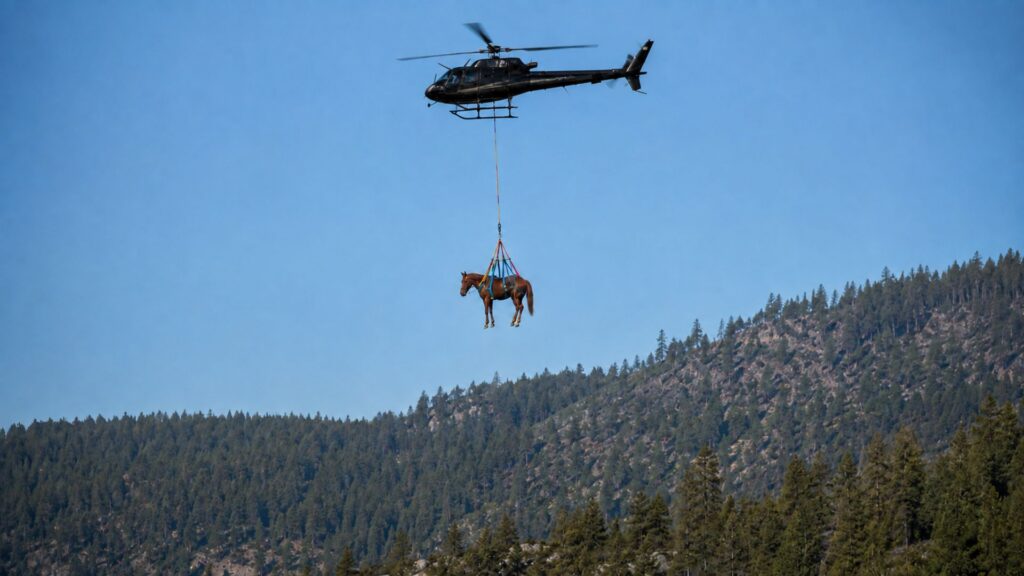
Once the veterinary team had the horse secured in an aerial rescue harness, the pilot carried out what officials described as a flawless external load flight. Video captured during the rescue shows the horse suspended safely as the helicopter carried him away from the mountainside. This kind of operation demands precise flying, since the aircraft has to manage the added weight and movement of a large animal dangling beneath it while navigating narrow mountain airspace.
A Careful Landing and a Quick Recovery

The horse was delivered to the receiving team at a landing area near the French Meadows Reservoir, a lake along the American River. After being gently set down, he was back on his feet and standing within just 15 minutes. From there, he was loaded into a trailer and driven to a nearby veterinary team for a full evaluation. The helicopter then returned to the mountain one final time to safely extract the remaining rescue personnel.
No Major Injuries, Just Dehydration

After the ordeal, veterinarians examined the horse and found no significant injuries. His main issue was dehydration from the hours spent stranded in the heat without access to water. Officials credited the successful outcome to close cooperation between several groups, including the Sheriff’s HEART team, the UC Davis Equine Medical Strike Team, the North Valley Animal Disaster Group, and the Butte County Sheriff’s Office Aviation unit, along with a pilot whose skill made the extraction possible.
The Bigger Lesson Behind a Dramatic Rescue

HEART emphasized that large animal technical rescue is not about dramatic moments, but about sound decision-making under pressure and flawless execution of the fundamentals. This mission showed how specialized equipment and trained crews can bridge the gap when an animal cannot be moved safely over land. It also showed why emergency responders in remote areas often serve as a safety net not just for people, but for pets, livestock, and wildlife caught in dangerous situations far from any road.
PetsFanatic Team
Pet Care Expert & Content Creator
Passionate about sharing knowledge and tips for better pet care. Writing about everything from pet health to training techniques.