
World Surf League Issues Its First Ever Code Red After a Photographer Is Bitten by a Sea Creature During Competition

A professional surfing competition in New Zealand came to a sudden, alarming halt when something in the water attacked the man behind the camera. Australian surf photographer Ed Sloane was shooting the semi-final between Brazilians Yago Dora and Italo Ferreira at Manu Bay in Raglan when something came from underneath and clamped onto his ankle without warning.
The World Surf League triggered a “Code Red” and halted the New Zealand Pro at Raglan just minutes into the men’s semi-final. The incident triggered the WSL’s emergency protocol, typically reserved for shark sightings, sending staff scrambling across the beach and into the water. Competing surfers from Brazil who were already in the water were extracted on jet skis, while the crowd at Manu Bay watched in stunned silence as the horn sounded and the heat was shut down. Nothing like this had ever happened before at a WSL event.
WSL Vice President of Tours and Competition Renato Hickel confirmed the activation on the broadcast: “We activate the Code Red when it’s a sea life attack on a surfer or a photographer. This time it was our beloved water photographer and thank God he’s in good spirits.” Hickel added that it was the first time the league had ever used the protocol for such an incident. The sport had never had to pull a photographer from the water under emergency conditions — until now. The question on everyone’s mind: what exactly was in the water?
The Creature Nobody Could Name
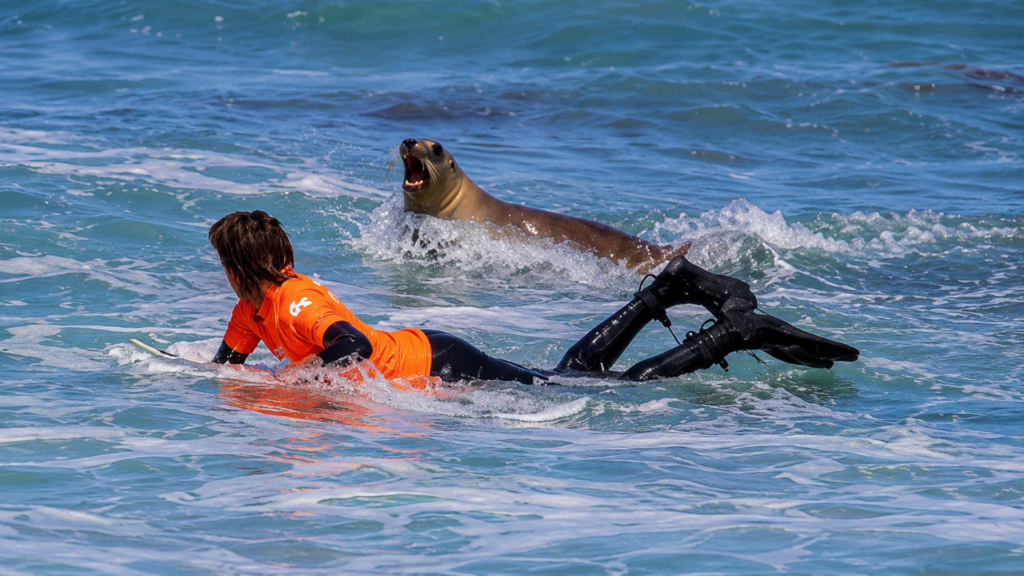
Officials could not confirm whether a shark or a sea lion was responsible for the attack, though the injuries appeared consistent with a sea lion bite. Hickel acknowledged the uncertainty plainly. “At this stage we’re not certain if it was a shark or a sea lion. The doctor that was here helping on the scene was inclined to think it was a sea lion instead of a shark. Nevertheless, very scary,” he said. The attack left no clear evidence, and the identity of the creature may never be confirmed.
The attack followed wild scenes earlier in the waiting period, when a shark was spotted destroying a seal in the lineup. That context made the Code Red feel even more urgent to those on shore. Sloane suffered puncture wounds to his ankle and had a flipper ripped off in the attack. A surf cam recorded the moment he was found thrashing in the water before a jet ski reached him. The incident wasn’t captured on the official broadcast, but the footage that did surface was enough to shake the entire competition.
The two surfers already in the water saw everything. Hickel said: “Italo and Yago obviously are shaken. They saw the splash and the incident and so another reason to put the event on hold.” Both competitors were pulled from the water before the severity of Sloane’s injuries was fully known. What initially looked like a frightening but minor incident would turn out to be far more serious — the kind of wound that ends seasons and changes lives.
Worse Than It Looked

The extent of Sloane’s injuries was worse than initially thought, with the bite damaging seven tendons in his leg. He was rushed to Waikato Hospital, where he underwent surgery that night, as the competition prepared to resume back at Manu Bay. The man who had spent 15 years photographing some of the world’s most dangerous surf was now lying in a hospital bed, facing a recovery that would sideline him far longer than anyone had anticipated.
Sloane shared a brief update the following day alongside photos of his wounds: “The last few shots I took before something thought they’d see how I went for breakfast. Nightmare fuel as it came from directly below. Bit of surgery ahead but should be fine.” He also thanked the WSL’s water patrol, medical team, and staff for their rapid response. The WSL paid for his family to fly from Victoria to be by his side, with their arrival expected on Wednesday.
Sloane faces a lengthy recovery that will include at least three months without walking, and his cast will need to be changed several times. Speaking from his hospital bed, he said he feared for his life when the attack happened. Yet despite the ordeal, Sloane told the WSL: “I love this place and can’t wait to watch an epic Finals Day. Cheering for everyone for a great finish to the event.” The competition, it turned out, carried on, and it carried on with his blessing.
A Historic Day, Finished Under Shadow

The inaugural WSL Championship Tour event in New Zealand eventually resumed, with Carissa Moore returning to competition after giving birth to her first child and winning the women’s final, and Italo Ferreira taking the men’s title. The results deserved celebration. Moore’s return alone was a story worth telling. But the day belonged, in a different and more sobering way, to the man who had been pulled from the water hours before the finals began.
Messages poured in from across the surfing world. Among those who reached out was Mick Fanning, the Australian surf legend who in 2015 was attacked by a shark during the J-Bay Pro in South Africa — one of the most watched moments in surfing’s history. That incident was broadcast live. This one was not. But the aftermath of both has stayed with the sport in ways that go beyond the scoreboard.
WSL Vice President Renato Hickel confirmed it was the first known time a sea creature had attacked a photographer at a WSL event. The Code Red protocol, built for exactly this kind of emergency, worked as designed. Surfers were extracted. Medical teams responded. The event resumed. But seven damaged tendons and months of recovery are the real measure of what happened at Raglan on May 26, 2026. The ocean has always been the most unpredictable element in professional surfing. Ed Sloane simply had the misfortune of being the first to prove it.
PetsFanatic Team
Pet Care Expert & Content Creator
Passionate about sharing knowledge and tips for better pet care. Writing about everything from pet health to training techniques.