
Unknown Giant Once Dominated Land 400 Million Years Ago

Scientists have uncovered evidence of an enormous organism that once dominated Earth’s land surfaces some 400 million years ago long before trees, dinosaurs, or even large animals evolved. The discovery challenges long‑held assumptions about the early landscape of life on land, revealing a creature so large and unusual that it does not clearly fit into any modern group of organisms known today.
This mysterious giant, known from towering fossils that reached heights of up to 8 meters, stood tall over the primitive ecosystems of the Devonian Period. At a time when vegetation was still sparse and land animals were only beginning to evolve, this unusual life form was an unmistakable presence on the ancient Earth.
Because it appears to belong to a completely extinct lineage, scientists say this find may represent one of the earliest experiments in large, complex life on land, a form of biology that simply does not exist today.
A Giant Unlike Anything Alive Today
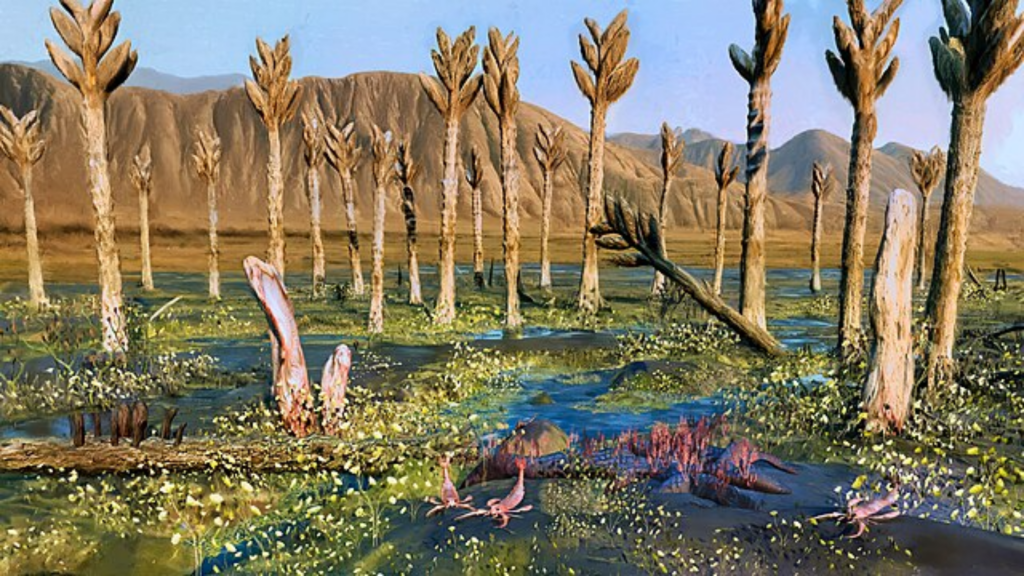
The organism, which researchers call Prototaxites, was first discovered as fossilized remnants resembling large columns or tree trunks. These structures have puzzled scientists for more than a century due to their immense size and unfamiliar anatomy.
Recent scientific analysis has shown that Prototaxites was likely not a plant, animal, or fungus, the main categories that define life today. Instead, its structure and chemistry suggest that it belonged to a wholly distinct and now extinct group of life, making it one of the earliest known giants to walk on land.
Fossils indicate these towering organisms could reach heights far greater than other terrestrial life forms of their time, dwarfing early plant life and creating a landscape very different from anything seen in later periods of Earth’s history.
What This Discovery Tells Us About Early Life

The discovery of Prototaxites offers crucial insights into how life on land may have evolved in unexpected ways. Its internal structure, composed of intricate interwoven tubes, is unlike that of any known modern organism, and defies classification into familiar kingdoms like plants or fungi.
Scientists hypothesize that this organism may have absorbed nutrients from the environment in ways similar to modern saprotrophs, feeding on decaying organic matter rather than photosynthesizing like plants. This would have allowed it to grow to massive proportions in an otherwise challenging environment.
The presence of such a giant at a time when terrestrial life was just beginning to diversify highlights how ancient ecosystems could be dominated by life forms that are completely foreign to modern biology, underscoring the many mysteries that remain about Earth’s earliest landscapes.
Rethinking Life’s Early Frontier

The discovery of this unknown giant pushes scientists to rethink how life evolved on land. Rather than a slow progression from simple algae to complex forests and animals, Earth’s early terrestrial ecosystems may have included enormous and enigmatic life forms that defy our current understanding.
While Prototaxites is now extinct, its legacy lives on in the fossil record, showing that the natural world experimented with biological forms that were once as alien as they were immense, and its existence challenges our understanding of how complex ecosystems developed during the earliest stages of life on land.
As research continues and more fossils are studied, scientists hope to shed additional light on this remarkable organism and what it reveals about the very first chapters of life on land, offering a glimpse into Earth’s most ancient and mysterious environments.
PetsFanatic Team
Pet Care Expert & Content Creator
Passionate about sharing knowledge and tips for better pet care. Writing about everything from pet health to training techniques.