
This Gorilla Could Talk… And What She Said About Humans is Something We Weren’t Ready For

We’ve always believed that language is what sets humans apart from every other creature on Earth. But then came Koko — a gorilla who proved otherwise. She learned more than 1,000 signs and used them to ask for kittens, crack jokes, and even tell little lies. She could show love, sadness, and joy in ways no one thought possible. But Koko’s most shocking words weren’t about food or play. They were about humans — and what she said about us was so unsettling, it may change the way you see yourself forever.
A Famous Photograph

In October 1978, National Geographic’s cover stunned readers worldwide. A gorilla held a camera, studying her own reflection with quiet concentration. This wasn’t staged—Koko had taken the photo herself. Photographer Ronald H. Cohn captured this moment at Stanford University, introducing millions to an animal who could communicate in ways no one thought possible. The image raised an uncomfortable question: what else had we misunderstood about animals?
Born on Independence Day

Koko was born on July 4, 1971, at the San Francisco Zoo. Her Japanese name, Hanabiko, meant “Fireworks Child”—fitting for her spirited personality. At six months old, she nearly died from viral pneumonia. Separated from her mother for treatment, she spent crucial early weeks surrounded by human voices. This unexpected isolation would later make her uniquely receptive to learning human language, setting the stage for an extraordinary life.
The Graduate Student’s Vision

Francine “Penny” Patterson was studying developmental psychology at Stanford when she met Koko in 1972. While volunteering at the zoo, Patterson noticed something others missed: alertness, curiosity, and focus in the young gorilla’s eyes. She proposed teaching Koko American Sign Language, a radical idea at the time. No gorilla had ever participated in language studies. Patterson’s experiment, named Project Koko, would challenge everything scientists believed about communication and intelligence.
Learning to Communicate

Training began in July 1972 with 10–20 hours weekly. Patterson and fluent ASL users taught Koko through molding—physically shaping her hands—and imitation. Within months, Koko signed her first independent word: “eat.” More followed: “drink,” “more,” “love.” By age three, she’d mastered 100 signs. Each gesture required verification by two observers and consistent, appropriate use. Patterson was determined that Koko’s abilities would withstand scientific scrutiny, not be dismissed as mere mimicry.
Inspired by a Chimpanzee

Before Koko, there was Washoe—a chimpanzee who became the first non-human to learn American Sign Language in the 1960s. Washoe acquired over 130 signs and used them spontaneously, even combining words creatively. What amazed researchers wasn’t just her vocabulary but her emotional depth. When a volunteer miscarried, Washoe signed “cry” and then “please person hug.” This display of empathy proved apes could connect symbols with feelings, inspiring Patterson’s work with Koko.
A Growing Vocabulary

By 1974, Koko knew more than 100 verified signs and used several hundred informally. Her comprehension at age three resembled a two-year-old child’s development. She signed “food,” “drink,” “love,” and “me Koko” with clear intent. Researchers charted her progress meticulously, sometimes finding she outpaced human benchmarks. The implications were staggering: if a gorilla could reach toddler-level cognition, where did human uniqueness truly begin? The answer remained elusive, but Koko kept learning.
Two Gorillas, One Language

In 1976, a young male gorilla named Michael joined Koko’s household. Initially, Koko resisted sharing attention, and their interactions often turned into wrestling matches. But something remarkable emerged: they began mimicking each other’s signs. Patterson taught Michael ASL the same way she’d taught Koko. When Michael struggled, Koko demonstrated signs first. For the first time ever, one ape was teaching another language. Their shared communication revealed that language could spread socially among gorillas.
Proving Intelligence

Critics demanded proof that Koko truly understood signs rather than simply reading human cues for rewards. The debate echoed “Clever Hans,” a horse who seemed to solve math problems but was actually responding to unconscious human facial expressions. To eliminate bias, Koko’s team designed double-blind tests. A researcher placed objects in boxes that only Koko could see. Another tester, without visual cues, asked what was inside. Koko identified 31 out of 50 correctly—far better than chance.
Emotions in Signs

Koko’s vocabulary expanded beyond objects to include feelings: “love,” “sad,” “cry,” “angry.” When asked how she felt, she signed “fine,” “good,” or sometimes “sleepy.” Michael, however, carried darker memories. When asked about his mother, he signed “trouble,” “cry,” “bad,” then mimed shooting. He’d witnessed poachers kill his mother in Cameroon before being captured. This devastating moment confirmed that trauma isn’t uniquely human—animals carry emotional wounds too, expressed through whatever language they possess.
Humor and Mischief

Koko’s intelligence included a playful side. During a 1985 National Geographic interview, she suddenly called writer Cynthia Gorney “toilet” in sign language. Patterson tried redirecting, but Koko seemed amused by her own joke. Humor requires timing and awareness—both present in Koko’s behavior. She also learned to lie. After breaking a toy, she blamed her caretaker, signing “Kate cat.” Later, when she broke a kitchen counter, she signed “Kate there bad.” Deception requires understanding what others know.
The Birthday Wish

In 1983, Koko signed what she wanted for her birthday: “cat.” Researchers gave her a stuffed toy. She looked at it and signed “sad.” Later that year, they brought a real kitten—a tailless gray one she named All Ball. Their bond was immediate. Koko cradled him gently, groomed him carefully, and signed “love cat.” The photos made National Geographic’s cover again. Here was a 230-pound gorilla treating a tiny kitten with remarkable tenderness, bridging species through pure affection.
Understanding Grief

Months later, All Ball escaped and was struck by a car. When Patterson told Koko, she signed “bad,” “sad,” “cry,” “frown.” For days, Koko refused food and sat motionless, facing the wall. Patterson described it as “the most human moment I’ve ever witnessed from a gorilla.” These were the first recorded signs of grief in a gorilla. Koko wasn’t just using language to request things—she was processing profound loss, an act as human as heartbreaking.
A Celebrity Connection

When comedian Robin Williams visited Koko in 2001, she immediately hugged him. They played together—she tried on his glasses, tickled him, and made him laugh uncontrollably. When shown a VHS box of his movie, Koko pointed to his face and signed “funny.” Thirteen years later, when Williams died, the staff informed Koko. She listened silently, then signed “woman” and “cry” after seeing a tearful caretaker. She sat down, lowered her head, and remained still for ten minutes—the same grief posture she’d shown after losing All Ball.
Creative Communication

Koko invented signs when she lacked vocabulary. Wanting “browse”—a leafy vegetable mix—she touched her brow repeatedly, connecting the similar sounds. She combined known words for new objects: “eye hat” meant mask; “finger bracelet” meant ring. This symbolic thinking—joining ideas to represent something new—was considered uniquely human. Both Koko and Michael also painted. Michael’s piece “Apple Chase” used black and white, inspired by his dog. Koko preferred bright colors, choosing pinks and oranges when painting about love.
Speaking to the World
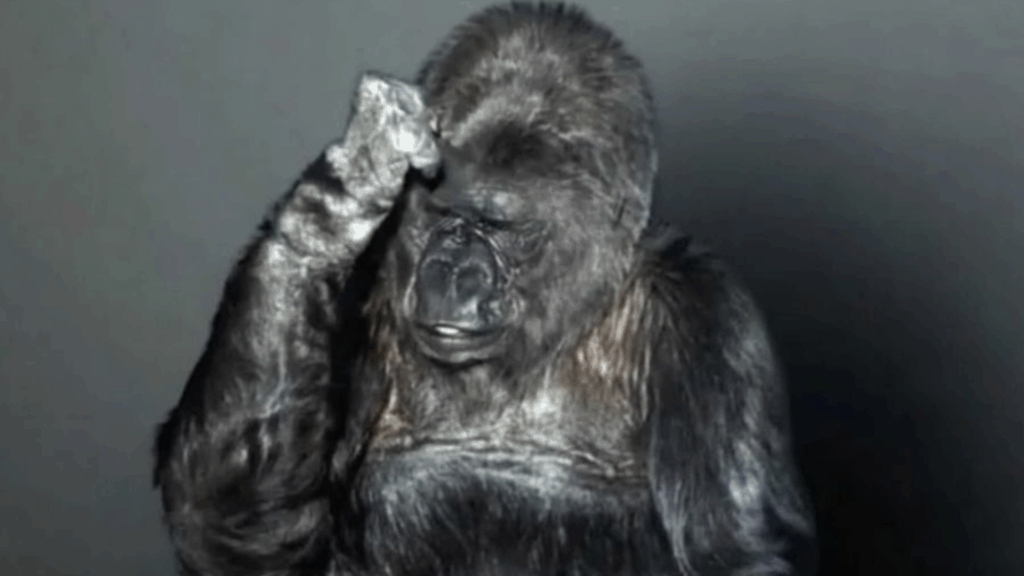
By the 1990s, Koko lived at the Gorilla Foundation in Woodside, California, becoming a global symbol for animal intelligence. In 2015, she recorded a message for the United Nations Climate Change Conference. After being briefed on environmental threats, Koko signed: “I am flowers, animals. I am nature. Man Koko love. Earth Koko love. But man stupid. Stupid!” She signed “fix earth” and “nature sees all of us.” Whether guided or not, her message echoed warnings humans had long ignored.
A Shared Warning
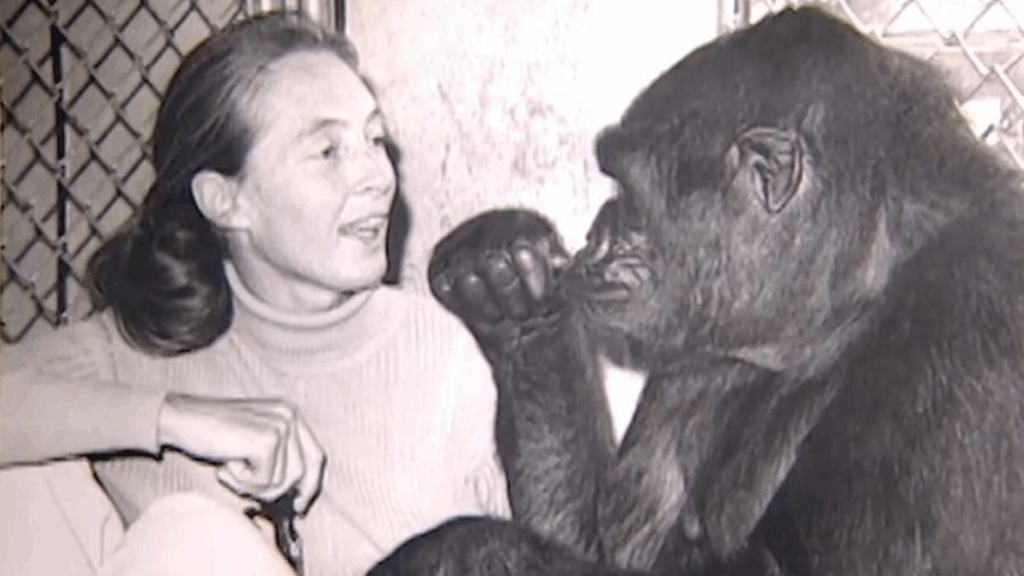
A decade after Koko’s viral environmental plea, the late Dr. Jane Goodall delivered a similar message at the 2025 Forbes Sustainability Leaders Summit. “We humans are the most intellectual species to walk the planet, but we’re not intelligent,” Goodall reflected. “If you’re intelligent, you don’t destroy your only home.” Both women—one human, one gorilla—urged protection of our shared world. Koko’s words, simple yet devastating, reflected what many scientists feared: animals understand what we’re doing to Earth, even if they can’t stop us.
What Koko Revealed

Koko’s message about humans wasn’t just environmental—it was existential. She called us “stupid” not out of malice but observation. Through decades of interaction, she witnessed human contradictions: intelligence without wisdom, love without protection, communication without understanding. She saw us destroy what we claimed to cherish. Her assessment was uncomfortably accurate. We are, as she signed, capable of love—but also capable of devastating the world that sustains us, her included. That truth remains unsettling.
The Scientific Debate

Not everyone accepted Koko’s abilities at face value. Linguists argued Patterson read too much into Koko’s signs, seeing meaning where only trained responses existed. Critics questioned whether Koko truly understood grammar or simply associated gestures with rewards. Patterson insisted Koko’s emotions were genuine: “You can see it in her eyes.” The debate continues, but even skeptics acknowledged something remarkable occurred. Whether Koko had “language” by strict definitions matters less than what she revealed about consciousness, emotion, and connection beyond species.
A Lasting Legacy

On June 19, 2018, Koko passed away peacefully in her sleep at age 46, a cat toy beside her. The Gorilla Foundation called her “a symbol of interspecies connection and compassion.” Penny Patterson, then 71, wrote: “Koko taught us that love and understanding can cross any boundary.” Koko’s life challenged our assumptions about intelligence, emotion, and what separates humans from animals. Her message about humanity—both our capacity for love and our destructive “stupidity”—remains uncomfortably relevant, a mirror we’re still reluctant to face.
PetsFanatic Team
Pet Care Expert & Content Creator
Passionate about sharing knowledge and tips for better pet care. Writing about everything from pet health to training techniques.