
The Gulf Stream Could Suddenly Shift 136 Miles North in Just Two Years, and Scientists Say That Would Be Catastrophic
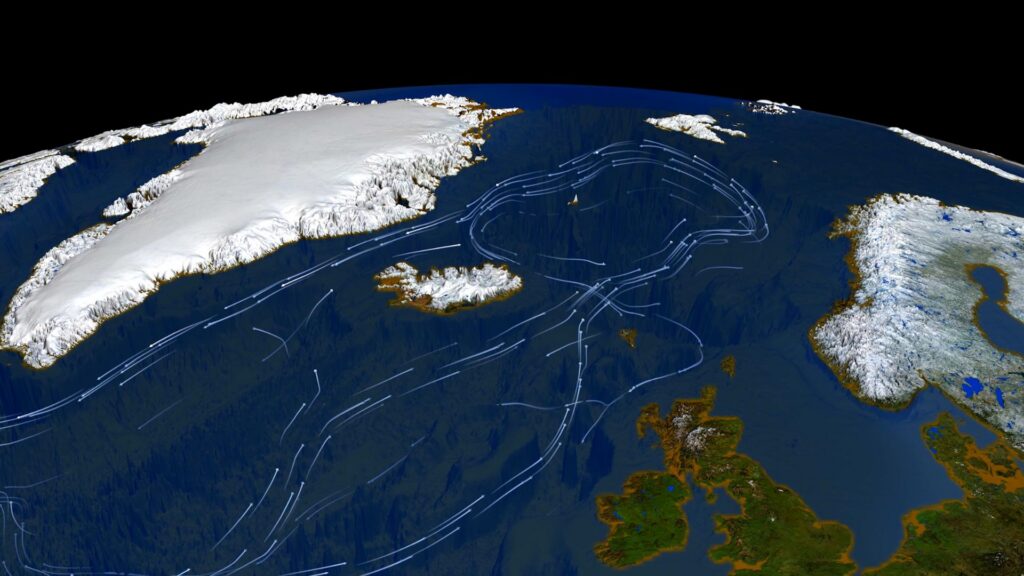
The Gulf Stream has been quietly drifting northward for decades, and a new study suggests that movement may be telling scientists something critical about the future of the Atlantic Ocean’s largest circulation system. Published February 26 in Communications Earth & Environment, the research identifies shifts in the Gulf Stream’s position as a potential early warning signal for the weakening of a vast Atlantic current network.
The Gulf Stream is a powerful warm-water current that begins in the Gulf of Mexico, travels along the U.S. East Coast, and eventually pushes out into the North Atlantic. It is part of the Atlantic Meridional Overturning Circulation, or AMOC, a sprawling network sometimes described as the ocean’s conveyor belt. AMOC moves heat from the tropics northward, keeping Europe’s climate far milder than its latitude would otherwise allow.
Evidence has been mounting for years that AMOC is losing strength. Research has pointed to roughly a 15 percent reduction in its circulation since the 1950s, driven largely by warming ocean temperatures and accelerating meltwater from Greenland. What has been harder to pin down is whether the signs of that decline could be detected before a collapse begins.
Researchers Found a Two-Stage Warning System Buried in the Gulf Stream’s Movement

René van Westen, a postdoctoral researcher in climate physics at Utrecht University, and his colleague Henk Dijkstra, a professor of physical oceanography at the same institution, ran high-resolution simulations to study what happens to the Gulf Stream as AMOC weakens. Unlike standard climate models, which tend to smooth out the Gulf Stream’s finer details, their model captured the current’s behavior in much sharper focus, bringing previously obscured patterns into view.
The simulation showed the Gulf Stream responding in two distinct phases. Over roughly 392 simulated years of gradual AMOC weakening, the current crept northward by about 83 miles at a key measurement point off Cape Hatteras at 71.5 degrees west longitude. Then, as weakening continued, the Gulf Stream made a sudden leap, jumping an additional 136 miles north in just two simulated years, a shift described as abrupt and far outside normal variation.
That sudden jump occurred 25 years before the AMOC collapse began in the model, which is what makes it potentially useful as a warning signal. Van Westen told Live Science that the gradual drift is connected to general AMOC weakening, while the abrupt jump appears to signal something far more critical approaching. This is the first time this particular shift in the Gulf Stream has been observed in such detail and linked to an approaching collapse.
The Signal May Already Be Showing Up in Real-World Satellite Data
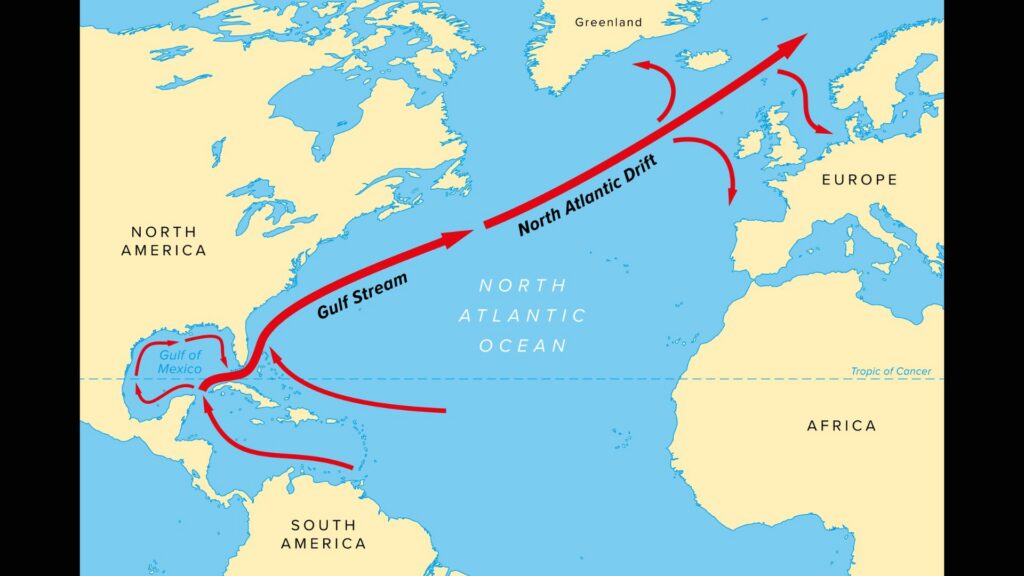
After running the simulations, the research team turned to real-world satellite data, and what they found aligned closely with the model’s first stage. According to the study, satellite observations show the current has been drifting northward from the coast near Cape Hatteras since the early 1990s, a period of roughly three decades. Van Westen said this positions the current in the slow-drift phase, with the abrupt jump still ahead.
A northward shift carries real consequences beyond what happens to ocean circulation. Van Westen noted that ecosystems currently sitting in cold water north of the Gulf Stream could find themselves in warmer water as the current moves, disrupting marine life that depends on those temperature ranges. The shift could also worsen sea level rise along the U.S. East Coast, since the Gulf Stream’s position influences how water piles up near shore.
The model does come with limitations, though. Van Westen acknowledged that the simulation only introduced additional freshwater into the North Atlantic to trigger the collapse, rather than accounting for the actual global temperature rise. That distinction matters because rising temperatures are accelerating AMOC’s decline faster than the model assumed. The 25-year window between the abrupt Gulf Stream shift and an AMOC collapse could be significantly shorter in reality.
Scientists Say More Work Is Needed Before This Signal Can Be Fully Relied Upon

Maya Ben-Yami, a climate tipping point researcher at the Technical University of Munich and the Potsdam Institute for Climate Impact Research, who was not involved in the study, told Live Science that the findings are a meaningful step but not yet a confirmed warning system. She noted that the results would need to be tested across multiple models before the Gulf Stream’s movement could be treated as a reliable predictor of AMOC collapse.
Ben-Yami also raised the possibility that the abrupt northward jump could happen without a collapse following it, meaning the signal might reflect AMOC weakening without necessarily pointing to a full breakdown. She added that under faster warming conditions than the model used, the lag time between the Gulf Stream’s jump and any potential AMOC collapse could shrink to almost nothing, effectively eliminating the warning window the study envisions.
For now, the researchers say satellites are already in place to detect the second-stage shift if and when it occurs. Van Westen has called the next priority figuring out the true lag time between that abrupt jump and an actual AMOC collapse, so the signal can be made actionable. Ben-Yami noted that how much warning time that signal ultimately provides will depend heavily on how fast global temperatures continue to climb.
PetsFanatic Team
Pet Care Expert & Content Creator
Passionate about sharing knowledge and tips for better pet care. Writing about everything from pet health to training techniques.