
Supermassive Black Hole Tears Free From Galaxy, Escaping Through Space at 2.2 Million MPH

A supermassive black hole is tearing through space at 2.2 million miles per hour, leaving behind a 200,000-light-year trail of newborn stars in its wake. The James Webb Space Telescope confirmed the runaway object, officially designated RBH-1, after spotting a telltale shock wave at its leading edge. Published on the preprint server Arxiv on December 3, the discovery represents the first confirmed case of a supermassive black hole escaping its host galaxy, according to researchers.
The Black Hole Was First Spotted as a Strange Line in 2023
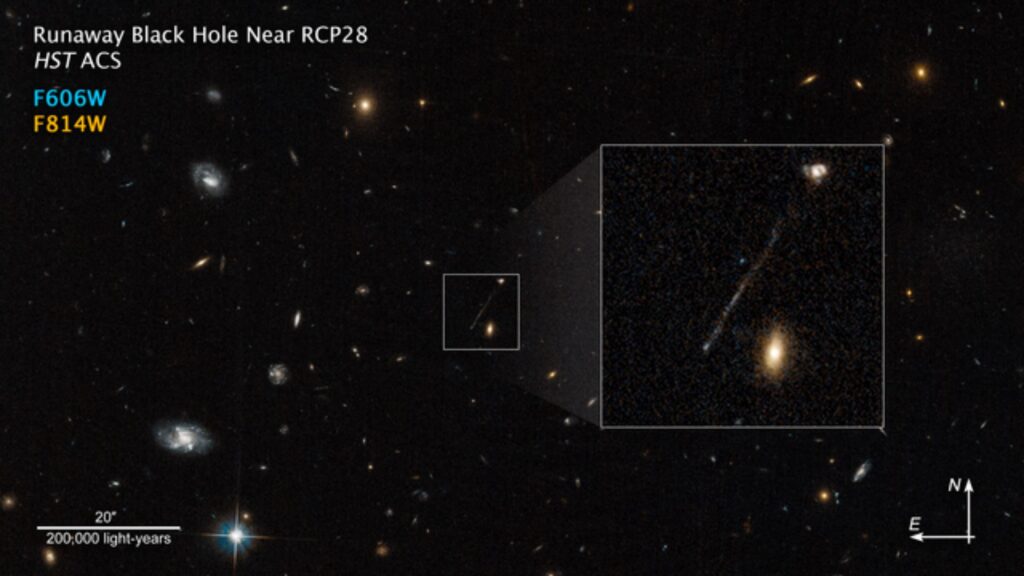
Pieter van Dokkum, a professor of astronomy and physics at Yale University, first noticed the candidate black hole in 2023 while examining archival Hubble Space Telescope images. The faint line appeared so unusual that the team thought it might be a camera glitch rather than a real cosmic feature. Van Dokkum’s team followed up with fresh observations from the Keck Observatory in Hawaii, which revealed the line was actually a wake of young stars stretching twice the diameter of the entire Milky Way.
JWST Captured the Smoking Gun Proof Researchers Needed

Van Dokkum admitted his team suspected a runaway supermassive black hole but lacked definitive proof. The James Webb Space Telescope’s mid-infrared instrument provided the breakthrough, rendering a bow shock at the leading edge of the black hole’s escape with unprecedented clarity. “It’s a bit like the waves created by a ship,” van Dokkum said. “In this case, the ship is a black hole and very difficult to see, but we can see the ‘water.'”
The Object Carries a Mass of 20 Million Suns

Observations from the Keck Observatory revealed the black hole has a mass of 20 million suns, racing at 954 kilometers per second, roughly 3,000 times the speed of sound at sea level. The Hubble image captures the event from when the cosmos was about half as old as it is today, approximately 13.8 billion years divided by two. The trail of stars stretches 200,000 light-years across space, twice the Milky Way’s diameter.
A Sharp Velocity Jump Reveals the Violence of the Encounter

JWST’s observations revealed a sharp 600-kilometer-per-second velocity jump across just one kiloparsec, with a post-shock flow velocity of approximately 300 kilometers per second. The measurements matched perfectly with data from Hubble and Keck across different wavelengths of light. “Everything about this object told us it was something really special, but seeing this clear signature in the data was incredibly satisfying,” van Dokkum said. The observations aligned exactly with theoretical models predicting such phenomena.
Two Black Holes, or Possibly Three, Collided to Create the Runaway

According to van Dokkum, ripping a supermassive black hole from its galaxy requires an extreme gravitational encounter. At least two of these massive objects must swing extraordinarily close to each other, with their intense gravitational forces eventually ejecting one into intergalactic space. The research suggests RBH-1 was produced after at least two, and potentially three, black holes interacted. With masses of at least 10 million suns each, the violence must have been “quite something,” van Dokkum noted, adding that mergers happen often in the life of a galaxy.
The Wake Has Created 100 Million Solar Masses Worth of Stars

As the black hole plows through intergalactic gas, it compresses hydrogen and oxygen in front of it, triggering star formation in its wake. The research paper indicates this cosmic contrail has created approximately 100 million solar masses worth of stars over tens of millions of years. Van Dokkum described the phenomenon as pushing gas much like a ship pushes water, with the compressed material collapsing to form young stars that trace the black hole’s violent path through space.
The Discovery Validates a 50-Year-Old Theoretical Prediction

Van Dokkum emphasized that this represents the first confirmation of a runaway supermassive black hole following five decades of theory and research. “It boggles the mind,” van Dokkum said, adding that “the forces that are needed to dislodge such a massive black hole from its home are enormous.” The discovery confirms long-standing predictions that supermassive black holes can escape their host galaxies through either gravitational wave recoil from mergers or three-body slingshot interactions.
The Cosmic Owl Presents Another Puzzling Candidate

The research paper notes several promising candidates for additional runaway black holes, though interpretation remains difficult. One example is the ambiguous object known as the Cosmic Owl, located roughly 11 billion light-years from Earth. This system includes two galactic nuclei, each with an active supermassive black hole, and a third supermassive black hole that appears stuck within a gas cloud separating the two galaxies. Van Dokkum’s JWST observations suggest this third black hole likely formed through direct gas collapse rather than ejection.
Future Sky Surveys Will Reveal How Often This Happens

Van Dokkum stated the obvious next step is searching for more examples of runaway supermassive black holes. He pointed to the Euclid telescope, already operational, and the upcoming Nancy Grace Roman observatory as ideal tools for this hunt. Both instruments will survey wide swaths of the cosmos rather than focusing on individual targets like JWST. “That will tell us how often this happens, something we’d dearly like to know,” van Dokkum told LiveScience. The discoveries will help scientists understand how galaxies and supermassive black holes evolved throughout cosmic history.
PetsFanatic Team
Pet Care Expert & Content Creator
Passionate about sharing knowledge and tips for better pet care. Writing about everything from pet health to training techniques.