
Scientists Unearth a New Spinosaurus Species With a Feature That Left Researchers Astonished

Ninety-five million years ago, a creature unlike anything else on the planet waded into the rivers of what is now central Africa. It wore a towering curved crest of bone atop its skull and drove a narrow, crocodilian snout into the shallows with the precision of a striking bird. Its name is Spinosaurus mirabilis, and its discovery, published February 19 in Science, is one of the most significant dinosaur finds in over a century.
S. mirabilis is only the second Spinosaurus species ever formally identified. A team led by Paul Sereno, professor of organismal biology and anatomy at the University of Chicago, named the new species after recovering fossilized skull and jaw fragments in Niger. The first, S. aegyptiacus, was described in 1915 by German paleontologist Ernst Stromer von Reichenbach from Egyptian fossils, making this the first addition to the genus in more than 110 years.
The fossils came from Jenguebi, a sandstone outcrop in Niger surrounded by dunes and rich with dinosaur remains. Reaching it from the city of Agadez required nearly three days of off-road desert driving, with the convoy repeatedly stuck in sand. A partial crest was recovered in 2019, though the team didn’t fully grasp what they had until a 2022 return expedition turned up two more crests and completed the picture.
A Skull Crest Unlike Anything in the Fossil Record

The cranial crest of Spinosaurus mirabilis is a blade-shaped ridge of solid bone rising roughly 20 inches (50 centimeters) from the skull, curving forward like a scimitar and dwarfing the modest crest of S. aegyptiacus. Steve Brusatte, a paleontologist at the University of Edinburgh not involved in the study, told CNN it resembled “a flamboyant crest of bone jutting off of its head, like the quiff hairstyle of Elvis.”
For all its visual impact, the crest was not built for fighting. Sereno called it “a very bad weapon,” pointing to its awkward position, relative fragility, and asymmetry as evidence against combat use. Researchers believe it was likely sheathed in keratin, similar to a bull’s horn, and probably brightly colored in life. The leading interpretation is that it served as a display structure for attracting mates or signaling dominance at feeding grounds.
The species name mirabilis is Latin for “astonishing,” chosen as a direct reference to the crest. Below it sat a jaw purpose-built for fish: a long, narrow snout lined with conical, serration-free teeth that locked together in a configuration called interdigitation. Co-author Daniel Vidal of the University of Chicago described the arrangement as a fish trap. “Spinosaurus mirabilis has some of the most extreme piscivorous adaptations of any dinosaur,” Vidal said.
How One Fossil Reshaped a Long-Running Scientific Debate
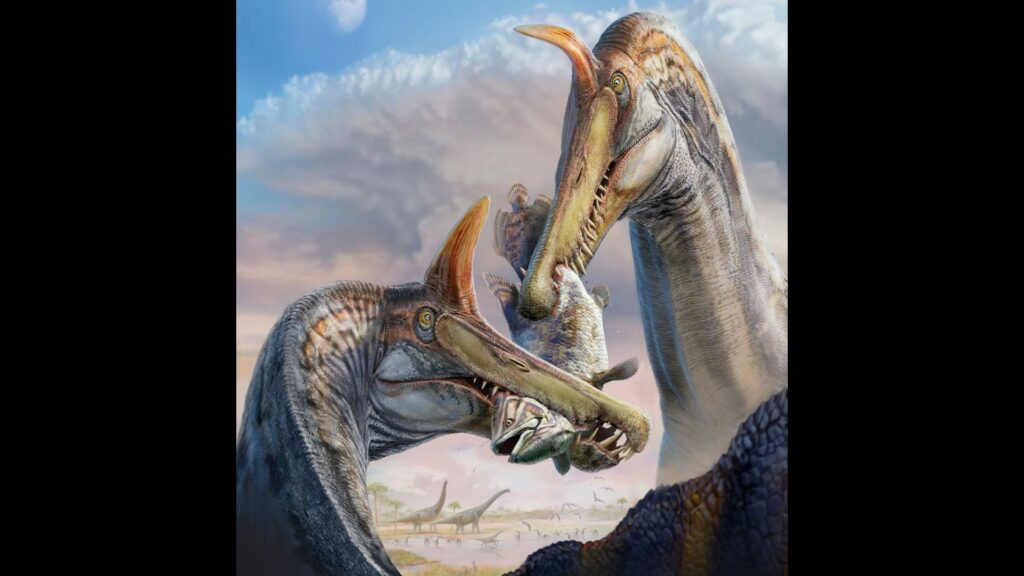
For decades, paleontologists disagreed on how Spinosaurus hunted: fully aquatic pursuit, predator, or shoreline wader. Sereno called the discovery of S. mirabilis “the coup de grâce for the aquatic hypothesis.” The fossils were found 300 to 600 miles from the nearest Cretaceous-era ocean shoreline, in terrain that was once an inland forested river system, making a marine lifestyle geographically implausible for this species.
When the team compared the skeletal proportions of S. mirabilis to those of a modern blue heron, the structural parallels were clear. Both share the anatomy of a shallow-water ambush hunter: long legs for wading, a neck built to drive the head downward fast, and a snout shaped for snaring fish. Sereno described S. mirabilis as a “hell heron,” a riverine predator roughly 40 feet long and 5 to 7 tons.
The inland fossil location was, in Sereno’s words, the “smoking gun.” Its nostrils were set farther back on the skull than typical, letting the animal submerge most of its snout while still breathing. The diet likely included large prehistoric fish such as coelacanths, hunted along river systems across what is now North Africa. Sereno compared finding such a creature so far from the ocean to “finding a blue whale in Chicago.”
A Lost World, Found With a 70-Year-Old Clue

The path to S. mirabilis traces back to a brief note a French geologist recorded in the 1950s, pointing to a possible fossil location. Sereno’s team tracked it down with the help of a local Tuareg man, who led them by motorbike deep into the Sahara to where he had once spotted exposed bones. At Jenguebi, untouched by researchers for over 70 years, they recovered teeth, jaw fragments, and parts of three S. mirabilis skulls.
The 2019 crest fragment was so large and unusual that the team couldn’t identify it immediately. Two more crests found in 2022 resolved the question. Running on solar power in the Sahara, the team built 3D digital models from hundreds of photographs and assembled the skull on a laptop screen. “I’ll forever cherish the moment in camp when we crowded around a laptop to look at the new species for the first time,” Sereno said.
The find places S. mirabilis alongside Tyrannosaurus, Giganotosaurus, and Carcharodontosaurus among the largest predatory dinosaurs on record, confirming Spinosaurus as the only known semiaquatic predator. For Sereno, it points to what the Sahara still holds. “If you can brave the elements and are willing to go after the unknown,” Sereno said, “you might just uncover a lost world.” As Brusatte noted, with each new fossil find, the real Spinosaurus is slowly coming into focus.
PetsFanatic Team
Pet Care Expert & Content Creator
Passionate about sharing knowledge and tips for better pet care. Writing about everything from pet health to training techniques.