
Scientists Say Parts of California Sank Nearly 3 Feet, Causing Damage That May Never Be Reversed
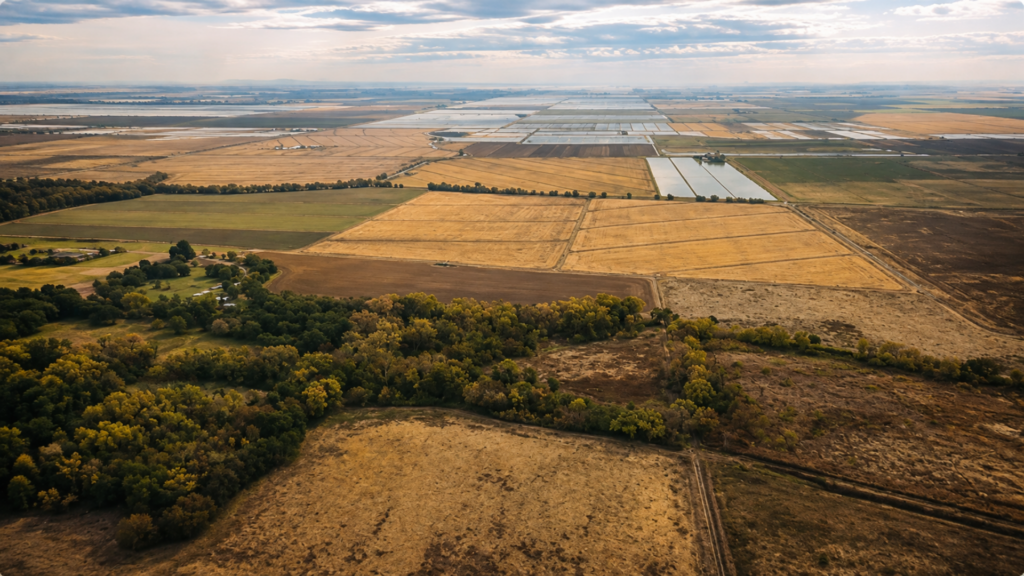
Farmland across California’s Sacramento Valley dropped by nearly 3 feet during the 2020 to 2022 drought, and it never came back up. Scientists tracking the region with satellites confirmed the ground did not rebound after the drought ended, a finding that upends decades of assumptions about how the valley’s water system behaves. The discovery signals that California’s water crisis, long associated with the state’s southern farmland, is now spreading north into new territory.
The research, published in the Proceedings of the National Academy of Sciences, used satellite observations to measure land movement across the valley from 2016 through 2022. During calmer years, the ground behaved predictably, sinking slightly in summer as farms pumped groundwater, then rising again each winter as rain and snowmelt recharged the aquifer. That pattern held steady for years, giving little indication of what was coming once the drought intensified.
Starting in 2021, the pattern broke. Broad sections of the valley kept sinking and stopped bouncing back, even after winter rains returned. Researchers led by Stacy Larochelle, an assistant professor of geophysics at UCLA, found the land had crossed into what scientists call irreversible compaction. In the worst-hit areas, the ground dropped by roughly 50 centimeters, close to 20 inches, in a single year.
UCLA Geophysicist Calls the Shift From Reversible to Irreversible Ground Loss “a Big Difference”

The distinction between reversible and irreversible sinking matters enormously. When an aquifer acts like a sponge, it compresses slightly as water is pumped out and expands again once water returns, a process scientists call poroelastic deformation. Nothing is permanently lost. But when fine clay layers deep underground are compacted past a certain threshold, they collapse for good, similar to a cardboard box that has been crushed. That process cannot be undone.
Letitia Grenier, director of the PPIC Water Policy Center, was not involved in the study but reviewed its findings. She called it a wakeup call for how California manages groundwater in a region long considered safer than the drought-battered San Joaquin Valley further south. “This is the first time that permanent damage to the aquifer has been documented in the Sacramento Valley, when the land surface sank due to groundwater pumping and did not rebound,” Grenier said.
The damage was not uniform. Researchers recorded the steepest losses, up to 2.7 feet, in the hardest-hit zones. Roughly 50 miles north of Sacramento, in Colusa County, permanent subsidence reached close to 2 feet between January 2021 and October 2022. Grenier said the loss is troubling for a specific reason: it permanently shrinks the aquifer’s capacity to store water for the state’s next drought, whenever it arrives.
Broken Roads and Canals Could Follow as Ground Keeps Sinking, Researchers Warn

Subsidence does more than lower the land. Grenier warned that sinking ground can crack roads and rupture canals, forcing costly repairs across a region that depends on both to move water and crops. Infrastructure built to handle a stable landscape is not designed for ground that shifts unevenly over time, and the Sacramento Valley’s aging canal system was never engineered with this kind of permanent movement in mind.
The Sacramento Valley has largely avoided the fate of the San Joaquin Valley to its south, where decades of heavy pumping have caused land to sink by as much as 30 feet in some areas, forcing farms to shut down as water supplies dried up. Researchers say the new findings suggest the north is now following a similar trajectory, just decades behind, and the warning signs are showing up faster than expected.
“The significance is that we are seeing a practice go from reversible effects to irreversible effects,” Grenier said. “And that is a big difference.” She pointed to climate projections showing future droughts will likely mirror the intensity of 2021 and 2022, meaning the same pumping patterns that caused this damage are expected to repeat, this time against an aquifer with less capacity left to absorb the strain.
Recent Rains Offer a Narrow Window to Prevent Further Permanent Damage

Despite the damage already done, the study’s authors are not without hope. They point to California’s recent resurgence in rainy-season precipitation as a chance to slow further harm to the aquifer system before more land crosses the same irreversible threshold. Recharging groundwater during wetter years reduces the pressure on farmers to pump during the next dry stretch, buying the valley time it did not have during the last drought.
Grenier said the lesson from Sacramento Valley applies well beyond its borders. “As climate change moves forward and droughts become more intense, this study is a reminder that even regions with relatively more water, like the Sacramento Valley, will need to focus on better groundwater management in order to avoid damaging their aquifers,” she said. The finding reframes groundwater as a finite resource even in parts of the state once assumed to be secure.
Nearly 3 feet of California’s farmland is gone for good, and no amount of rain will bring it back. What the study makes clear is that the choice ahead is not whether to protect the water still underground, but how quickly the state acts on a warning it has now seen firsthand. The ground has already answered the question of what happens when it does not.
PetsFanatic Team
Pet Care Expert & Content Creator
Passionate about sharing knowledge and tips for better pet care. Writing about everything from pet health to training techniques.