
Scientists Find Greenland Ice Melted 7,100 Years Ago at Today’s Temperatures

Researchers drilling through 1,600 feet of ice at Prudhoe Dome in northwest Greenland uncovered bedrock containing chemical signatures that reveal the massive ice formation completely melted within the past 10,000 years. The discovery, published Monday in the journal Nature Geoscience, shows the 50-mile-wide mountain of ice disappeared when global temperatures weren’t much higher than today’s climate. Lead author Caleb Walcott-George, a glacial geologist at the University of Kentucky, said the findings hold a warning for a warming planet.
The 2023 expedition was part of GreenDrill, a multimillion-dollar project designed to determine exactly when and how quickly Greenland’s ice sheet has melted in Earth’s recent past. If the same melting that occurred at Prudhoe Dome happened across large portions of Greenland today, it would raise average sea levels anywhere from 7.5 inches to 2.4 feet. The Arctic is the fastest-warming place on the planet, and Greenland contributes more to rising oceans than any other ice mass on Earth.
The researchers faced brutal conditions atop the ice sheet, where temperatures at the summit dropped well below 0 degrees Fahrenheit. Blizzards so dense they blocked the sun routinely disrupted the unprecedented drilling effort, and a violent windstorm trapped the team inside their tents for days. The ice around the drill bit cracked, slowing progress to a crawl. On the last day before packing up equipment, they finally pierced through to the sediments and rocks below, marking only the third such extraction from beneath Greenland’s deepest ice.
Luminescence Dating Revealed the Ice Vanished Just 7,100 Years Ago

Walcott-George used a technique called luminescence dating to determine how long the material had been covered by ice. Buried sediment grains accumulate electrons from radioactive decay in nearby rocks, and the darkness allows these electrons to build up over time within the crystal structures. Scientists expose the samples to light in a laboratory, triggering an immediate electron release. Counting these electrons and measuring their accumulation rate reveals the last time the sediments were exposed to sunlight.
When Walcott-George examined the sample at a laboratory in Texas several months after the expedition, the results surprised him. The findings, published in Nature Geoscience, showed the sediments had been buried for only about 7,100 years. The GreenDrill team had hoped to find that Prudhoe Dome hadn’t melted since the last interglacial, a geological period more than 100,000 years ago, when global temperatures were slightly warmer than today. “Oh boy,” Walcott-George recalled thinking when he saw the data.
The discovery means the ice atop Prudhoe Dome disappeared amid conditions similar to the current climate, when the Arctic was about 3 to 5 degrees warmer than it was in the 19th century. Jason Briner, a geologist at the University at Buffalo and co-author of the study, said scientists have fewer rocks from beneath Greenland than from the surface of the moon. “It felt like a really big triumph,” Walcott-George said about finally reaching the bedrock after days of setbacks.
Arctic Amplification Drives Temperatures to Match Ancient Melting Conditions
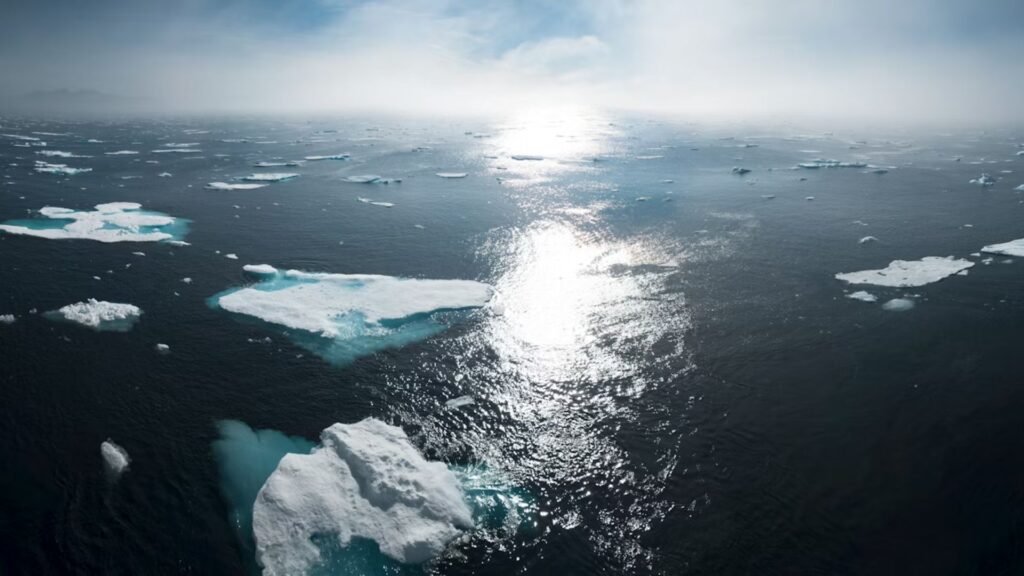
The research helps illustrate the toll of Arctic amplification, which causes polar regions to warm faster than the rest of the globe. The phenomenon is driven by the loss of sea ice, which exposes the dark ocean surface to the sun’s radiation and causes it to absorb more heat. Studies show that Arctic temperatures have increased by 3 degrees Celsius just in the past five decades, reaching levels of warmth similar to when Prudhoe Dome last disappeared 7,100 years ago.
The discovery bolsters a growing body of evidence suggesting that Greenland’s ice sheet is extremely susceptible to temperature swings, Briner said. In a 2016 analysis of samples from beneath the thickest part of the ice sheet, he helped show that bedrock was exposed to sunlight sometime in the past 1.1 million years. Such a catastrophe has happened before, raising urgent questions about what Earth’s temperature was when the melting occurred and how fast the ice disappeared.
Scientists aren’t certain exactly what will happen as global temperatures continue to rise. Changes in the ice sheet’s elevation and reflectiveness could trigger feedback loops that slow the pace of melting or accelerate it. Some research suggests that Greenland might be approaching a tipping point toward irreversible decline. If the entire ice sheet melted, it would boost global sea levels by 24 feet. Present-day melting may not precisely emulate what happened in the past, the researchers acknowledged.
The Findings Could Improve Predictions About Greenland’s Future
The cause of modern climate change, pollution primarily from burning fossil fuels, is distinct from the slight wobbles in Earth’s orbit that triggered warming thousands of years ago. But researchers said their findings could be used to improve the computer models used to simulate how the ice sheet responds to warming. “Understanding how the ice sheet evolved in the past allows us to make better predictions about our future,” Walcott-George said.
Joerg Schaefer, a climate geochemist at Columbia University’s Lamont-Doherty Earth Observatory who led the GreenDrill project with Briner, compared the expedition to a high-stakes medical exam. “We are basically taking biopsies, which will hopefully tell us how sensitive the patient is to ongoing warming and how much warming is fatal,” he told The Washington Post in 2023. The drilling effort aimed to provide a clearer picture of what happened when Greenland melted away.
Briner said the research provides crucial data connecting specific climate conditions to ice volume changes. “It’s giving us a sense of X climate change equals X ice volume change. I think it’s a really important data point from that perspective,” he said. By drilling for rocks beneath different parts of the ice sheet and testing samples to see when they were last exposed to sunlight, researchers can better understand Greenland’s sensitivity to temperature increases and refine projections for future melting.
PetsFanatic Team
Pet Care Expert & Content Creator
Passionate about sharing knowledge and tips for better pet care. Writing about everything from pet health to training techniques.