
Scientists Discover a New Form of Life Standing 26 Feet Tall
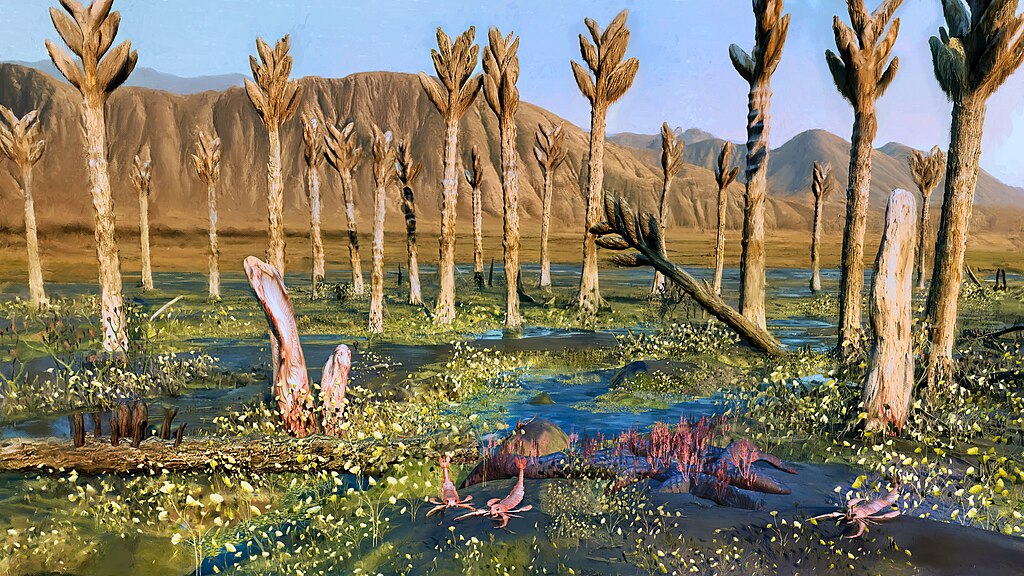
For more than a century, paleontologists have puzzled over massive fossilized structures that looked like tree trunks but didn’t behave like trees. Some of these organisms stood more than 26 feet tall, dominating landscapes hundreds of millions of years before dinosaurs appeared. For decades, scientists tried and failed to place them neatly into existing categories of life.
Now, researchers say those assumptions may have been wrong all along. New analyses suggest the organism, known as Prototaxites, may not have been a plant, fungus, or animal at all, but instead part of an entirely extinct branch of life with no modern equivalent. The discovery challenges some of the most basic frameworks used to classify living things.
“They are life, but not as we now know it,” said Sandy Hetherington, a research associate at the National Museums Scotland and senior lecturer at the University of Edinburgh, in a statement accompanying the study. Hetherington described Prototaxites as a biological experiment that left no descendants, making it one of the strangest organisms ever discovered.
What Exactly Was This Towering Organism?

Prototaxites lived roughly 420 to 375 million years ago during the Devonian period, when life on land was still in its early stages. Fossils show the organism formed tall, cylindrical columns up to eight meters high and about one meter wide, resembling enormous, branchless tree trunks rising from ancient landscapes.
For much of the 20th century, scientists leaned toward classifying Prototaxites as a giant fungus. In a landmark 2007 study published in Geology, University of Chicago researchers used carbon isotope analysis to argue the organism fed on decaying matter rather than producing its own food through photosynthesis—a hallmark of fungi. “A 20-foot-tall fungus doesn’t make any sense,” said geoscientist C. Kevin Boyce at the time, “but here’s the fossil.”
That explanation held for years, until more recent studies complicated the picture. Writing in BBC Science Focus, trends editor Hatty Willmoth reported that new fossil evidence suggests Prototaxites lacked key fungal traits, including chitin in its cell walls, raising doubts about whether it belongs in the fungal kingdom at all.
Why Scientists Now Think It Was Something Else Entirely

In a recent study published in Science Advances, researchers examined fossils of Prototaxites taiti, a smaller species preserved in Scotland’s Rhynie chert. While the fossils contained tube-like structures similar to fungi, the tubes branched and reconnected in ways unlike any known fungal anatomy. Chemical analysis also revealed compounds more similar to plant lignin than fungal material.
“That combination doesn’t fit anywhere on the current tree of life,” Hetherington said, explaining that the organism appears chemically and structurally distinct from fungi, plants, animals, and protists. The team concluded that Prototaxites likely represents an entirely extinct eukaryotic lineage, one that evolved complex multicellularity independently.
Even scientists who previously supported the fungal theory now acknowledge the shift. Stanford University professor Kevin Boyce, who led the 2007 study, told New Scientist that while Prototaxites might still turn out to be fungal, “there is no good place to put it in the fungal phylogeny,” adding that it represents a “novel experiment with complex multicellularity” that vanished from Earth.
Why This Discovery Matters Beyond Ancient Fossils

The implications stretch far beyond one strange organism. If Prototaxites truly belonged to an unknown branch of life, it suggests early Earth hosted far more biological diversity and evolutionary dead ends than scientists once imagined. Those lost experiments could reshape how researchers think about the conditions that allow complex life to emerge.
Benjamin Mills, professor of Earth system evolution at the University of Leeds, told BBC Science Focus that organisms like Prototaxites evolved during a critical moment when oxygen levels were rising and life was first spreading across land. Understanding why this lineage disappeared could offer insight into how fragile or resilient early ecosystems really were.
For now, Prototaxites remains a reminder that Earth’s history is filled with biological paths that led nowhere. As scientists continue reexamining old fossils with new tools, more forgotten forms of life may emerge, quietly reshaping how we define what it means to be alive at all.
PetsFanatic Team
Pet Care Expert & Content Creator
Passionate about sharing knowledge and tips for better pet care. Writing about everything from pet health to training techniques.