
Scholars Finally Deciphered a Burned Pompeii Scroll That Spent Centuries in a ‘Very Unreadable State’

For nearly 2,000 years, it sat in a museum drawer, black and brittle, looking more like a piece of charcoal than one of the most important documents in human history. Nobody could open it. Nobody could read it. And for a long time, nobody believed anyone ever would. Then three graduate students and an AI changed everything.
The scroll came from Herculaneum, the Roman town that died alongside Pompeii when Mount Vesuvius erupted in AD 79. Buried inside a villa believed to have belonged to Julius Caesar’s father-in-law was an entire library, over a thousand papyrus scrolls scorched into fragile, carbonized husks. Every attempt to physically unroll them ended the same way: the scrolls crumbled to dust the moment they were touched.
That problem stood for centuries. Then in 2023, a computer scientist named Brent Seales and a group of Silicon Valley backers launched the Vesuvius Challenge, a global competition offering more than $1 million in prizes to anyone who could extract readable text from CT scans of the scrolls. Scholars of antiquity believed they were on the brink of a new era. They were right, and the people who got them there weren’t who anyone expected.
How Artificial Intelligence Cracked Open a Scroll No Human Hand Could Touch
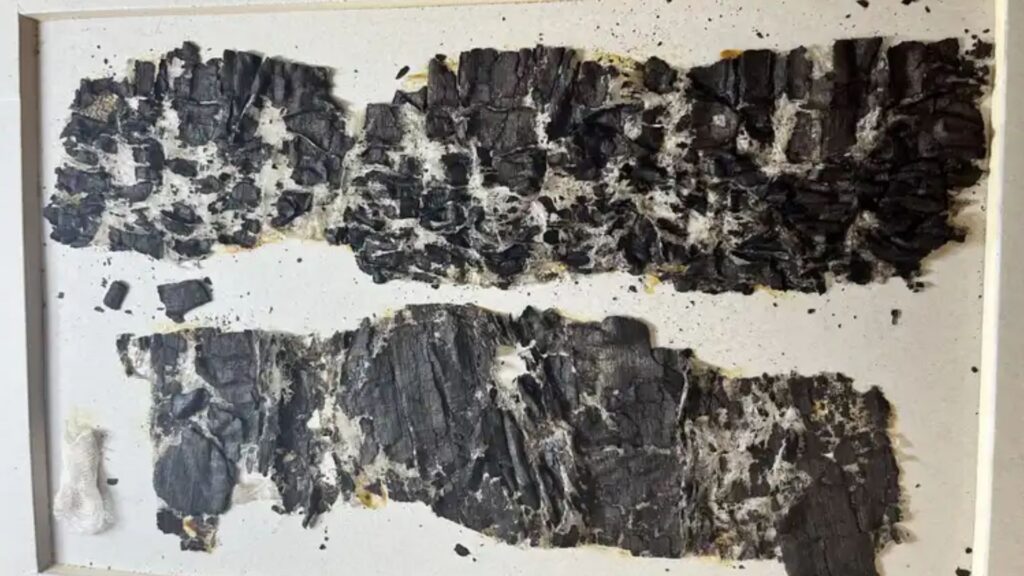
The key to reading the scrolls was never going to be physical. The Herculaneum scrolls are extremely fragile and crumble if taken apart, which means any traditional attempt to unroll them would only cause more destruction. The solution required a completely different approach: scanning the scrolls from the outside and using AI to detect what was hidden within.
Seales had already pioneered a way to virtually unwrap ancient scrolls using X-ray tomography and computer vision. But the ink used in these scrolls was carbon-based, making it nearly invisible to standard X-ray technology. His team spent years training AI algorithms to detect ink from the subtle changes it left in the papyrus fibers, a method they eventually opened up to competitors worldwide through the challenge.
The Vesuvius Challenge team released thousands of 3D images of two rolled-up scrolls from Herculaneum, alongside a machine-learning algorithm trained to detect invisible letters and symbols written on the layers of carbonized papyrus. Contestants from around the world were invited to build on that foundation. The race was on, and what the winners eventually produced stunned even the experts who had spent their careers studying these documents.
Three Students, One Ancient Text, and a $700,000 Prize

None of the three winners was a seasoned archaeologist or papyrologist. Luke Farritor was an undergraduate at the University of Nebraska-Lincoln, Youssef Nader was a doctoral student at Freie Universität Berlin, and Julian Schilliger had recently earned his master’s degree in robotics from ETH Zürich. Together, they formed an unlikely team that outpaced every other contestant in the world.
The first real crack came in October 2023, when Farritor identified the ancient Greek word for “purple” buried inside the scroll, winning a $40,000 prize. He and Nader began collaborating shortly after. Schilliger, who had developed an algorithm to automatically unwrap CT images, joined the team just days before the December 31 deadline. Their combined AI models revealed 2,000 characters in four full columns, far outstripping the grand prize’s requirement of four passages of 140 characters.
For Nader, the process was all-consuming. “The adrenaline rush is what kept us going,” he said. “It was insane. It meant working 20-something hours a day. I didn’t know when one day ended and the next day started.” In early February 2024, the Vesuvius Challenge awarded the team the $700,000 grand prize. The readable text comprises around five percent of the first scroll. Five percent, after 2,000 years of silence. And what it said was worth the wait.
What the Scroll Actually Says, and Why It Could Reshape Ancient History

The text is a philosophical treatise, most likely written by Philodemus, an Epicurean philosopher believed to have lived and worked at the very villa where the scrolls were found. The subject is pleasure, specifically whether the enjoyment of a combination of things comes from its dominant elements or its rarest ones. The author’s conclusion: scarcity alone does not make something more pleasurable. He then closes with a pointed attack on rival thinkers who, he argues, have nothing meaningful to say about pleasure at all.
For scholars, the content is remarkable. But the real significance is what this moment unlocks going forward. “Some of these texts could completely rewrite the history of key periods of the ancient world,” said Robert Fowler of the Herculaneum Society. Hundreds of scrolls remain unread. Some researchers believe even more are still buried beneath the villa in sections never excavated. The same technology could also be adapted to read carbonized scrolls from a Byzantine church in Jordan, fragments of the Dead Sea Scrolls, and papyrus hidden inside Egyptian mummy masks.
The Vesuvius Challenge continues, with organizers now aiming to read 85 to 90 percent of the scanned scrolls. A new Oxford scroll, imaged in 2024 at the Diamond Light Source synchrotron, is already yielding more text. The conversations preserved inside these scrolls, about love, war, peace, and philosophy, have waited 2,000 years to be heard. Thanks to three students and an algorithm, the waiting may finally be over.
PetsFanatic Team
Pet Care Expert & Content Creator
Passionate about sharing knowledge and tips for better pet care. Writing about everything from pet health to training techniques.