
Punxsutawney Phil Has Predicted Weather for 135 Years, and NOAA Just Graded His Accuracy
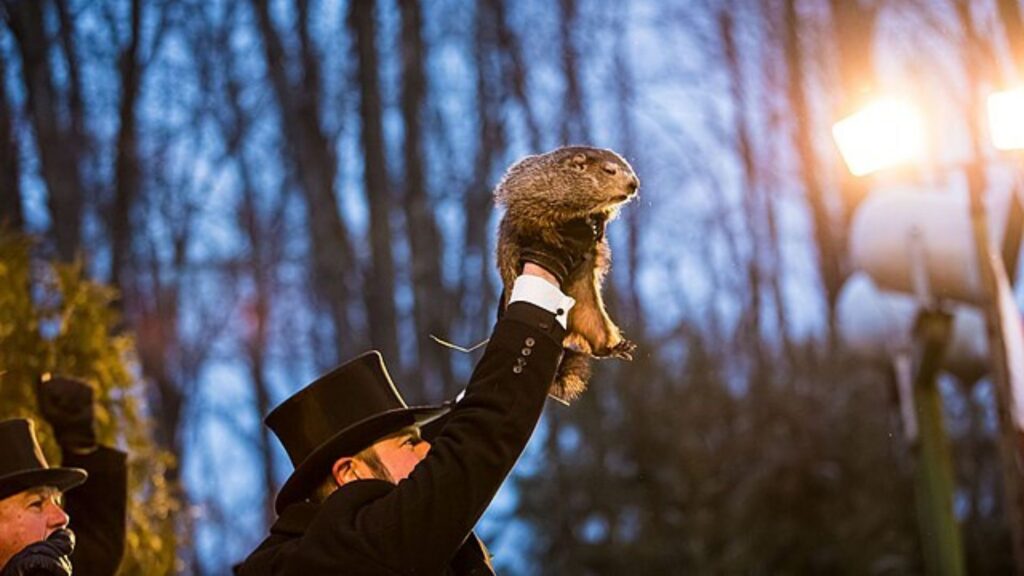
Every February 2, thousands gather at Gobbler’s Knob in Punxsutawney, Pennsylvania, to witness a furry forecaster emerge from his burrow. Punxsutawney Phil has been predicting weather patterns since 1887, making him America’s longest-running seasonal prognosticator. This year, Phil saw his shadow once again, signaling six more weeks of winter ahead. But the National Oceanic and Atmospheric Administration recently decided to examine whether Phil’s century-plus track record actually holds up against meteorological data.
The tradition stems from German settlers who brought the custom to America, originally using hedgehogs instead of groundhogs. According to the Punxsutawney Groundhog Club’s archives, Phil has now seen his shadow 109 times out of 130 total predictions, an 84% shadow-sighting rate. Between 1903 and 1933, he never failed to see his shadow once, creating an unbroken 32-year streak. Legend claims there’s only been one Phil, sustained by “groundhog nog” served at annual picnics.
NOAA’s National Centers for Environmental Information took on the challenge of grading Phil and 18 other weather-predicting animals across the United States. The agency evaluated their accuracy over the past 20 years, comparing predictions against actual February and March temperature averages from 2006 to 2025. The competitors included not just groundhogs, but also a tortoise, a prairie dog statue, and even some taxidermied groundhogs, all vying for the title of most reliable forecaster.
Phil’s Predictions Fall Short of a Coin Flip

NOAA’s analysis revealed that Punxsutawney Phil achieved just 35% accuracy over the past two decades. This means Phil would have performed better by simply flipping a coin, which would yield roughly 50% accuracy. His prediction for 2025 exemplified this unreliability. Phil called for six more weeks of winter, but February temperatures ended up near normal, and March became the sixth-warmest on record for the country, according to NOAA temperature data.
NOAA graded each animal by checking if they correctly forecasted warmer or colder than average conditions for late winter and early spring. Meteorologists compared the groundhogs’ shadow-based predictions against actual temperature records compiled by the National Centers for Environmental Information. Phil’s 35% success rate placed him near the bottom of the rankings, tied for 17th place out of 19 total competitors in the weather-predicting animal competition.
Despite his poor performance, Phil remains America’s most famous prognosticator, drawing crowds and media attention each year. His celebrity status hasn’t translated to forecasting skill, though. The beloved rodent’s predictions follow a simple formula. Seeing his shadow means six more weeks of winter, while no shadow signals early spring. Astronomical winter ends on the spring equinox around March 20, regardless of what Phil sees on February 2.
A New York Groundhog and Bronze Statue Outperform the Pennsylvania Legend

Staten Island Chuck, also known as Charles G. Hogg, claimed first place with an impressive 85% accuracy rating. The New York City resident lives at the Staten Island Zoo and has proven himself the nation’s most reliable weather forecaster, despite occasionally unpredictable behavior. He once bit the hand of New York City’s mayor during a Groundhog Day ceremony. His forecasting prowess apparently doesn’t extend to manners around politicians.
In a surprising twist, second place went to Lander Lil, who isn’t even alive. She’s a bronze statue of a prairie dog residing on the grounds of a post office in Lander, Wyoming, achieving 80% accuracy. Modeled after a real prairie dog who once lived in the area, Lil’s shadow at sunrise determines how long until spring arrives. In 2001, someone stole her, prompting a search party that eventually found her at the town dump.
General Beauregard Lee rounded out the top three with 75% accuracy. Georgia’s Official Weather Prognosticator lives in Weathering Heights, his groundhog-sized mansion at Dauset Trails Nature Center in Jackson, Georgia. Other competitors included Concord Charlie from West Virginia at 70%, and several taxidermied groundhogs from Pennsylvania. Mojave Max, a tortoise from Nevada who awakens from winter brumation to herald spring’s arrival, placed last with just 20% accuracy.
Actual Meteorologists Offer More Reliable Forecasts Than Furry Prognosticators

The National Weather Service’s Climate Prediction Center produces actual forecasts for temperatures and precipitation across the United States on timescales ranging from one week to more than a year. For February through April 2026, forecasters expect above-average temperatures across most of the country, especially the South, East, and Southwest. Northern regions, including the Pacific Northwest and Northern Rockies, can expect active storm patterns and below-average temperatures instead.
Long-range forecasts remain notoriously complex even with sophisticated prediction tools and climate models. Winter has become the fastest-warming season for nearly 75% of the United States as global temperatures rise due to fossil fuel pollution. Bouts of brutal cold and extreme winter storms still occur, but they happen far less frequently than they once did. This warming trend makes traditional groundhog predictions even less relevant to actual seasonal weather patterns.
Phil’s popularity persists despite his track record. The Groundhog Day tradition, celebrated in America since at least 1886, offers lighthearted fun rather than real weather forecasting. Phil’s handlers claim he communicates predictions in “groundhogese,” maintaining the whimsical folklore. Staten Island Chuck may forecast more accurately, but Punxsutawney Phil remains the beloved face of Groundhog Day. Charm and tradition carry more weight than scientific precision when it comes to America’s favorite forecasting rodent.
PetsFanatic Team
Pet Care Expert & Content Creator
Passionate about sharing knowledge and tips for better pet care. Writing about everything from pet health to training techniques.