
NASA’s Closest Look at the Sun Left Everyone With Questions
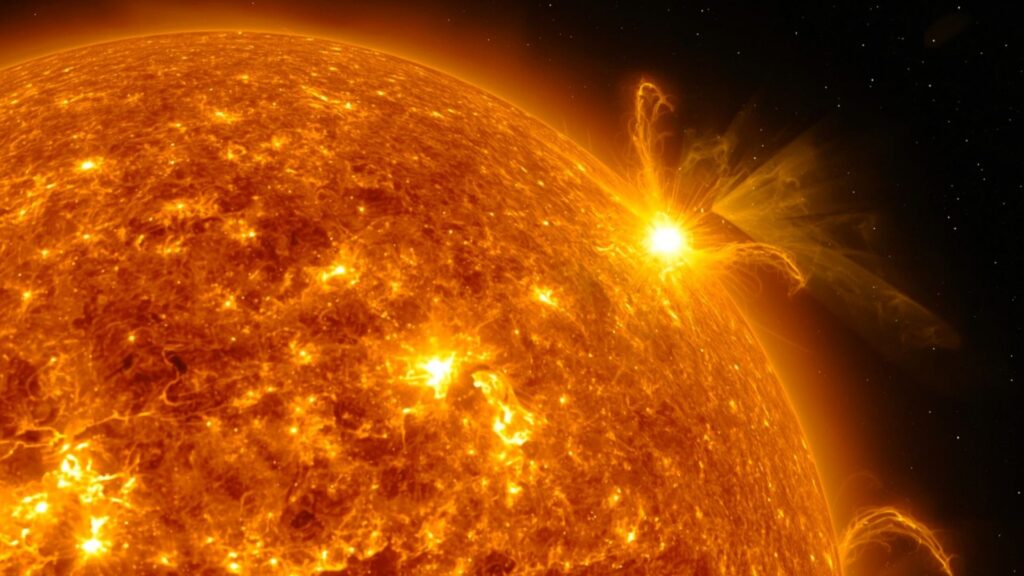
When NASA’s Parker Solar Probe traveled to within 3.8 million miles of the Sun on December 24, 2024, it marked the closest approach ever achieved by a human made object. The spacecraft entered the Sun’s outer atmosphere, the corona, capturing images with unprecedented clarity. As those visuals spread online, admiration quickly mixed with curiosity about what appeared to be missing.
This milestone was the result of years of orbital adjustments, using repeated Venus flybys to gradually tighten the probe’s path. The latest pass initiated its closest operational phase, allowing instruments to observe where the solar wind originates and how magnetic energy behaves near the surface.
Although the images are visually compelling, the mission’s purpose is scientific. Parker is designed to measure plasma, magnetic fields, and energetic particles. The photographs represent data driven observation, yet one visual detail soon became the focus of public debate.
The image that sparked online curiosity

Viewers quickly noticed that the background of the Sun’s closest portrait appeared empty. If the spacecraft was so near to our star, why were no stars visible behind it? The question fueled speculation across social platforms.
The explanation is grounded in basic photography. The corona is intensely bright compared to distant stars. To prevent overexposure, the probe uses short exposure times and settings optimized for capturing fine solar detail. Under those conditions, faint starlight does not register.
This effect is familiar in other space images, including photos taken from orbit around Earth. Cameras adjusted for bright subjects naturally suppress dim background light. The stars remain present, but the sensor prioritizes the Sun’s luminous structures.
Inside the instrument designed to track solar activity

The Wide Field Imager for Solar Probe, known as WISPR, is engineered to study the corona rather than create a star filled panorama. Its orientation and exposure settings focus on subtle brightness changes in plasma streams and magnetic structures.
Long exposures could reveal distant stars, but they would blur dynamic coronal features and overwhelm the sensor with scattered light. Short exposures freeze motion and preserve detail in solar eruptions and streamers, which are central to the mission’s goals.
The absence of stars therefore reflects a deliberate design choice. By minimizing background light, scientists gain sharper contrast and clearer insight into how solar material moves and evolves near its source.
Why this close look matters for Earth

Observing the Sun at 3.8 million miles allows researchers to study the solar wind before it disperses through space. By combining imagery with direct measurements of particles and magnetic fields, scientists can better understand how solar storms form and intensify.
This knowledge is essential. Powerful solar events can disrupt satellites, affect navigation systems, and strain power grids. More precise models improve forecasting and provide earlier warnings to industries that rely on stable infrastructure.
Public debate about the missing stars highlights how technical details can shape perception. Yet beyond online speculation, the mission delivers critical insight into the forces that influence modern life. The closest images ever captured of the Sun may look minimalistic, but they reveal the complex dynamics that ripple outward and ultimately reach Earth.
PetsFanatic Team
Pet Care Expert & Content Creator
Passionate about sharing knowledge and tips for better pet care. Writing about everything from pet health to training techniques.