
The Most Complete Dinosaur Fossil Ever Has Been Found

Scientists in Wyoming have made an extraordinary discovery that’s rewriting what we know about dinosaurs. Two Edmontosaurus fossils, preserved so perfectly they’re called “mummies,” reveal details never seen before. For the first time, researchers can see a complete dinosaur profile, including skin, spikes, and remarkably, hooves. This groundbreaking find answers questions paleontologists have asked for two centuries.
What Makes These Fossils Different

These aren’t typical fossils. While most dinosaur remains show only bones, these specimens preserve external features in stunning detail. The skin, spikes, and hooves survived through a unique preservation process. Paul Sereno, senior author of the study from the University of Chicago, explains that these fossils allow scientists unprecedented confidence in reconstructing dinosaur appearance. Published in Science, the research offers revelations never before possible.
The Historic Discovery Site

The area in east-central Wyoming has become known as “the mummy zone,” where thick river sand layers captured dinosaur bodies 66 million years ago. This compact region, less than six miles across, has produced multiple exceptional specimens. Researchers relocated sites where famous dinosaur mummies were first found in the early 1900s, mapping the zone’s exact boundaries using historical photographs and letters.
Charles Sternberg’s Original Find

In 1908, renowned fossil collector Charles Sternberg and his sons made paleontology history. They discovered the first dinosaur mummy near Lusk, Wyoming, a specimen that would eventually sell to the American Museum of Natural History for $2,000. This specimen, nicknamed the “AMNH mummy,” became one of the museum’s most prized displays. It inspired generations of paleontologists, including Paul Sereno himself.
Sereno’s Personal Connection

The mummy study represents a meaningful full circle for Sereno. “That’s when I decided to be a paleontologist,” he recalls of standing next to the 1908 specimen decades ago. “Little did I know my career would end up taking me back to where that mummy was discovered by Charles Sternberg more than a century ago.” This childhood inspiration ultimately drove his groundbreaking research.
Detective Work and Ranch History

Relocating the historic discovery sites required real detective work. Sereno’s research “involved sleuthing archives and finding photographs from these original excavations that no one knew of, and then also talking to ranchers,” he explains. A Wyoming rancher provided crucial clues about his great-grandmother’s involvement with the original site. The location sits on the Zerbst Ranch, still family-owned after five generations.
Meet “Ed Jr.” and “Ed Sr.”
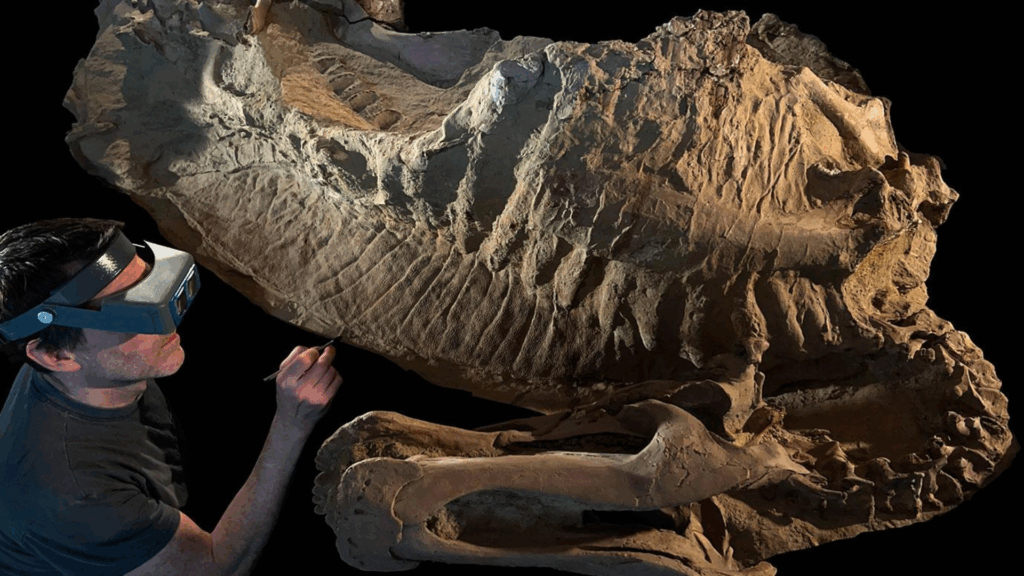
The team excavated two new specimens, affectionately nicknamed “Ed Jr.” and “Ed Sr.” Ed Jr., a late juvenile, was approximately two years old at death, while Ed Sr., an early adult, was between five and eight years old. Ed Jr. holds special significance as the only juvenile dinosaur mummy ever discovered. Together, these complementary specimens allowed researchers to reconstruct a complete dinosaur profile for the first time.
Understanding “Mummy” Preservation
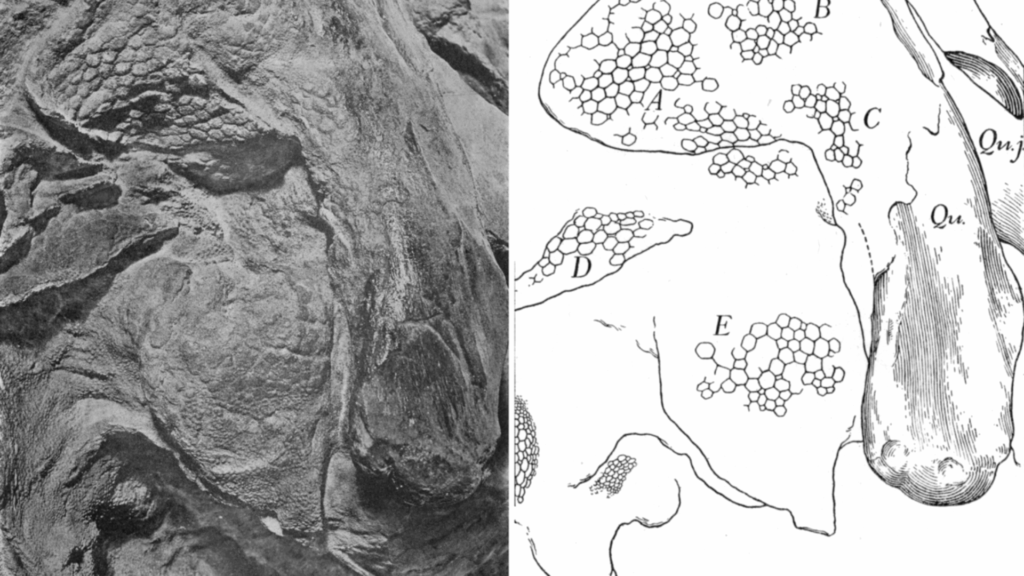
These dinosaur “mummies” differ drastically from Egyptian mummies. “This is a mask, a template, a clay layer so thin you could blow it away,” Sereno said. “It was attracted to the outside of the carcass in a fluke event of preservation.” No organic material remains—instead, physical features were preserved in a clay film just 1/100th of an inch thick, creating detailed templates of the dinosaur’s surface.
The Clay Templating Process

Scientists used advanced imaging to understand this unique preservation. After each sun-dried carcass was covered suddenly by flash floods, a biofilm on the surface electrostatically pulled clay from wet sediment to form a wafer-thin template layer. This captured the true surface in three dimensions. The organic material then decayed away while the skeleton fossilized over longer timescales, preserving remarkable external details.
Advanced Research Techniques

The research team employed cutting-edge technology to analyze the specimens. They used hospital CT scans, micro-CT scans, thin sections, X-ray spectroscopy, and clay analyses. Physical examination of the discovery site confirmed their findings. This comprehensive approach allowed scientists to reconstruct the fleshy appearance of Edmontosaurus with unprecedented accuracy, creating detailed three-dimensional models of the living animal.
The Groundbreaking Hoof Discovery

The most shocking revelation was discovering that Edmontosaurus had hooves. This is the first time this feature has ever been seen in a dinosaur. The larger specimen revealed three hind toes covered in wedged hooves similar to a horse. However, experts clarify that these resemble rhino hooves more than horse hooves—prominent nails at the front of fleshy pads. Footprint evidence from the same period confirmed this extraordinary finding.
Multiple “Firsts” in One Discovery
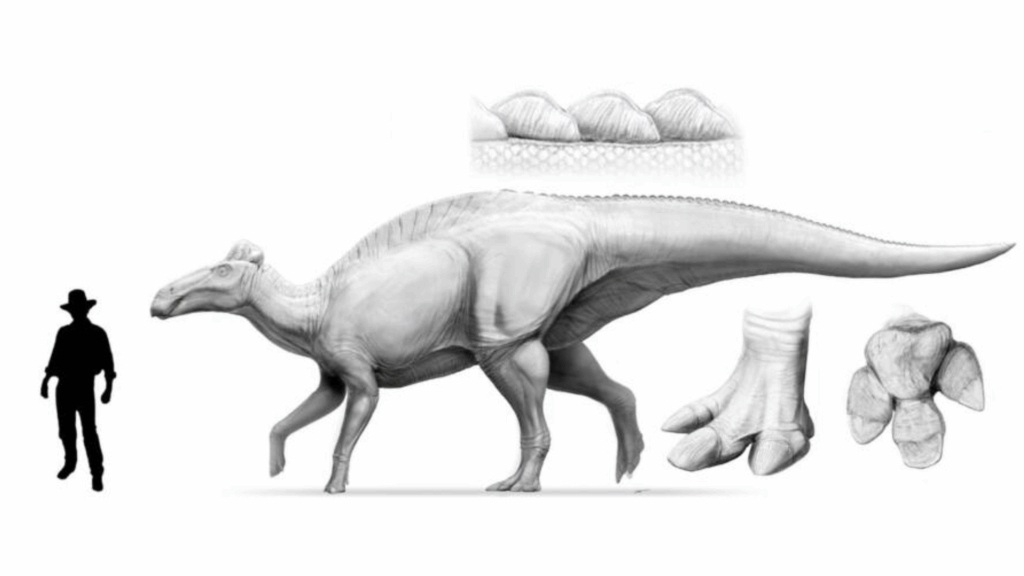
“There are so many amazing ‘firsts’ preserved in these duck-billed mummies—the earliest hooves documented in a land vertebrate, the first confirmed hooved reptile, and the first hooved four-legged animal with different forelimb and hindlimb posture,” Sereno said. Each revelation challenges the previous understanding of dinosaur anatomy. The discoveries provide unprecedented insights into how these massive herbivores moved and lived.
The Fleshy Crest Discovery

Reconstruction revealed surprising soft tissue features. The specimens show a continuous midline feature beginning as a fleshy crest along the neck and trunk. This crest transitioned over the hips into a single row of spikes running down the tail. “This is sort of dragon-like,” says Sereno. Each spike is positioned over a single vertebra, fitting together in an interlocking pattern that has never been fully documented before.
Scale Patterns and Skin Texture

The preserved skin revealed unexpected details about Edmontosaurus’ appearance. Most scales were tiny pebble-like structures just 1–4 millimeters across, surprisingly small for a dinosaur growing over 40 feet in length. The lower body and tail featured the largest polygonal scales. Sharp-crested wrinkles over the ribs suggested the skin was very thin but flexible, allowing natural movement for this massive herbivore.
Complete Profile Reconstruction

For the first time, scientists created a fully fleshed-out dinosaur reconstruction. “The two specimens complemented each other beautifully,” Sereno explained. “For the first time, we could see the whole profile rather than scattered patches.” Digital artists worked alongside scientists to produce detailed reconstructions. The resulting image shows a 40-foot grazer with a ridged back, spiked tail, and hooves designed for muddy floodplains.
Life in the Cretaceous Floodplains

Edmontosaurus lived along ancient coastlines in what is now Wyoming, Montana, and Saskatchewan 68 to 66 million years ago. “It was the buffalo at the end of the dinosaur era,” Sereno said. “They roamed around in herds, literally in the same way the buffalo were running around in the 19th Century.” These duck-billed herbivores were among the most common dinosaurs of their time, with Tyrannosaurus rex as their primary predator.
Why This Location Was Special

The mummy zone’s preservation success stems from unique geological conditions. The coastline’s bottom was “falling out for bigger geologic reasons,” meaning once buried, fossils remained untouched even as landscapes dramatically changed above them. Unlike typical fossils that get exposed and moved repeatedly until destroyed, these specimens stayed pristine beneath Wyoming’s terrain for 66 million years, never reaching depths where later rivers could disturb them.
Impact on Paleontology

This research provides more than anatomical revelations. The study offers a comprehensive toolkit for future soft tissue research, including new preparation methods, clear terminology for soft structures, and imaging workflows from fossil to flesh model. It establishes a new model for dinosaur mummification involving clay templating that scientists can test on future finds, potentially revolutionizing how paleontologists search for and analyze specimens.
What Comes Next

The mummy zone likely holds many more secrets. The same area has produced a partial Tyrannosaurus skeleton and “Lane,” a large Triceratops with extensive skin renderings. Sereno remains confident about future discoveries in these Wyoming ravines. Researchers plan targeted searches for similarly preserved specimens in the same strata and elsewhere, while developing biomechanical models that now have reliable external boundaries to work with.
A Message for Future Paleontologists

Sereno has a message for young dinosaur enthusiasts: “If you’re an enthused kid, thinking, maybe we found everything. No, we have not.” Plenty of work remains in discovering new specimens and solving mysteries about dinosaur life. For the next two generations, scientists will continue finding more about the deep past than ever before. This extraordinary research proves that even after 200 years of paleontology, revolutionary discoveries still await.
PetsFanatic Team
Pet Care Expert & Content Creator
Passionate about sharing knowledge and tips for better pet care. Writing about everything from pet health to training techniques.