
Massive Deep-Sea Volcano Offers New Clues to How Earth Was Shaped
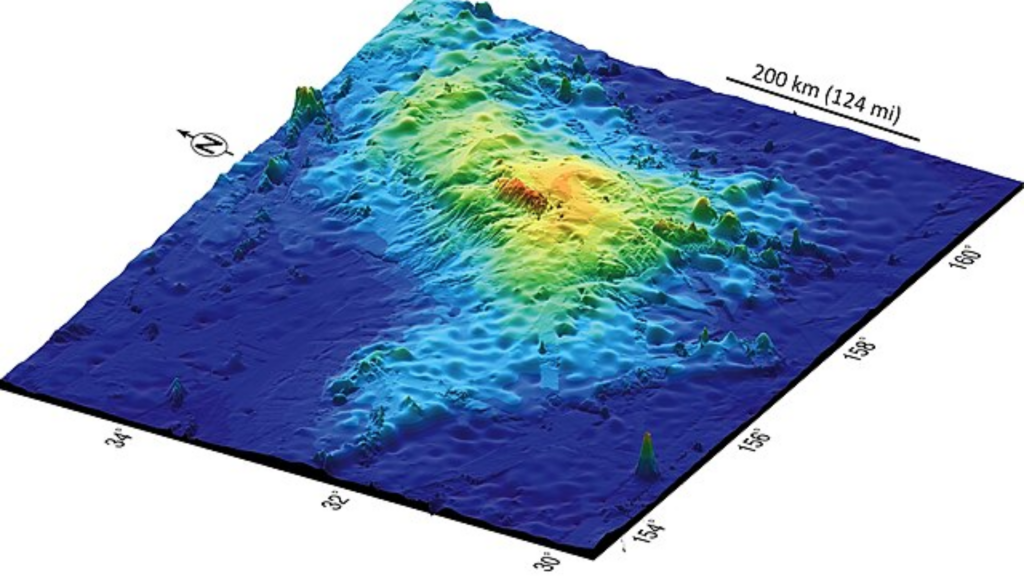
Deep beneath the northwest Pacific Ocean, a geological titan is forcing scientists to throw out the old textbooks. Known as the Tamu Massif, this submerged structure is so massive that it covers approximately 310,000 square kilometers, an area comparable to the British Isles and Ireland combined. It isn’t just a mountain; it is one of the largest volcanic structures ever identified on our planet.
For years, researchers believed the region was simply a cluster of many small, separate volcanoes. However, a landmark 2013 study led by geophysicist William Sager suggested something much more imposing: the entire mass might be a single, solitary “supervolcano”. The sheer scale of the discovery drew immediate comparisons to Olympus Mons on Mars, the largest known volcano in our solar system.
But as scientists looked closer, the mystery only deepened. While its top sits nearly 2,000 meters below the waves, its base plunges 6.4 kilometers into the Earth’s crust, acting as a massive root that anchors the structure. This hidden giant is now at the center of a debate that could redefine how we understand the very ground, and seafloor, beneath our feet.
The 4,460-Meter Tower of Basalt
To grasp the scale of the Tamu Massif, you have to compare it to the giants we already know. It stands roughly 4,460 meters tall from base to peak. Most strikingly, it is approximately 60 times larger than Hawaii’s Mauna Loa, which was long considered the heavyweight champion of Earth’s active volcanoes.
Scientific drilling during Expedition 324 of the International Ocean Discovery Program revealed the violent history required to build such a monument. Researchers extracted basalt flows up to 23 meters thick, confirming a period of “extremely effusive” eruptions. These massive lava flows occurred during the Late Jurassic period, roughly 145 million years ago.
This isn’t just a pile of rock; it’s a record of a planet in upheaval. The volcanic dome stretches roughly 450 by 650 kilometers across the seafloor. The sheer volume of magma required to create this structure suggests that the Earth’s interior was working overtime during its formation, pumping out enough molten rock to bury entire countries.
A Tectonic Mystery at the Triple Junction
In 2019, a scientific expedition aboard the ship Falkor added a shocking twist to the story. By collecting nearly two million magnetic measurements, researchers found linear patterns of opposite magnetic polarity. This data suggests the Tamu Massif might not be a single volcano after all, but rather a product of seafloor spreading along a tectonic ridge.
The formation likely occurred at a “triple junction,” a rare and complex environment where three tectonic plates separate simultaneously. This created massive fractures in the Earth’s crust, allowing colossal volumes of magma to surge upward. It challenges the old idea that giant volcanic plateaus only form from isolated “mantle plumes” or hot spots.
Instead, the Tamu Massif suggests that the simple expansion of the ocean floor can create geological monsters under the right conditions. This finding is weakening classic geological analogies and forcing a revision of plate tectonic models. It turns out the seafloor is much more dynamic and unpredictable than we previously dared to imagine.
The Silent Legacy of a Submerged Giant
Today, the Tamu Massif remains silent and still, resting nearly two kilometers beneath the Pacific surface. While it is no longer erupting, its scientific legacy is just beginning to heat up. Each new rock sample helps researchers piece together the history of “Large Igneous Provinces” that have shaped Earth’s crust over millions of years.
This submerged giant serves as a natural laboratory for modern geophysics. It proves that the most significant features of our planet aren’t always the ones we can see from the shore. As technology improves, scientists expect to find even more hidden giants lurking in the unexplored depths of the global ocean.
The lesson of the Tamu Massif is one of humility. It reminds us that even with satellite mapping and advanced sensors, Earth still holds secrets the size of Great Britain. We are still learning the true story of how our world was built, one massive eruption at a time.
PetsFanatic Team
Pet Care Expert & Content Creator
Passionate about sharing knowledge and tips for better pet care. Writing about everything from pet health to training techniques.