
What He Thought Was Gold Was Actually a 4.6-Billion-Year-Old Find

In the historic goldfields of southeastern Australia, David Hole discovered something unusual near Maryborough Regional Park. The rust-colored rock was oddly heavy and strangely smooth. Convinced it contained gold, he took it home and began trying to open it with every tool available.
Saws, drills, acid, and even a sledgehammer proved useless against the mysterious object. The rock refused to crack or chip, no matter how much force Hole applied. Its reddish tint and dense weight matched the region’s gold-bearing geology perfectly, fueling his determination.
After years of failed attempts, Hole finally brought the stubborn rock to the Melbourne Museum. He hoped geologists could identify what made it so impossibly hard. What they discovered would prove far more valuable than any gold nugget he’d imagined finding.
Geologists Reveal the Rock’s Cosmic Origins

Museum geologists Dermot Henry and Bill Birch immediately suspected something extraordinary. The object’s sculpted, dimpled surface suggested it had traveled through Earth’s atmosphere at extreme speeds. “That’s formed when they come through the atmosphere,” Henry explained to The Sydney Morning Herald.
Using a diamond saw, the team cut a small slice from the rock and confirmed their suspicions. The 17-kilogram object was an H5 ordinary chondrite, a type of stony meteorite containing high iron content and visible chondrules—tiny molten droplets formed at the solar system’s birth.
The meteorite, now named Maryborough after the nearby town, became one of only 17 meteorites ever documented in Victoria. Despite thousands of gold nuggets found in the state, this space rock proved far rarer. It ranks as Victoria’s second-largest chondritic mass ever discovered.
The Long Journey From Museum Visit to Scientific Confirmation

Hole’s path to discovery wasn’t quick. He found the mysterious rock in May 2015, buried in yellow clay about two kilometers outside Maryborough while sweeping his metal detector across the ground. For three years, the 38.5cm x 14.5cm x 14.5cm object sat in his possession, defying every attempt at explanation.
When Hole finally brought it to Museums Victoria in 2018, curators began their meticulous process. They photographed the specimen from every angle, created detailed molds of its surface, and carefully weighed each measurement. Only then did they use specialized equipment to extract a thin slice for laboratory analysis.
The confirmation process required publishing findings in a peer-reviewed scientific journal. Bill Birch led the research paper describing the Maryborough Meteorite, which appeared in the Proceedings of the Royal Society of Victoria. This formal documentation secured the meteorite’s place in scientific records and Victoria’s state collection.
Preserving Secrets From Before Earth Existed
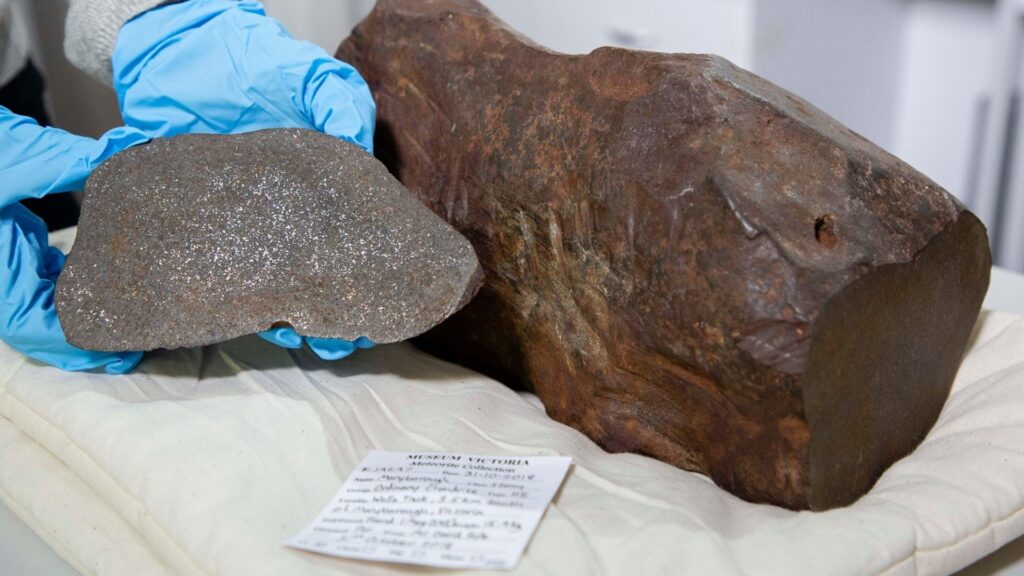
Inside the meteorite, researchers found patterns of metallic mineral droplets embedded throughout its structure. These chondrules represent some of the earliest solid materials in our solar system, formed over 4.6 billion years ago. They existed before Earth itself took shape.
Scientists believe the Maryborough meteorite originated in the asteroid belt between Mars and Jupiter. Collisions between ancient asteroids ejected fragments into space, sending them on journeys lasting millions of years. Carbon dating suggests this particular rock reached Earth between 100 and 1,000 years ago.
Chondrites like this one act as natural time capsules, preserving original material from the early solar nebula. They contain information about the chemical composition that eventually led to planets. Some even hold prebiotic molecules such as amino acids, offering clues about life’s building blocks.
A Fireball in the Victorian Sky
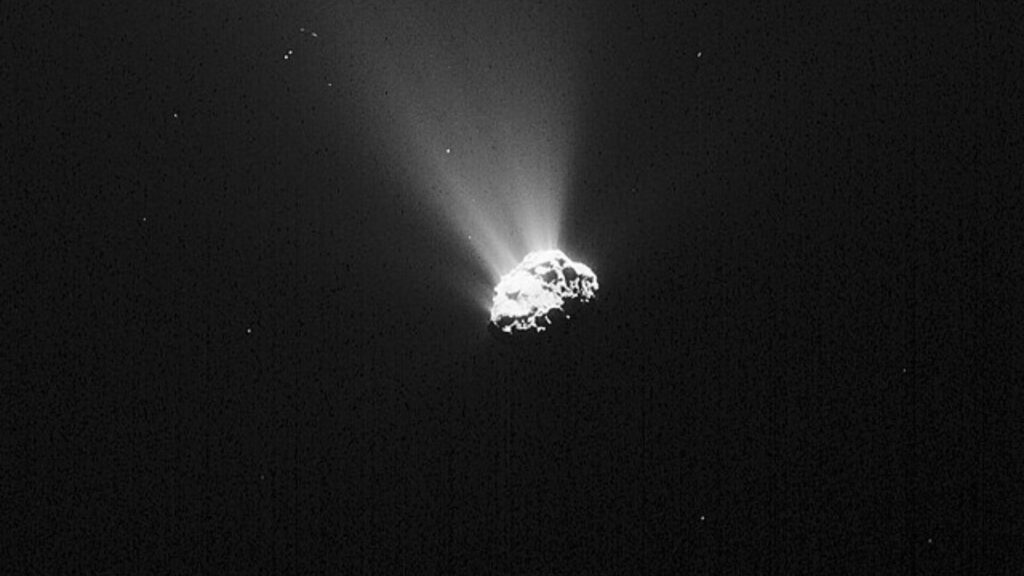
Multiple eyewitness accounts from the Maryborough district may hold clues to when this space traveler arrived. Local newspapers documented meteor sightings between 1889 and 1951, reporting bright fireballs streaking across the Victorian sky. One particularly notable event occurred in June 1951, when residents saw a brilliant streak near the exact area where Hole would later make his discovery.
These historical records suggest the Maryborough meteorite might have landed relatively recently in cosmic terms. The timing aligns with carbon-14 testing results, which narrowed the arrival window to sometime within the past millennium. If the 1951 sighting corresponds to this meteorite’s landing, witnesses unknowingly observed a 4.6-billion-year-old object’s final moments of flight.
The violent entry through Earth’s atmosphere would have created the distinctive sculpted surface that first caught the geologists’ attention. Extreme heat melted the outer layers while atmospheric resistance carved those characteristic dimples and flow patterns into the rock’s exterior.
How One Rock Joined an Elite Scientific Collection

Museums Victoria’s meteorite collection contains over 400 specimens, representing fragments from across the solar system. The Maryborough meteorite now stands among some of the world’s most studied space rocks, including the famous Murchison meteorite, which landed in Victoria in 1969.
The acquisition process transformed Hole’s backyard curiosity into public property available for ongoing research. Scientists worldwide can now request samples for analysis, potentially unlocking discoveries about solar system formation that weren’t possible with previous technology. Each new analytical technique offers fresh opportunities to extract information from this ancient material.
The meteorite’s addition to the state collection ensures its preservation for future generations. Unlike gold, which can be melted and reshaped, meteorites provide irreplaceable scientific data. Their rarity makes each specimen precious—not for monetary value, but for the cosmic history locked within their crystalline structures.
The Incredible Odds of Discovery

Victoria’s last confirmed meteorite find before Maryborough occurred at Willow Grove, Gippsland, in 1995—over 20 years earlier. That iron-nickel specimen represented a different meteorite classification entirely, demonstrating how diverse these cosmic visitors can be. Before that, the Ballarat meteorite languished unrecognized from the late 1860s until 2002, when scientists confirmed its extraterrestrial origins.
The Ballarat specimen’s story particularly illustrates how easily meteorites disappear into history. Found in river gravels buried under basalt flows, it had traveled far from its original impact site. Researchers classify it as a “fossil” meteorite due to its geological context, currently displayed in Melbourne Museum’s Dynamic Earth exhibition.
Hole himself recognized the astronomical improbability of his find. “It was just pot luck, mate,” he told reporters. “A billion to one—bigger, a trillion to one. Got more chance of being struck by lightning twice.” His casual metal detecting expedition that May morning could easily have missed the rock entirely, leaving it buried for another thousand years.
Why Meteorites Often Go Unrecognized for Decades

The Maryborough meteorite sat unidentified for years, demonstrating how easily extraterrestrial rocks are overlooked. They often resemble rusty iron lumps or ordinary stones, making them difficult to distinguish without specialized analysis. Henry noted that most people wouldn’t recognize one if they found it.
Throughout his career, evaluating thousands of samples, Henry confirmed only two authentic meteorites. The rarity of proper identification means countless space rocks likely remain misidentified worldwide. One U.S. meteorite even served as a doorstop for over 80 years before scientists recognized its true nature.
Now displayed at Museums Victoria, the Maryborough meteorite continues attracting scientific interest and public curiosity. Researchers studying its structure gain insights into planetary processes that occurred before Earth formed. Sometimes the most extraordinary discoveries come from the most unexpected places, waiting patiently to reveal their ancient secrets.
PetsFanatic Team
Pet Care Expert & Content Creator
Passionate about sharing knowledge and tips for better pet care. Writing about everything from pet health to training techniques.