
Man Kept a Rock He Thought Was ‘Gold’ for Years. Turns Out It Was a 4.6-Billion-Year-Old Treasure Even Rarer than Gold

In the historic goldfields of southeastern Australia, David Hole discovered something unusual near Maryborough Regional Park. The rust-colored rock was oddly heavy and strangely smooth. Convinced it contained gold, he took it home and began trying to open it with every tool available.
Saws, drills, acid, and even a sledgehammer proved useless against the mysterious object. The rock refused to crack or chip, no matter how much force Hole applied. Its reddish tint and dense weight matched the region’s gold-bearing geology perfectly, fueling his determination.
After years of failed attempts, Hole finally brought the stubborn rock to the Melbourne Museum. He hoped geologists could identify what made it so impossibly hard. What they discovered would prove far more valuable than any gold nugget he’d imagined finding.
Geologists Reveal the Rock’s Cosmic Origins

Museum geologists Dermot Henry and Bill Birch immediately suspected something extraordinary. The object’s sculpted, dimpled surface suggested it had traveled through Earth’s atmosphere at extreme speeds. “That’s formed when they come through the atmosphere,” Henry explained to The Sydney Morning Herald.
Using a diamond saw, the team cut a small slice from the rock and confirmed their suspicions. The 17-kilogram object was an H5 ordinary chondrite, a type of stony meteorite containing high iron content and visible chondrules—tiny molten droplets formed at the solar system’s birth.
The meteorite, now named Maryborough after the nearby town, became one of only 17 meteorites ever documented in Victoria. Despite thousands of gold nuggets found in the state, this space rock proved far rarer. It ranks as Victoria’s second-largest chondritic mass ever discovered.
Preserving Secrets From Before Earth Existed
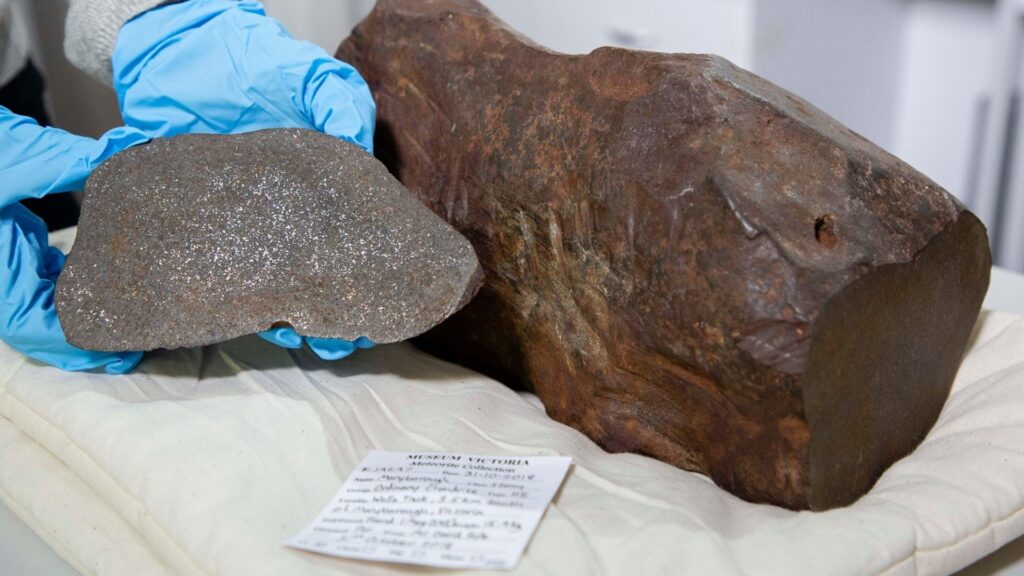
Inside the meteorite, researchers found patterns of metallic mineral droplets embedded throughout its structure. These chondrules represent some of the earliest solid materials in our solar system, formed over 4.6 billion years ago. They existed before Earth itself took shape.
Scientists believe the Maryborough meteorite originated in the asteroid belt between Mars and Jupiter. Collisions between ancient asteroids ejected fragments into space, sending them on journeys lasting millions of years. Carbon dating suggests this particular rock reached Earth between 100 and 1,000 years ago.
Chondrites like this one act as natural time capsules, preserving original material from the early solar nebula. They contain information about the chemical composition that eventually led to planets. Some even hold prebiotic molecules such as amino acids, offering clues about life’s building blocks.
Why Meteorites Often Go Unrecognized for Decades

The Maryborough meteorite sat unidentified for years, demonstrating how easily extraterrestrial rocks are overlooked. They often resemble rusty iron lumps or ordinary stones, making them difficult to distinguish without specialized analysis. Henry noted that most people wouldn’t recognize one if they found it.
Throughout his career evaluating thousands of samples, Henry confirmed only two authentic meteorites. The rarity of proper identification means countless space rocks likely remain misidentified worldwide. One U.S. meteorite even served as a doorstop for over 80 years before scientists recognized its true nature.
Now displayed at Museums Victoria, the Maryborough meteorite continues attracting scientific interest and public curiosity. Researchers studying its structure gain insights into planetary processes that occurred before Earth formed. Sometimes the most extraordinary discoveries come from the most unexpected places, waiting patiently to reveal their ancient secrets.
PetsFanatic Team
Pet Care Expert & Content Creator
Passionate about sharing knowledge and tips for better pet care. Writing about everything from pet health to training techniques.