
‘Living Fossil’ Fish Thought Extinct for 70 Million Years Found Alive

A fish species dating back more than 400 million years to before the dinosaurs has been photographed in a rare sighting that marks a significant first for marine science. Marine biologist Alexis Chappuis captured images of the elusive creature at approximately 475 feet below the ocean’s surface. The discovery, supported by Swiss luxury watchmaking company Blancpain, involved overcoming dangerous deep-diving conditions to reach one of the ocean’s most mysterious inhabitants, once believed lost to time.
The Indonesian Coelacanth Had Never Been Photographed There Before

Chappuis photographed the Indonesian coelacanth, Latimeria menadoensis, in the Maluku Archipelago, marking the first time this species has been documented on camera in Indonesian waters. The rare fish was spotted by divers searching the deep ocean environment where these creatures dwell. The find represents a milestone for an animal once believed extinct for 70 million years, until a specimen with shimmering blue-green scales and four limb-like fins surfaced in a trawl net off South Africa in 1938.
The Species Survived Before Dinosaurs Walked the Earth

Coelacanths have existed for over 400 million years, predating dinosaurs by millions of years. The fish belongs to the group of lobe-finned species whose strong, fleshy fins became precursors to the paired limbs of tetrapods, including all land-living vertebrates like amphibians, reptiles, birds, mammals, and humans. In fact, coelacanths are more closely related to tetrapods than to any other known fish species, making them a crucial link in understanding evolutionary history.
Scientists Once Believed the Fish Died with Dinosaurs

The youngest known fossil coelacanth dates back 66 million years, leading scientists to assume the species vanished during the same extinction event that killed the dinosaurs. That assumption held until the 1938 South Africa find, which marked one of the biggest natural history discoveries of the 20th century. The revelation proved that coelacanths had survived in ocean depths for millions of years, adapting to life far below the surface where they remained hidden from observation.
Two Living Species Exist in Different Ocean Regions

Two extant coelacanth species survive today in separate regions. The West Indian Ocean coelacanth, Latimeria chalumnae, inhabits waters off South Africa’s east coast, while the Indonesian coelacanth, Latimeria menadoensis, lives in the Maluku Archipelago. Chappuis photographed the Indonesian species, which had never been documented on camera in Indonesian waters despite being known to science. Both species live in the benthic zone, dwelling on the sea floor as deep as 984 feet.
The Expedition Required Dangerous Deep Mixed-Gas Diving

Alexis Chappuis, working with UNSEEN Expeditions, overcame the significant challenge of deep mixed-gas diving to reach the coelacanth’s habitat. The technique involves breathing specialized gas mixtures at extreme depths, where many divers have suffered from decompression sickness, commonly called “the bends,” according to the U.S. Centers for Disease Control and Prevention. The expedition represented a collaboration between international organizations and Udayana University in Bali, combining expertise to locate one of the ocean’s most elusive creatures.
Laurent Ballesta Made History with the First Wild Photos in 2013
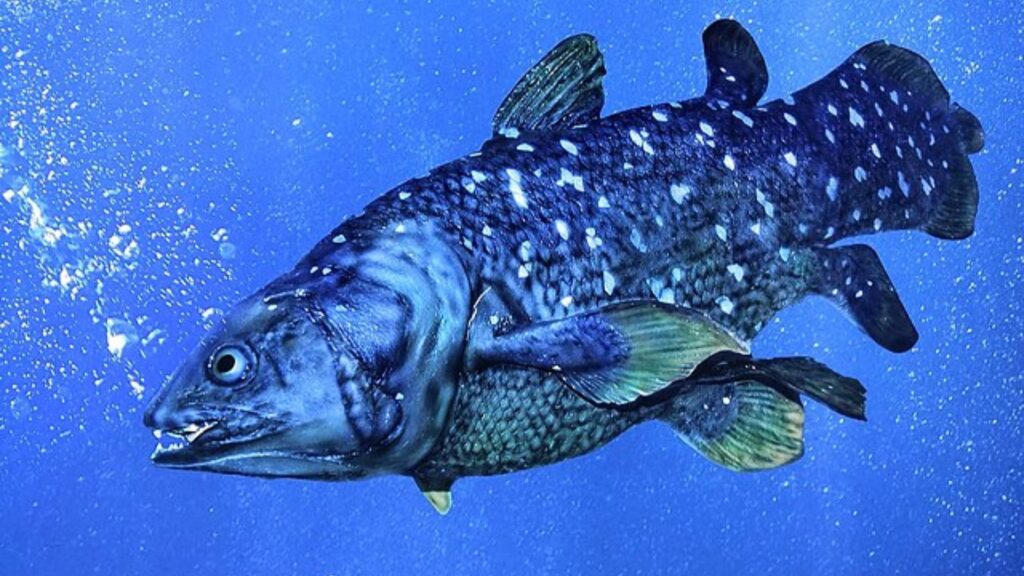
Before Chappuis’s Indonesian discovery, French photographer Laurent Ballesta documented wild coelacanths in 2013 at Sodwana Bay, off South Africa’s east coast. Ballesta’s images marked the first time a coelacanth was photographed in its natural habitat. In 2010, Ballesta and his team, carrying 32kg worth of camera equipment, descended into submarine caves where coelacanths gather during daylight hours. The fish only emerge from these caves at night to feed along steep underwater slopes and shelves, according to the BBC.
The Fish Earned an Inaccurate Nickname

The coelacanth has been dubbed a “living fossil” or “dinosaur fish,” though experts say these nicknames misrepresent the species. The fish has evolved, albeit extremely slowly, since its ancient origins. The modern coelacanth no longer dwells on the periphery of land in steamy marshes like its Triassic Period ancestors but has adapted to life in deep ocean environments. This shift represents significant evolutionary change over hundreds of millions of years, despite the creature’s ancient appearance.
The Discovery Location Remains Secret for Protection

The exact location of Chappuis’s find in the Maluku Archipelago will remain confidential until further environmental protections are established. Coelacanths are highly sensitive to their environment, making habitat protection critical for their survival. Dr. Gino Valentino Limmon, a researcher at Pattimura University and expedition partner, stated that the discovery highlights the rich biodiversity of North Maluku and underscores the urgency of continued exploration and conservation of the mesophotic zone.
A Luxury Watch Company Funded the Groundbreaking Expedition

Blancpain, the Swiss luxury watchmaking company, helped fund Chappuis’s expedition, continuing its two-decade commitment to marine conservation. The company created the Fifty Fathoms watch in 1953, which became widely used by underwater divers. Blancpain CEO Marc A. Hayek said the company is proud to support bold scientific projects that lead, inspire, and have a positive impact on global marine conservation. The funding followed Blancpain’s support of Laurent Ballesta’s milestone 2013 coelacanth documentation.
PetsFanatic Team
Pet Care Expert & Content Creator
Passionate about sharing knowledge and tips for better pet care. Writing about everything from pet health to training techniques.