
In 1908, a Cowboy Stumbled Upon an Ancient Civilization That Rewrote American History

On August 27, 1908, the small town of Folsom, New Mexico, with a population of roughly 250 people, was hit by a catastrophic cloudburst. The resulting flood was among the worst ever recorded in the region, with water rushing through streets and flooding homes as residents clung to furniture and climbed to rooftops. At least 17 people died that night. The next morning, African American cowboy George McJunkin rode out to check fences and arroyos for damage along the Dry Cimarron River.
McJunkin, foreman of the Crowfoot Ranch near Folsom, was riding with friend Bill Gordon when they approached a side drainage called Wild Horse Arroyo. The floodwaters had cut a fresh channel through the arroyo wall, revealing something unusual. Large bones jutted from the newly exposed sediment, bones he recognized as bison but considerably bigger than any modern bison he knew. Born into slavery near Midway, Texas, in 1851, McJunkin had earned a reputation as one of the best horse breakers in New Mexico and taught himself to read by trading riding lessons with other cowboys.
McJunkin spent years attempting to draw scientific attention to his find, writing to experts and showing bones to interested parties in the region. He died in January 1922 without learning what the massive bones represented. Seven months after his death, Carl Schwacheim finally visited Wild Horse Arroyo and eventually brought samples to Jesse Figgins at the Colorado Museum of Natural History in 1926. Figgins and Harold Cook launched formal excavations, revealing bones from at least 30 extinct bison later identified as Bison antiquus.
A 7,000-Year Shift in the Timeline of Human Presence
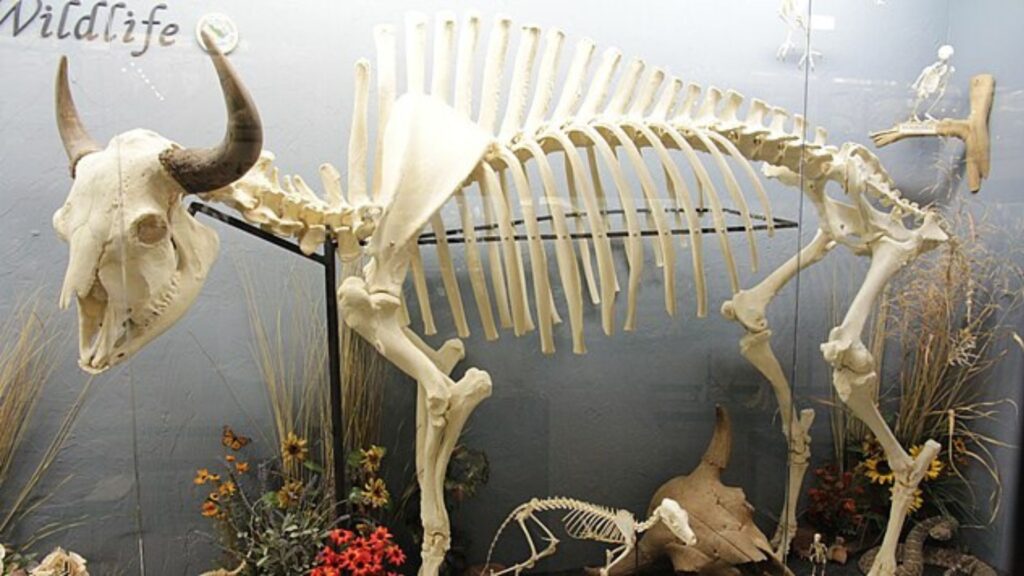
In the summer of 1927, excavators made a groundbreaking discovery at the Folsom site. They found a stone spear point lodged directly between the ribs of an extinct Bison antiquus skeleton, preserved in its original position within the soil. At the time, most archaeologists and paleontologists believed people had only lived on the North American continent for about 4,000 years. Aleš Hrdlička, the foremost expert of the era, refused to accept human presence older than about 3,000 years, making this discovery controversial.
The spear point embedded in extinct bison ribs provided direct evidence that humans lived in the Southwest more than 11,000 years ago, pushing accepted timelines back over 7,000 years. The discovery revealed the Folsom culture, which existed between 11,000 and 10,000 BCE across a vast territory. Archaeological evidence shows the culture extended from central Canada to northeastern Mexico, covering much of what became the central United States and dominating the Great Plains region during this period.
Dating evidence places the Folsom site’s occupation between 10,800 and 10,200 BCE. Many archaeologists initially dismissed the findings, holding to theories influenced by biblical beliefs that the world was created 6,000 years ago. Figgins and Cook faced significant resistance, excluded from seven academic symposiums on ancient North America over the following decade. William Henry Holmes at the Smithsonian Institution created an intimidating environment for scientists who challenged the established 3,000-year timeline for human presence in the Americas.
Fluted Spear Points and Strategic Hunting Techniques

The Folsom people specialized in hunting Bison antiquus using distinctive fluted spear points that represented an advancement over the preceding Clovis culture’s technology. These spearheads featured a groove etched down the center from top to bottom, creating sharper weapons. Archaeological sites contain numerous failed attempts at crafting these points, revealing how Folsom craftspeople refined their techniques through experimentation. The flint selected was higher quality and worked with greater precision than earlier tools, according to artifacts recovered from settlements across the region.
Folsom hunters employed coordinated group strategies to take down large numbers of bison simultaneously. They drove herds into narrow valleys where additional clan members positioned themselves on elevated terrain. As bison entered the confined space, hunters attacked from above with spears and rocks, enabling substantial kills from individual hunts. The Cooper Bison Kill Site in Harper County, Oklahoma, shows evidence of use during two or three separate hunts, with each event yielding between 20 and 30 animals.
At the Cooper site, archaeologists found one bison skull painted with red zigzag patterns across the cranium, suggesting the location may have held ritual significance for Folsom communities. Beyond spears, the Folsom people created knives and scrapers from flint for processing food, preparing animal carcasses, cutting wood, and fashioning additional tools. When flint was scarce, they turned to stone and bone for tool construction. Some stone and bone implements were colored with primitive paints made from ochre, possibly indicating ritual use or personal decoration.
The Culture’s Mysterious Disappearance by 8,000 BCE

The Folsom people organized themselves into small communities, typically composed of several families grouped together for manageable feeding and shelter during the harsh winter months. Archaeological evidence suggests up to five families totaling 25 to 30 people occupied individual villages. Despite living in separate communities, neighboring groups maintained regular communication. When bison herds appeared in the region, multiple tribes or clans coordinated their efforts to hunt together, dividing the rewards among participating communities for collective benefit.
The Folsom people inhabited a landscape vastly different from the modern Great Plains. Their world featured rolling hills, expansive grasslands, arid deserts, and wooded areas rich with resources. Rivers teemed with fish while bird populations filled the skies. They encountered numerous extinct megafauna species, including mammoths and ground sloths that have since disappeared. Archaeologists believe the Folsom culture developed from the earlier Clovis culture, with technological innovations in tool-making and hunting methods that rendered previous techniques less effective.
By 10,200 to 10,000 BCE, numerous Folsom sites show signs of abandonment, and by 8,000 BCE, archaeological evidence of the culture vanishes entirely. The emergence of newer technologies across the continent likely prompted communities to relocate and merge with other groups in different areas. The Folsom site became the first widely accepted proof of ancient human habitation in North America, triggering extensive archaeological interest in the Southwest and Pleistocene period that shapes research today.
PetsFanatic Team
Pet Care Expert & Content Creator
Passionate about sharing knowledge and tips for better pet care. Writing about everything from pet health to training techniques.