
Idaho Once Parachuted 76 Live Beavers Out of Airplanes for an Unexpected Mission

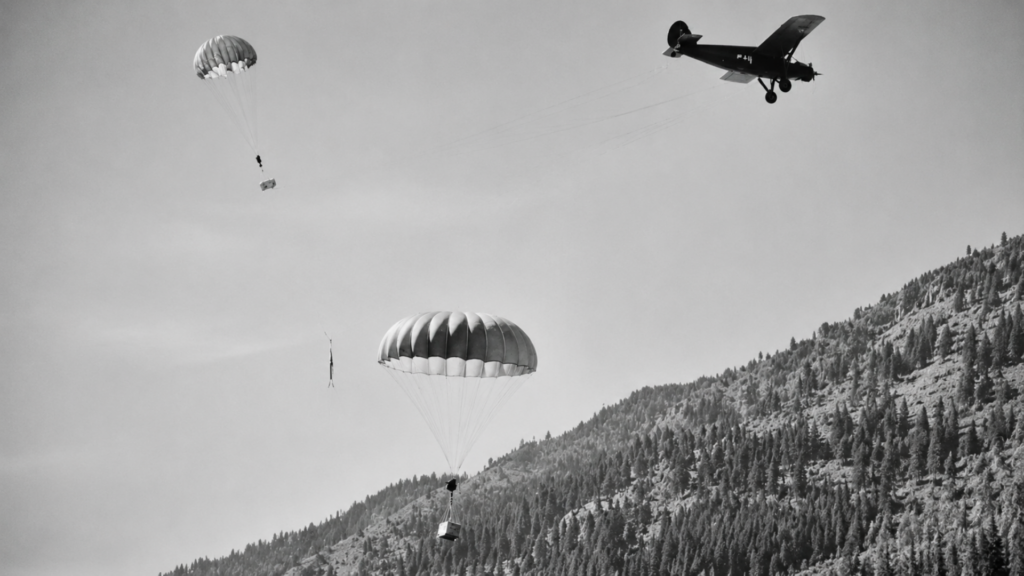
On August 14, 1948, a twin-engine Beechcraft aircraft lifted off over central Idaho carrying eight wooden crates, each holding a live beaver, and released them over a remote mountain wilderness. No roads reached the destination. No mules could make the trip in time. So the Idaho Department of Fish and Game did something no wildlife agency had ever done before or has done since: they parachuted the animals in. It was ridiculous. It worked.
Why Idaho Had a Beaver Problem in the First Place
After World War II, a housing boom pushed residents of Idaho’s cities into rural areas near Payette Lake and the town of McCall. Those areas already had established beaver populations. The new arrivals quickly found themselves dealing with flooded fields, plugged culverts, toppled trees, and damaged orchards. Wildlife officials were receiving consistent complaints from homeowners and farmers. But killing the beavers was not a preferred option. Relocation was the answer. Getting them somewhere remote enough was the problem.
Beavers Are Worth Protecting. Here Is Why.

North American beavers are considered ecosystem engineers. Their dams create wetlands that improve water quality, prevent erosion, stabilize local water supplies, and provide habitat for fish and birds. By 1900, centuries of heavy trapping during the fur trade had reduced the continental beaver population to roughly 100,000 individuals. According to the U.S. Department of the Interior, relocating a single beaver in the late 1940s cost between $7 and $8, while the environmental benefits that beaver created over its lifetime were valued at approximately $300.
The Old Way Was Not Working. At All.

Before parachutes entered the picture, wildlife officials tried moving beavers by truck and pack mule across steep Idaho wilderness. The trips took multiple days. Beavers overheated in their crates and had to be regularly soaked to prevent illness. They refused to eat and suffered severe stress. Many did not survive the journey. In a 1950 report for the Journal of Wildlife Management, Idaho Fish and Game employee Elmo W. Heter wrote that horses and mules became “spooky and quarrelsome” when loaded with struggling, odorous beavers. A better method was clearly necessary.
The Man Who Designed the Parachute Box

Elmo W. Heter, an Idaho Fish and Game employee, proposed the aerial solution and designed the delivery system himself. His first prototype, woven from willow branches, was quickly scrapped after he realized a stressed beaver could simply chew through the sides during flight. The final version resembled a wooden suitcase fitted with ventilation holes, heavy elastic cords, and a rope harness that kept the crate shut during descent. When the box hit the ground and the parachute collapsed, the tension on the cords released automatically and the crate sprang open.
Geronimo the Beaver Tested the Box Repeatedly and Kept Getting Back In

Before any full-scale deployment, Heter ran live animal trials using an older male beaver the team nicknamed Geronimo. Geronimo was dropped multiple times on a flying field as crews observed the box’s performance from each flight. According to reporting by Popular Science and the A-Z Animals account sourced from Heter’s original records, Geronimo reportedly became so accustomed to the process that after each landing he would calmly climb back into his crate, as if ready to go again. Once the trials confirmed the design worked, the team prepared 76 beavers for the full operation.
On August 14, 1948, the First Beavers Fell From the Sky

The first official mission launched on August 14, 1948. A Beechcraft aircraft carried eight beaver crates over the Chamberlain Basin and released them above remote mountain meadows. Geronimo was given what Heter described as a priority reservation on the historic first flight, dropped alongside three female companions into a valley officials reportedly called a beaver paradise. By the end of the full operation, 76 beavers had been parachuted into the wilderness. Remarkably, 75 of them survived. The one fatality occurred when an agitated beaver partially escaped its crate in midair and fell before the box reached the ground.
Within Two Weeks, the Beavers Were Already Building Dams

The mission was declared a success almost immediately. According to newspaper reports from the time, within two weeks of the initial drop, Idaho Fish and Game officials were already observing signs of dam-building activity in the landing area. By 1949, officials confirmed that the relocated beavers, nicknamed “Parabeavers” by Popular Mechanics magazine, had successfully built dams, established lodges, and started reproducing in the basin. The estimated cost of dropping four beavers by parachute in 1948 was approximately $30, equivalent to roughly $388 in today’s dollars, according to Boise State Public Radio.
The Footage Was Lost for Decades and Found by Accident

Idaho Fish and Game had filmed the entire operation, but the footage disappeared for decades. In 2014, historian Sharon Clark, who had spent six years searching for a rumored government film called Fur for the Future, received a call from archivist Michal Davidson at the Idaho State Archives. Davidson had found the mislabeled film canister. Once the footage was digitized and uploaded online in 2015, the story of the parachuting beavers went viral. National Geographic covered it, and the Great Beaver Drop became one of the more celebrated oddities in American conservation history.
The Descendants of Those 75 Beavers Still Live in Idaho Today

The aerial relocation program was short-lived because it achieved its goals quickly. Modern wildlife management has since moved to helicopters and non-lethal tools like beaver bafflers, piping systems that manage flooding without requiring the animals to be moved at all. But the descendants of the 75 beavers who survived that 1948 drop still live in the Frank Church-River of No Return Wilderness. In 2025, the Boise Hawks baseball team temporarily rebranded as the Boise Battle Beavers to honor the operation. Few conservation experiments have ever sounded more absurd or delivered more lasting results.
PetsFanatic Team
Pet Care Expert & Content Creator
Passionate about sharing knowledge and tips for better pet care. Writing about everything from pet health to training techniques.