
How Europe’s Most Ancient Genomes Uncover a Forgotten Chapter of Human Evolution

Some 45,000 years ago, a small band of humans moved across Ice Age Europe’s tundra, their dark skin warmed by fur-lined cloaks. They hunted woolly rhinos, fashioned distinctive stone tools, and perhaps exchanged stories around fires in caves. Fossilized remains unearthed in Germany and the Czech Republic have revealed the oldest modern human genomes yet found in Europe. These ancient ancestors left no genetic mark on people alive today, their lineage ending without descendants.
Six Family Members Were Discovered in a German Cave
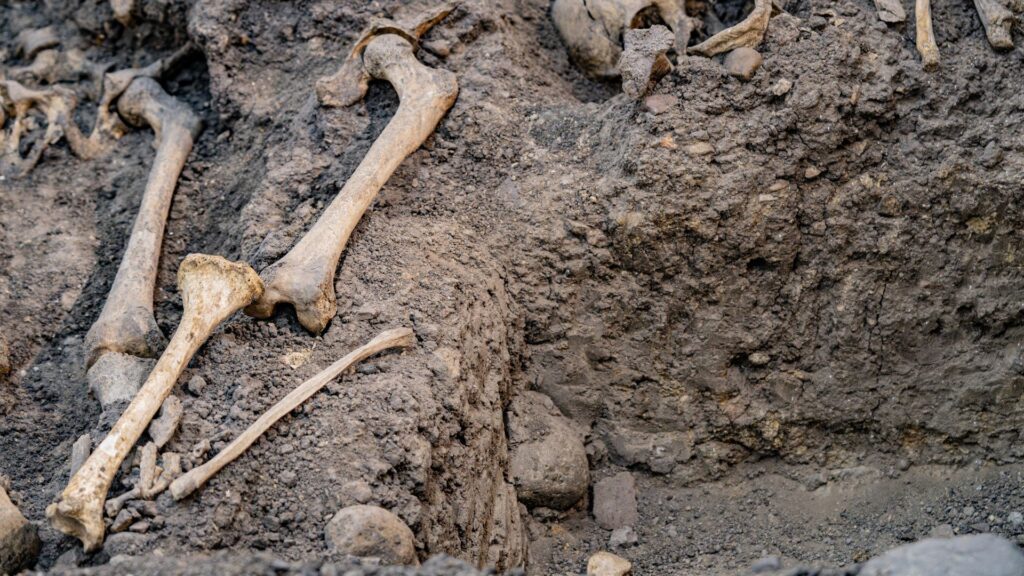
In Ranis, Germany, archaeologists recovered bone fragments belonging to six individuals, a family that included a mother, her daughter, and distant cousins. Researchers at the Max Planck Institute for Evolutionary Anthropology sequenced the remains, which date back 45,000 years. The individuals belonged to a cultural group known as the Lincombian-Ranisian-Jerzmanowician, or LRJ. About 230 kilometers away, scientists also sequenced DNA from an ancient woman’s skull found at Zlatý kůň, Czech Republic, and discovered these groups were related.
The Two Groups Were Part of the Same Extended Family

The people from Ranis and Zlatý kůň shared genetic connections across the 230-kilometer distance. “It’s the same group, the same extended family,” said Johannes Krause, a geneticist at the Max Planck Institute, to the NY Times. “It could be that they knew each other.” These families were few in number, perhaps only hundreds roaming across the vast, inhospitable landscape. Their genetic uniformity hints at isolation in a sparse population struggling to survive Europe’s harsh conditions.
The Population Was Remarkably Small and Genetically Close
Kay Prüfer, a paleogeneticist and co-author of the study, explained the genetic closeness. “If I were to go to New York and just take one person from the Bronx and then go over to Long Island and take another person from there, it would be unlikely that these two have a common ancestor within the last three generations,” Prüfer said. “But, of course, we are talking about the deep past, when things were different.” The tiny population faced extinction pressures.
They Had Dark Skin Despite Living in Europe

Unlike Europeans today, the LRJ people did not carry genes for pale skin. Their skin remained dark, a trait inherited from their African ancestors. Although the lineage survived a trip out of Africa and several generations in Europe’s harsh wilderness, their time was short-lived. Their line eventually disappeared, and their DNA left no mark on modern populations. This genetic dead end stands in contrast to other migration waves that successfully established lasting populations across the continent.
They Carried Neanderthal DNA From Recent Interbreeding

The ancient genomes reveal a connection with Neanderthals. The LRJ people carried long stretches of Neanderthal DNA, suggesting their ancestors had interbred with Neanderthals only 1,000 to 2,500 years earlier, about 46,000 years ago. Researchers at the Max Planck Institute for Evolutionary Anthropology and UC Berkeley showed that Neanderthal and Homo sapiens interbreeding lasted for an estimated 7,000 years. This timing narrows the window for when humans moved from the Middle East into Europe, offering precise dates for ancient migration.
The Interbreeding Occurred in Multiple Waves Over Millennia

Another recent study suggests that modern humans and Neanderthals interbred in multiple waves spanning nearly 200,000 years. “It was really fantastic to see a similar date,” said Priya Moorjani, a paleogeneticist at the University of California, Berkeley, who co-authored a related study. While the LRJ people carried Neanderthal ancestry, they did not pass their own DNA to future generations. Their extinction mirrors the fate of the Neanderthals, who vanished around 40,000 years ago.
Not All Human Migration Waves Survived

The discovery reshapes understanding of human migration. While modern humans reached Australia 65,000 years ago and possibly China 100,000 years ago, the LRJ people represent a late wave into Europe. Many such waves probably occurred during humanity’s history of migration out of Africa, and some groups were more resilient than others. “It’s kind of interesting to see that human story is not always a story of success,” Krause told CNN.
Earlier Discoveries Show an Even Longer History

The complexity of human dispersal was highlighted in August 2025, when scientists at Tel Aviv University analyzed remains of a five-year-old child from Skhul Cave in Israel. Dating back 140,000 years, the child possessed both Neanderthal and modern human traits, proving that the vanishing European branch was just one late chapter in a much longer saga. These genomes are the oldest yet found of modern humans in Europe, though a 1.4-million-year-old fossil ancestor discovered in Spain in March 2025 proves hominins visited long before.
Survival Required More Than Adaptation Alone

The revelations highlight how fragile survival was for early humans navigating Ice Age Europe. The LRJ people survived nearly 80 generations across the frozen landscape before their lineage ended without descendants. Small populations faced extinction pressures, even as others thrived and eventually populated the globe. Some paths vanished in the cold, while others blazed forward, shaping the world today. The findings, published in the journal Nature, show that survival required both adaptation and circumstance.
PetsFanatic Team
Pet Care Expert & Content Creator
Passionate about sharing knowledge and tips for better pet care. Writing about everything from pet health to training techniques.