
Beachgoers Spot ‘Sea Serpent’ Near Cabo But the Truth Behind Creature Stuns Everyone
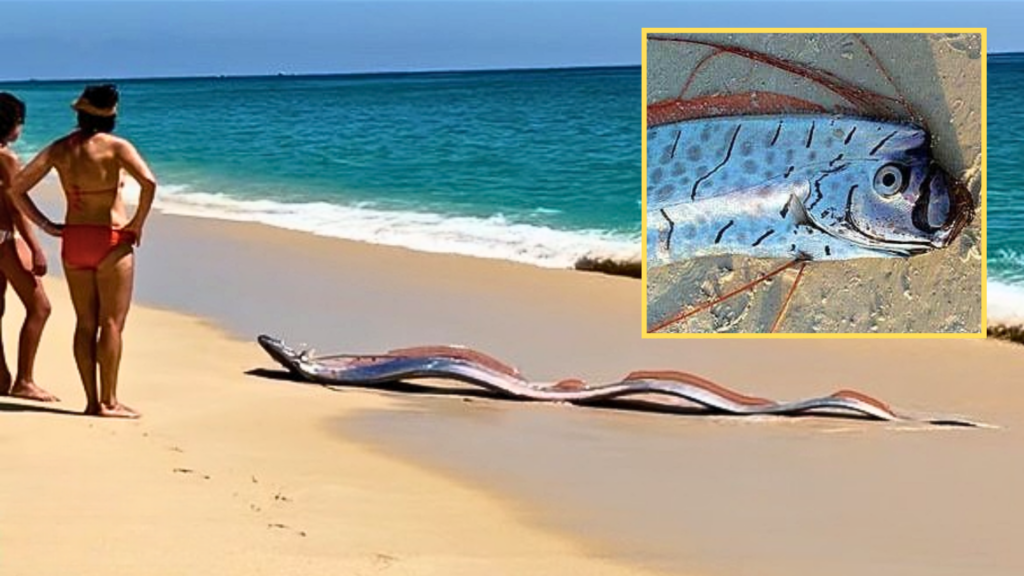
A typical morning stroll on a Cabo San Lucas beach turned into a scene from ancient mythology when a pair of massive, shimmering creatures emerged from the surf. For most tourists in Baja California Sur, the day involves looking for shells, not legendary beasts. But sisters Monica and Katie Pittenger captured viral footage on March 4, 2026, of what appeared to be living sea serpents writhing in the shallow water. The animals, characterized by metallic silver skin and crimson, ribbon-like fins, were quickly identified as giant oarfish (Regalecus glesne). These deep-sea titans can grow up to 30 feet long and are so rarely seen alive that a simultaneous sighting of two individuals on a public beach is considered a historic biological event.
The Prophet of Doom

While marine biologists were stunned by the scientific significance of the sighting, social media immediately ignited with a darker interpretation. In Japanese folklore, the oarfish is known as Ryugu no Tsukai, or the Messenger from the Sea God’s Palace, and it carries a chilling reputation as the Doomsday Fish. Superstition holds that these deep-dwellers only rise to the surface to warn of imminent natural disasters, specifically powerful earthquakes and tsunamis. This belief gained global traction in 2011 when multiple oarfish washed ashore in Japan just months before the catastrophic Tōhoku earthquake and subsequent tsunami, fusing the image of the silver giant with the fear of tectonic catastrophe.
The Race Against the Surf

The initial shock of seeing a sea serpent was quickly replaced by a rescue effort. Oarfish are mesopelagic creatures, typically living in the twilight zone nearly 3,000 feet below the surface. They possess very little muscle mass and lack scales, making them extremely delicate and ill-equipped for the turbulent, high-oxygen environment of a shoreline. Realizing the magnificent animals were struggling and likely to die, the Pittenger sisters and other bystanders rushed into the waves. They heroically worked to push the massive, slippery bodies back toward the deeper waters of the Sea of Cortez, demonstrating that empathy can override fear, even in the face of a legendary Apocalypse Fish.
The Science of the Shimmer

Physically, the giant oarfish is the longest bony fish in existence, a biological marvel perfectly adapted for the abyssal depths. Its silver, mirror-like appearance comes from a coating of guanine, as it lacks the standard scales of shallow-water fish. Grounding the story in concrete reality, the rare live footage from Cabo offers scientists a unique opportunity to study the animal’s mesmerizing, undulating swimming motion. Because they are rarely seen alive, most of our knowledge comes from dead specimens. The fact that two live oarfish were found together suggests a shared environmental trigger, potentially a sudden shift in deep-sea currents or a toxic upwelling event, rather than a mythical message of doom.
Debunking the Earthquake Connection

Despite the persistent “Doomsday Fish” moniker and the unsettling Tōhoku coincidence, modern seismology and marine biology find no scientific basis for the earthquake prediction theory. The belief likely stems from confirmation bias; when a rare fish appears and a disaster follows, people connect the dots, ignoring the many times oarfish have appeared without a subsequent quake. Experts emphasize that oarfish rise to the surface when they are injured, disoriented by storms, or suffering from parasitic infections. The “Messengers from the Sea God” are far more likely to be victims of oceanic volatility than prophets of geological destruction.
Fear Goes Viral in Los Cabos

The shift from a rare biological anomaly to a doomsday omen has had a massive ripple effect on Cabo’s vital tourism industry. In the Wild West of social media, the rescue footage was quickly weaponized into a narrative of impending disaster. This created a worry for travelers planning spring vacations, leading to a spike in search terms like “Cabo earthquake probability.” Local officials and travel bureaus, including the Cabo Sun, move swiftly to reassure tourists that there is absolutely no reason to panic or cancel trips. The true conflict here is not between tectonic plates, but between ancient folklore and modern tourism economics.
Indicators of an Oceanic Bankruptcy

While scientists debunk the earthquake warning, they are deeply worried about what the oarfish appearance actually signals regarding deep-ocean health. The mesopelagic zone is increasingly stressed by microplastic pollution, rising deep-water temperatures, and noise pollution from shipping and resource exploration. The oarfish may not be warning us of a geological shift, but they might be reflecting a broader pattern of environmental decline. These rare sightings are an alarm bell that the deep sea, once thought to be pristine and isolated, is suffering its own form of “oceanic bankruptcy,” driving its most specialized residents to a surface they cannot survive.
The “Canary in the Coal Mine”

The encounter in Cabo has successfully doused the world in a renewed interest in deep-sea conservation. Biologists view the oarfish as the ultimate “canary in the coal mine” for the mesopelagic zone. Every live sighting provides precious data on a species that is vital to the ocean’s nutrient cycle. While we may never know if the two rescued individuals survived their ordeal, their appearance has created an urgency to understand and protect the abyssal plains. This is a final statement on the interconnectivity of the ocean; what happens in the twilight zone eventually washes up on our vacation beaches.
A Message of Empathy

The story of the 2026 Cabo sighting is not one of doom, but of hope. Two sisters stood on a beach and faced a creature that sailors once feared as a sea serpent, a being that culture had branded as a harbinger of death. Instead of running, they chose empathy. By fighting the surf to save the “Doomsday Fish,” they rewrote the narrative from superstition to stewardship. Their act proves that we can choose to react to the mysteries of the natural world not with panic, but with a desire to help, learn, and coexist.
The Unwritten Future

As the two silver giants disappeared back into the depths of the Sea of Cortez, they left behind an enduring mystery. The Messenger from the Sea God will always carry its folklore, but its true message is one we are still deciphering. The Apocalypse Fish didn’t bring an earthquake to Cabo, but it did bring a powerful, quotable warning that our oceans are changing rapidly. Whether these rare encounters remain terrifying omens or become catalysts for conservation is up to us. The next time you walk along a beach and see a silver flash in the water, remember: it might just be the Messenger, and it’s our job to decide what the message truly means.
PetsFanatic Team
Pet Care Expert & Content Creator
Passionate about sharing knowledge and tips for better pet care. Writing about everything from pet health to training techniques.