
Geologists Solve 150-Year Mystery of Why Green River Flows ‘Uphill’ Through Mountains

Rivers naturally flow downhill. They descend from mountain peaks toward the ocean, winding around obstacles rather than plowing straight through them. Yet Utah’s Green River defies this basic principle. Instead of skirting the towering Uinta Mountains, the waterway slices directly through their heart, carving a dramatic 2,296-foot gorge. Scientists have puzzled over this geological oddity for a century and a half, unable to explain how a river would choose such an improbable route.
The timeline makes the mystery even stranger. When the Uintas thrust skyward roughly 50 million years ago, the Green River didn’t yet exist. The waterway only began flowing along its current trajectory sometime within the last eight million years, meaning it carved through rock that predates it by tens of millions of years. Spanning 730 miles from Wyoming through Utah and Colorado before merging with the Colorado River, the Green seemingly ignored easier pathways around these ancient peaks.
An international research team led by Dr. Adam Smith from the University of Glasgow’s School of Geographical & Earth Sciences may finally have the answer. Publishing their findings in the Journal of Geophysical Research: Earth Surface, the scientists propose that deep underground forces temporarily warped the landscape itself. Using seismic imaging combined with geological modeling, they discovered evidence that Earth’s crust beneath the mountains sagged downward like heated wax before slowly rising again across millions of years.
Dense Rock Layers Sank Deep Into Earth’s Mantle

The researchers looked at a geological phenomenon called lithospheric dripping. Dense minerals collect at the base of Earth’s crust beneath mountain ranges and grow heavier over time. As this material builds up, it eventually gets massive enough to sink into the softer mantle below. The descending mass drags the land above it downward, lowering entire mountains. When the dense material finally breaks away and keeps falling, the mountains bounce back up. This leaves a distinctive circular pattern in the surrounding terrain.
Smith’s team examined seismic imaging data from beneath the Uintas. This technology tracks how earthquake waves travel through different rock types, revealing hidden structures deep within our planet. About 125 miles down, they spotted something remarkable. A cold, circular anomaly measuring 22 to 31 miles across appeared in the data. The researchers interpret this as a relic piece of ancient lithosphere that broke away millions of years ago and continues its slow descent through the mantle.
Multiple lines of evidence back up this idea. The terrain around the Uinta Mountains shows a circular pattern of uplift. Lithospheric dripping leaves this signature fingerprint behind. Measurements also showed that the crust underneath these peaks is much thinner than expected for mountains this tall. The missing rock accounts for about 1,312 feet of elevation difference. Based on where the drip is now and how fast it’s sinking, scientists estimate it broke away 2 to 5 million years ago.
Water Carved Deeper as Land Slowly Rose Beneath It

The evidence dismantles alternative theories that geologists have debated for decades. The river didn’t predate the mountain range. Sediments didn’t pile high enough to let water overflow the peaks. Erosion from neighboring valleys didn’t capture and redirect the Green’s flow. Instead, lithospheric dripping temporarily lowered the Uinta barrier, creating a brief geological window when water could establish a channel across terrain that stood substantially lower than today’s towering peaks.
Once the heavy mineral mass broke free, the mountains began their gradual rebound. But the river maintained its course. Water had already etched channels and pathways into the bedrock. Rather than abandoning its established route to seek an easier way around the rising terrain, the Green simply kept cutting downward at the same pace the land rose upward. Over millions of years, this persistent erosion created today’s spectacular canyon, slicing through the range.
This puzzle was tough to crack because the region lacks active tectonic forces, and major geological events are rare here. Lithospheric dripping is still a relatively new concept in Earth sciences, which makes it harder to spot. Smith and his team have now gathered enough evidence to show that lithospheric drip pulled the land down enough to let the rivers connect. Their findings answer questions scientists have been asking since the 1870s.
The River Merger Changed North America’s Continental Divide
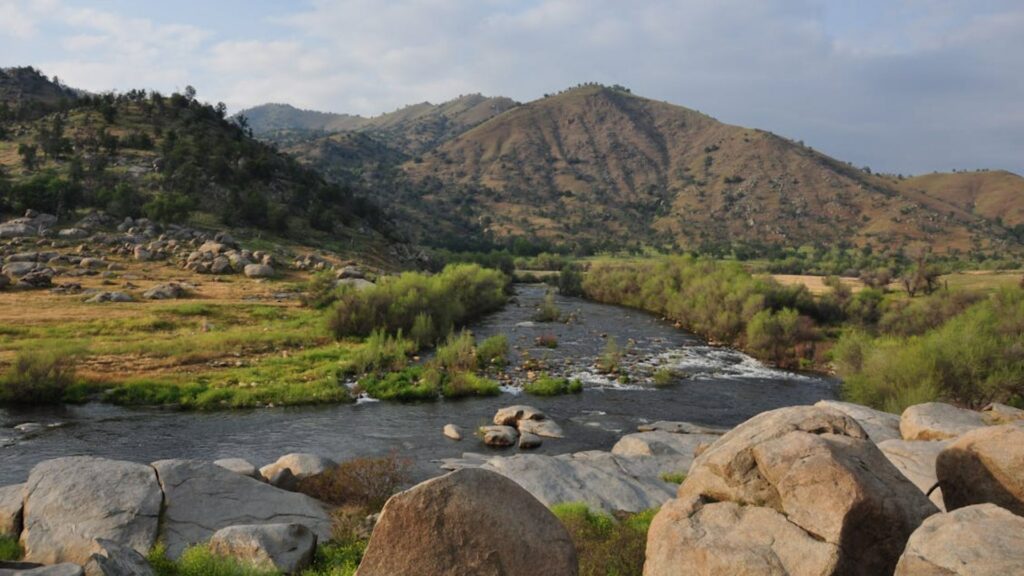
When the Green River punched through the Uinta Mountains and joined the Colorado River several million years ago, it completely reshaped North American geography. Smith explained that the merger changed the continental divide, creating the boundary that separates rivers flowing into the Pacific from those draining into the Atlantic. This proved hugely important for the continent and also created new habitat boundaries for wildlife, shaping how animal populations evolved and spread across the region.
Beyond solving this regional mystery, the research has broader value. The team thinks their work gives other scientists a template for studying puzzling geological features around the world. Lithospheric dripping might explain landscape quirks in tectonically quiet regions where standard theories about mountain formation and river development don’t match what we see. Understanding these slow processes helps scientists piece together how Earth’s surface has changed over millions of years.
The study relied on major advances in seismic imaging and geological modeling that let researchers look miles beneath Earth’s surface and piece together events from millions of years ago. By combining seismic data with measurements of crustal thickness and calculations of how terrain bounces back after dripping, the team built a strong case for why the Green River takes its strange route through the ancient mountain range.
PetsFanatic Team
Pet Care Expert & Content Creator
Passionate about sharing knowledge and tips for better pet care. Writing about everything from pet health to training techniques.