
Record Sargassum Surge Clogs Florida Beaches As Scientists Track Climate Links

Every spring, a thick belt of brown floating seaweed drifts west across the Atlantic and begins washing onto Florida’s shores. In January 2026, the University of South Florida reported that the total mass of sargassum across the Atlantic, Caribbean, and Gulf of Mexico had already reached 9.5 million metric tons, with most regions setting records for that time of year. By February, the total had exceeded 10 million metric tons. USF researchers described 2026 as “very likely another major sargassum year.” For beachgoers in Miami, the Florida Keys, and communities across the Caribbean, the message was straightforward: what is coming could be the largest marine seaweed invasion ever recorded.
What Sargassum Is and Why It Matters
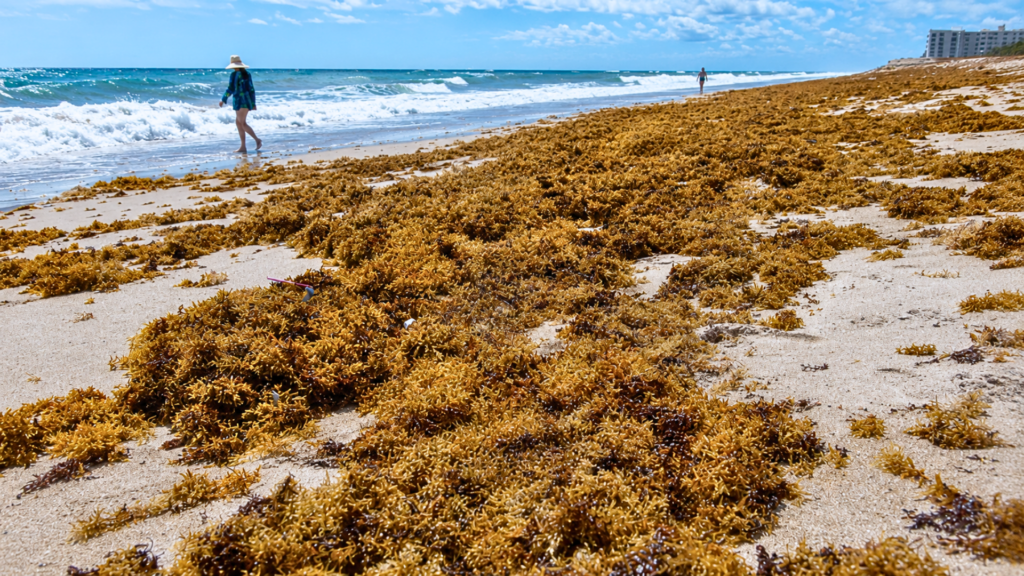
Sargassum is a genus of free-floating brown seaweed that originates primarily in the Sargasso Sea, a region of the North Atlantic. In the open ocean it plays a critical role as habitat, providing shelter and feeding grounds for sea turtles, juvenile fish, crabs, and hundreds of other marine species. NOAA classifies sargassum as a critical marine habitat, which means it cannot be removed from the water until it has already washed ashore. The problem begins when massive quantities reach the coast, rot in the heat, and release hydrogen sulfide gas, producing a smell described as rotten eggs. Once stranded, the mush degrades water quality, damages coral reefs and seagrass beds, and renders beaches unusable for swimmers and tourists.
The Great Atlantic Sargassum Belt Did Not Always Exist

Before 2011, sargassum stayed largely within the Sargasso Sea and caused no significant problems for Florida or the Caribbean. Then something changed. A continuous band of sargassum began forming each year across the tropical Atlantic from the coast of West Africa to the Caribbean Sea and Gulf of Mexico. Researchers named it the Great Atlantic Sargassum Belt. By 2022, it had reached 19 million metric tons during its peak season. By July 2025, USF estimated the belt at 38 million metric tons, double the 2022 record. The speed of the growth over just 15 years has led researchers at USF’s College of Marine Science to describe it as posing challenges on a hemispheric scale for marine ecosystems and coastal communities.
What Is Fueling the Explosion

The cause of the Great Atlantic Sargassum Belt is not simple and remains a subject of active scientific debate. Scientists at Florida Atlantic University’s Harbor Branch Oceanographic Institute have tracked four decades of sargassum changes and identified a combination of contributing factors. Warmer ocean temperatures accelerate growth. Altered ocean currents driven by climate change spread the seaweed into new regions. Nutrient runoff from major rivers, including the Amazon, Mississippi, and Orinoco, provides nitrogen and phosphorus that feed sargassum blooms. A 2021 study found nitrogen concentrations in sargassum were 35 percent higher than samples collected 30 years earlier, suggesting that agricultural and sewage runoff may be playing a significant role alongside warming temperatures.
The Cause Debate Is Still Evolving

A landmark study published in Nature Geoscience in 2025 introduced a new variable into the debate. Researchers found that equatorial upwelling of phosphorus from the deep ocean may be a primary driver of the blooms, challenging earlier theories that had focused primarily on Amazon River discharge. A separate study published the same year found that ocean current changes rather than riverine nutrients may better explain the growth pattern since 2011. The science is actively evolving, and no single factor has been confirmed as the dominant cause. What is consistent across all current research is that human activity, whether through greenhouse gas emissions, land use, or agricultural runoff, appears to be amplifying conditions that allow sargassum to grow and spread at an accelerated rate.
Dr. Chuanmin Hu’s Warning to Florida

Dr. Chuanmin Hu, a professor of oceanography at the University of South Florida who leads the USF Sargassum Watch System in partnership with NOAA, has been one of the most direct voices about the current trajectory. He told the Miami Herald that what is scary to him as a scientist is that more historical records keep being broken. His team uses satellite imagery combined with transport models to track sargassum in near real time and produce seasonal forecasts. The January 2026 satellite data showed some of the largest sargassum masses ever recorded for that month. His team cautioned that variable factors including ocean currents and winds still make it difficult to predict exactly where and how much seaweed will ultimately make landfall in any given season.
The Cost to Florida’s Economy and Communities
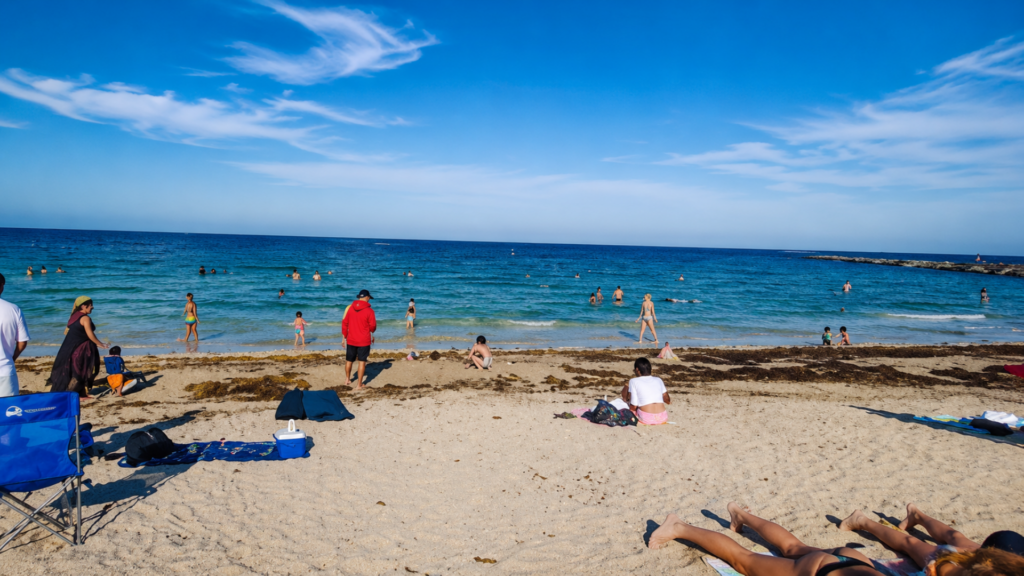
Cleaning up sargassum is expensive and logistically difficult. Miami-Dade and Broward counties both have plans in place to rake and mix seaweed along the coast, with material typically taken to landfills. The Environmental Protection Agency has put the annual economic cost of sargassum to U.S. businesses and governments in the millions of dollars. Tourism revenue suffers when beaches become impassable, particularly during peak spring and summer travel seasons. The Florida Department of Health in St. Johns County recommends that people avoid touching sargassum and use gloves if handling is necessary. The Mexican Navy has deployed sargassum-collection ships and containment barriers daily to address early 2026 arrivals in Caribbean waters before they reach U.S. shores.
The Ecological Stakes Go Beyond Dirty Beaches

The impact of sargassum on marine ecosystems extends well beyond the tourist experience. When massive quantities wash ashore and decompose in shallow coastal waters, they deplete oxygen levels and can suffocate seagrass beds and coral reefs. Sea turtle nesting is directly affected, as turtles struggle to navigate thick mats of beached sargassum when coming ashore to lay eggs. The same seaweed that provides critical open-ocean habitat for hundreds of species becomes an ecological threat when it arrives in quantities that coastal environments are not equipped to absorb. Research from USF has incorporated sargassum vulnerability into updated coastal risk assessment models, recognizing that the seaweed itself now represents a quantifiable threat to shoreline ecosystem health.
What Comes Next for Florida

USF’s forecast suggests that sargassum will arrive in the Florida Keys first, followed by Broward and Miami-Dade County beaches in April or May 2026. That timeline aligns with the annual pattern of the Great Atlantic Sargassum Belt moving westward on ocean currents. Whether the 2026 season surpasses previous records will depend significantly on wind and current patterns that researchers cannot fully predict months in advance. What is already clear is that the volume of sargassum in the Atlantic in early 2026 is at or near record levels for this point in the season, and USF has explicitly described continued growth as the expected trajectory. For Florida beach communities, the question is not whether sargassum will arrive but how much of it will.
A Seasonal Nuisance Has Become a Permanent Crisis

Before 2011, Florida’s sargassum problem was manageable and largely unremarkable. Within 15 years, it has grown into a hemispheric-scale ecological and economic challenge with no clear resolution in sight. The science linking its expansion to warming oceans, altered currents, and nutrient pollution is strong enough that researchers at multiple institutions have described the current trend as likely to continue. What began as a curiosity for oceanographers has become a recurring disruption to Florida’s beaches, economy, and marine ecosystems. Addressing it meaningfully would require reducing the nutrient inputs and warming temperatures driving the growth. That is a goal that extends far beyond any county rake-and-remove operation on a South Florida beach.
PetsFanatic Team
Pet Care Expert & Content Creator
Passionate about sharing knowledge and tips for better pet care. Writing about everything from pet health to training techniques.