
Europa’s Ice May Be Sliding Into Its Ocean in a Way Scientists Didn’t Expect

Europa has fascinated planetary scientists for decades, largely because beneath its frozen exterior lies a vast, global ocean of salty water. Recent research suggests that this moon may have a previously overlooked way of sending crucial chemical ingredients from its surface down into that hidden ocean. If confirmed, this process could help resolve one of the biggest questions surrounding Europa, how a dark, oxygen-poor ocean could still support life.
Unlike Earth, Europa’s ocean is sealed beneath kilometers of ice and receives no sunlight, making photosynthesis impossible. Any potential organisms would need to rely on chemical energy instead. Scientists have long known that Jupiter’s intense radiation creates oxidants on Europa’s surface, compounds that could act as an energy source for life. The challenge has been explaining how those surface materials could cross the thick ice shell to reach the ocean below.
New findings point toward a slow but persistent geological mechanism that may be doing exactly that. Rather than requiring dramatic fractures or violent events, this process could quietly transport surface ice, along with its chemical cargo, downward over long periods of time, offering a steady link between the surface and the ocean beneath.
A Moon Shaped by Constant Motion

Europa’s surface is anything but static. Driven by the immense gravitational pull of Jupiter, the moon experiences constant stress that fractures and reshapes its icy crust. Observations from past missions reveal a landscape crisscrossed with ridges and disrupted terrain, clear signs of ongoing geological activity.
However, most of this motion appears to occur sideways rather than vertically. This horizontal movement limits how much material can naturally sink toward the ocean. Adding to the complexity, Europa’s upper ice layer is believed to behave like a rigid shell, often described as a stagnant lid, which further restricts vertical transport.
This combination has made it difficult to explain how oxidants produced at the surface could reach the ocean in meaningful amounts. Traditional explanations relied on rare, large-scale events, leaving open the possibility that Europa’s ocean might be chemically isolated for long stretches of time.
A Slow Drip Through the Ice
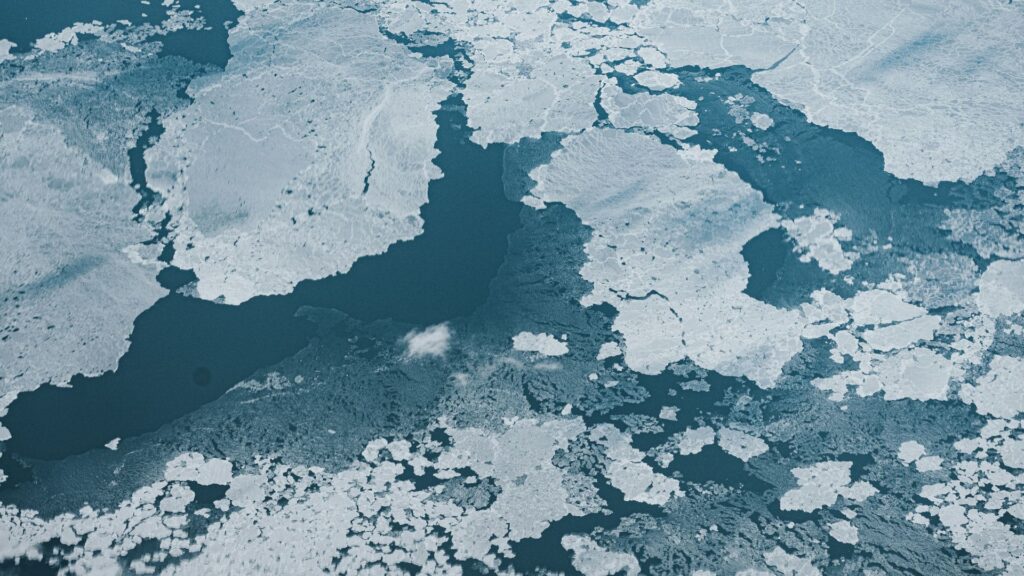
The new study proposes a different scenario. Using computer simulations, researchers found that ice near the surface can sometimes become enriched with salt. This salt-rich ice is both denser and mechanically weaker than the purer ice around it. Under the right conditions, these dense patches can gradually detach and sink downward through the ice shell.
This phenomenon, known as lithospheric foundering, is not entirely unfamiliar. On Earth, similar processes occur when parts of the planet’s outer layer slowly descend into the mantle. Applying this concept to Europa, the models suggest that surface material within a few hundred meters of the top layer can eventually make its way to the ocean below.
In some scenarios, this descent begins after millions of years, while in more weakened or damaged ice shells, the process can start in as little as tens of thousands of years. Importantly, the simulations showed that the mechanism works across a wide range of salt concentrations, as long as the ice experiences some degree of structural weakening.
Why This Matters for Life Beyond Earth

If this slow sinking process is active on Europa, it could provide a reliable pathway for delivering life-supporting chemicals to the ocean. That connection would help address a longstanding concern about the moon’s habitability, namely whether its ocean has access to enough chemical energy to sustain life.
The idea also reshapes how scientists think about icy worlds more broadly. Rather than being sealed off environments, moons like Europa may have subtle internal processes that continually refresh their oceans with surface materials, increasing their potential to host living systems.
Future observations will be crucial. NASA’s Europa Clipper mission, launched in 2024, is set to arrive in the Jupiter system in 2030. Over dozens of close flybys, the spacecraft will gather detailed data on Europa’s ice shell and ocean, helping researchers determine whether this newly proposed mechanism is truly at work. If it is, Europa’s hidden ocean may be even more promising than previously imagined.
PetsFanatic Team
Pet Care Expert & Content Creator
Passionate about sharing knowledge and tips for better pet care. Writing about everything from pet health to training techniques.