
Cave With Over 110,000 Spiders Is Home to a Web Unlike Any Other

Deep inside a dark, sulfur-filled cave on the border of Greece and Albania, scientists have uncovered what may be the largest spider web ever recorded, an enormous, almost surreal structure housing more than 110,000 spiders. The discovery, made in a place known as Sulfur Cave, has stunned researchers due to both its sheer size and the unusual behavior of the spiders living within it.
The web itself stretches across roughly 1,140 square feet, about half the size of a tennis court, and forms a dense, layered network that covers sections of the cave wall like a living blanket. Scientists describe it as a “megacity” of spiders, with thousands of interconnected webs forming a massive, unified structure unlike anything previously documented.
What makes the discovery even more remarkable is that it was found in near-total darkness, in an environment filled with sulfur gases that are toxic to most life. Despite these harsh conditions, the cave supports a thriving ecosystem, showing just how adaptable and resilient certain species can be when faced with extreme environments.
A Massive “Spider City” Built by Two Unlikely Species

The enormous web is not the work of a single species, but rather a collaboration between two very different spiders: Tegenaria domestica, commonly known as the barn funnel weaver, and Prinerigone vagans, a much smaller sheet weaver. Under normal circumstances, these species would not peacefully coexist, in fact, one would typically prey on the other.
Instead, inside this cave, the two species appear to live side by side in a rare form of cooperation, building and maintaining the giant web together. Scientists believe the unique conditions, particularly the lack of light and abundance of food, may reduce aggressive behavior, allowing the spiders to share space without conflict in a way that has never been observed before.
This unusual coexistence has intrigued researchers because it challenges long-held assumptions about spider behavior, which is typically solitary and territorial. The cave colony suggests that under the right environmental pressures, even species known for aggression can adapt to communal living, opening new questions about evolution and survival strategies.
How This Extreme Ecosystem Keeps 110,000 Spiders Alive

The survival of such a massive spider population depends on a surprisingly complex food chain that begins with sulfur-eating microbes living in the cave. These microorganisms support large populations of tiny insects, particularly midges, which thrive in the damp, chemical-rich environment and serve as the primary food source for the spiders.
Because the cave is isolated and completely dark, the spiders have adapted in unique ways, including potential changes in their behavior and even their genetics. Researchers have found evidence that these cave-dwelling populations are beginning to diverge from their surface-dwelling counterparts, suggesting that evolution may already be reshaping these species.
The density of the web also plays a key role in survival, allowing the spiders to efficiently capture large numbers of insects while maintaining a stable environment for reproduction. Scientists have observed significant egg-laying activity within the web, indicating that the colony is not only surviving but actively growing in this unusual underground habitat.
A Discovery That’s Changing What We Know About Spiders
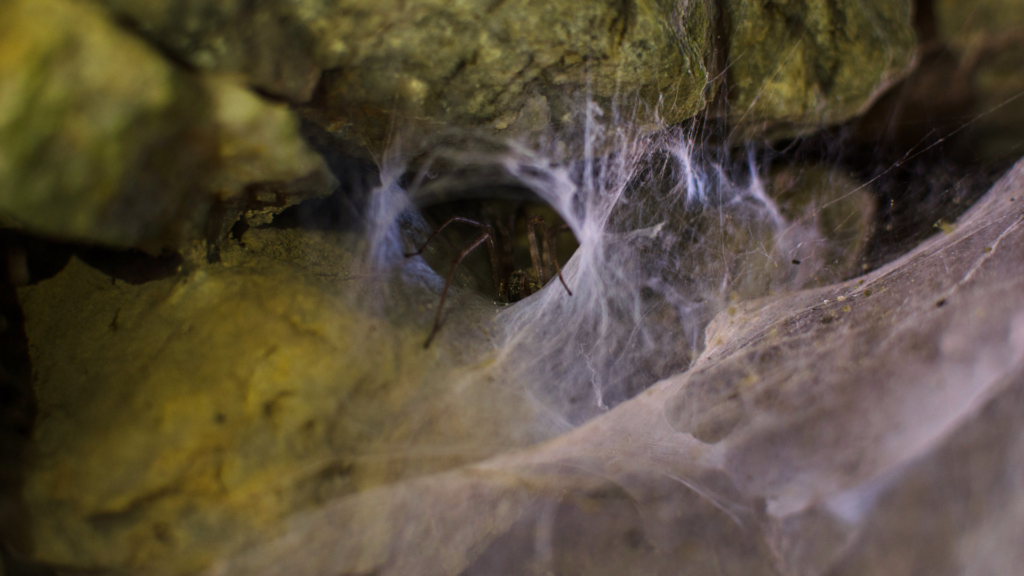
The discovery of this massive spider colony is more than just a curiosity, it’s a glimpse into how life can adapt in ways scientists never expected. From cooperative behavior between species to survival in toxic, lightless conditions, the cave challenges many assumptions about how ecosystems function.
Researchers say the site could offer valuable insights into evolution, ecology, and even how life might survive in extreme environments beyond Earth. The ability of these spiders to thrive under such conditions highlights the remarkable flexibility of life when faced with unusual challenges.
As studies continue, scientists hope to learn even more about how this “spider city” formed and how it might change over time. For now, it stands as one of the most astonishing natural discoveries in recent years, an underground world where over 110,000 spiders live together in a web unlike anything ever seen before.
PetsFanatic Team
Pet Care Expert & Content Creator
Passionate about sharing knowledge and tips for better pet care. Writing about everything from pet health to training techniques.