
Burial of the ‘First Christians’ Found Near Medieval Settlement

Archaeologists have uncovered around 20 skeletons dating back 1,000 years in the village of Borkowo, central Poland, near the remains of a circular stronghold from the ninth and tenth centuries. The discovery occurred during construction work for a gas pipeline by energy firm Polska Spółka Gazownictwa. The burials date to a transitional period when many people were converting from paganism to Christianity, and the deceased were laid to rest with grave goods including silver rings, carnelian beads, arrowheads, knife blades, and battle axes.
The Discovery Marks a Cultural Turning Point

The cemetery represents a time when Poland was adopting Christianity while pagan customs persisted. Lead archaeologist Piotr Alagierski described the period to Gazeta Wyborcza as “It’s a turning point, a complete cultural shift.” He explained that “there was already a belief that the bodies of the deceased could not be burned, that they had to be placed in a grave in an inhumation, but the pagan impulse to place weapons, gifts and ornaments with the body remained.” The find was reported to the provincial office for the protection of monuments.
Experts Debate Whether the Site Has Military Significance

The interpretation of the burial site has sparked disagreement among researchers. Some archaeologists involved in the excavations believe the cemetery has no military significance and represents an ordinary Christian burial ground where people were interred individually. However, Alagierski has speculated that the males buried at the site may have fallen in battle and could be connected to the armies of Duke Mieszko I, who ruled Poland from 960 to 992. The debate centers on whether physical evidence supports a military connection.
Physical Characteristics Suggest Elite Status

According to Alagierski’s observations reported in Notes from Poland, the male skeletons found at the burial site are much taller and more well-built than average for the period, while the female skeletons are of average size. One individual was buried with arrowheads, others with battle axes, and one skeleton’s bones showed signs typical of very regular horse riding. The presence of imported jewelry led Alagierski to conclude that “this was not an average community,” adding that “the entire warrior elite of the time lived at a very high standard.”
Silver May Point to Payment for Military Service

Silver and carnelian found in the graves may indicate elite status, as both materials were brought into Poland through trade networks during the medieval period. Mieszko I, who united Polish lands and created an independent state, established strongholds in many territories and recruited soldiers, whom he paid in silver, goods, and patronage to their families. The presence of silver in the graves could indicate an association with military service, though this interpretation remains contested among the archaeological team working on the site.
Other Researchers See an Ordinary Cemetery

Justyna Marchewka-Długońska, a researcher at Cardinal Stefan Wyszyński University in Warsaw and a member of the research team, offered a different interpretation in an interview with Live Science. “Historically, we do not yet know whether we can discuss any connections at all,” she said regarding potential links to Mieszko I. She and other archaeologists have stated that media claims about a mass burial containing warriors who served the duke are inaccurate, emphasizing instead that the people were buried in single graves within a cemetery.
The Burials Are Called Representatives of the First Christians

“We view these people as representatives of the ‘first Christians’ in these lands,” Marchewka-Długońska said. The characterization emphasizes the religious transition occurring in Poland during the tenth century rather than military significance. Even though people were converting from paganism to Christianity, they still placed grave goods in their burials, a practice more commonly done among pagans. This blending of traditions provides insight into how cultural and religious changes unfolded gradually rather than abruptly in medieval Poland.
Mass Burials From This Period Are Extremely Rare

If the site is confirmed as a mass burial, it would represent the first such discovery from this period in Poland and would be unique in Europe, according to Alagierski. “Mass burials from this period are practically nonexistent. We usually find individual remains. Here we have a complete scene,” he said. However, this characterization is precisely what other team members dispute, maintaining that the archaeological evidence shows individual graves rather than a mass burial, making the site significant but not unprecedented in the way initially suggested.
One Individual Shows Signs of Healed Trauma
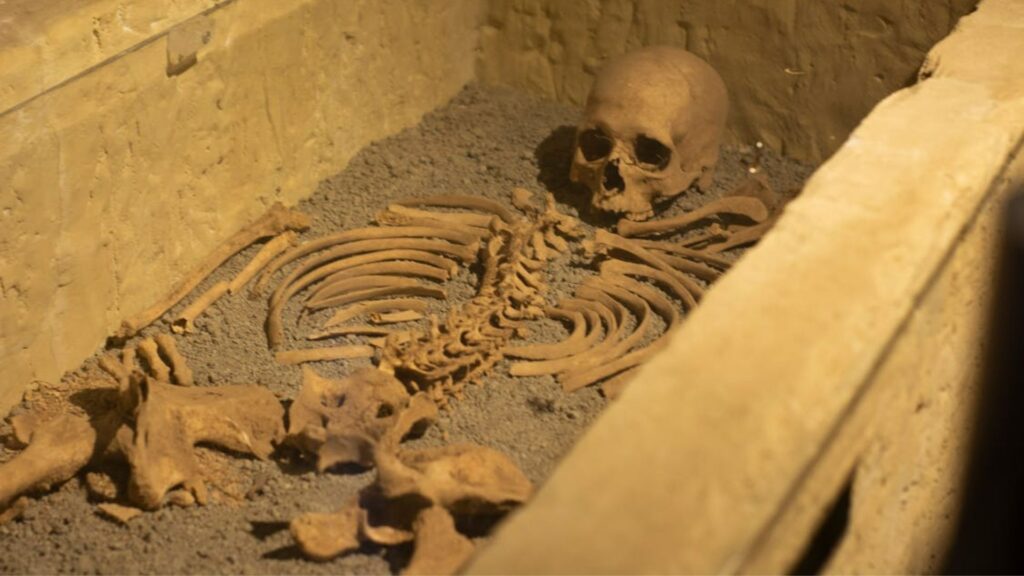
“Preliminary observations, made before cleaning, revealed traces of healed rib fractures” on the right side of one of the bodies, according to Marchewka-Długońska. At least one of the individuals may have experienced significant trauma in their life. The skeletons have been collected for anthropological analysis, which may provide more definitive answers about who these people were, how they lived, and whether any sustained injuries were consistent with combat. The analysis could help resolve the ongoing debate about the cemetery’s nature.
Analysis May Lift the Shroud of Mystery

“It is very rare in archaeology to have the luxury of connecting a cemetery with the place where the people buried there lived,” Alagierski said. “Here, not only do we know that there’s a stronghold nearby, but the findings from the cemetery confirm that the deceased were definitely connected to this settlement.” The skeletons are undergoing anthropological analysis that may clarify whether the site was an elite warrior burial ground or an ordinary Christian cemetery. The research continues as archaeologists work to extract more information from the remains.
PetsFanatic Team
Pet Care Expert & Content Creator
Passionate about sharing knowledge and tips for better pet care. Writing about everything from pet health to training techniques.