
Black Bear Sightings Are Spiking This Summer and Experts Say There Are Two Reasons Why

Your backyard might have a visitor this summer, and it weighs 600 pounds. Across the United States, black bear sightings are climbing sharply as summer sets in, sending homeowners scrambling for their phones every time a shadow moves across the lawn. Wildlife experts say this isn’t random. There are two reasons why bears are suddenly everywhere, and both come down to biology working exactly as it should.
The first reason starts with an empty stomach. “During hibernation, black bears are essentially in torpor or asleep for three to four months,” says Kari Kingery, wildlife program manager for the Confederated Salish and Kootenai Tribes. When bears wake up, months of fasting have drained their energy reserves completely, leaving them desperate to refuel before winter comes calling again.
That hunger doesn’t fade quickly. Kingery says most bears won’t rebuild their body weight until mid-July, which means an entire season of foraging lies ahead. Bears aren’t picky about where that food comes from either. Bird feeders, unsecured trash cans, and pet food left on porches all become easy targets. But appetite alone doesn’t explain everything driving bears into view this summer.
Bears on the Move

The second reason has nothing to do with food. It’s mating season, and male bears are covering serious ground searching for partners. “They’re moving around, especially those males moving from female to female, in that kind of search mode,” Kingery explains. That restless searching sends bears wandering into neighborhoods and yards they’d normally avoid entirely.
Kingery says the activity has been impossible to miss lately. “Just this week, some landowners nearby have caught some footage of interactions happening,” she notes, describing courtship encounters caught on camera. Combined with the hunger driving bears toward human food sources, mating season means bears are simply on their feet more than usual right now.
Hunger and courtship explain why bears are moving, but they don’t fully explain why so many people are suddenly seeing them. That answer involves a much longer story, one that stretches back nearly a century and includes a surprising piece of modern technology sitting right on your front porch.
A Comeback Nobody Expected

More than 300,000 black bears now live across the United States, ranging from the Arctic Circle down into central Mexico. That number represents one of conservation’s genuine success stories. “The reason people see them so often, the reason that they are such a big part of North American life, is because of the conservation work that’s been done to bring them back,” says Rae Wynn-Grant, a National Geographic Explorer and wildlife ecologist.
That comeback wasn’t guaranteed. By 1900, unregulated hunting and widespread deforestation had wiped out black bears from 55% of their historic range. Congress responded in 1937 with the Pittman-Robertson Act, redirecting firearm and ammunition taxes toward wildlife restoration. Decades of funded research and habitat work followed, and populations have since rebounded across roughly 60% of their former range.
Population growth only tells part of the story, though. Home security has quietly transformed how often people actually notice bears nearby. “We have all these Ring cameras and home security doorbells where you can look at your phone every second and know if there’s a bear walking through your yard,” Wynn-Grant says. Quiet, solitary animals that once passed by unnoticed now trigger a notification instantly.
What to Actually Do When One Shows Up
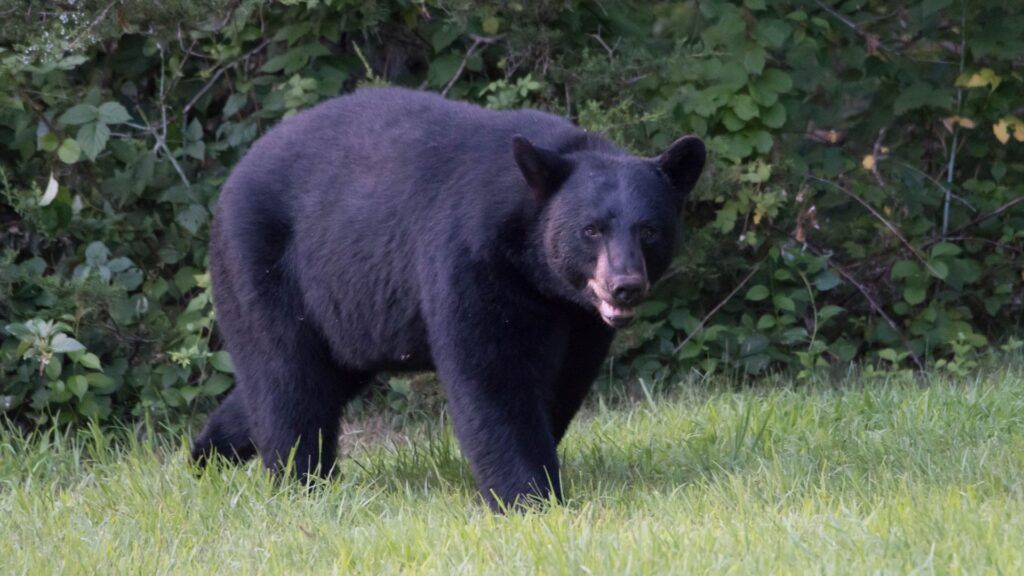
Seeing a bear on camera or in your yard sounds alarming, but experts insist it rarely means danger. “There’s a huge difference between a bear sighting and a bear conflict,” Wynn-Grant says, adding that aggressive displays like jaw-clacking or short charges are almost always bluffs meant to create distance, not attacks. Bears spend a lifetime avoiding fights whenever possible, and most people never test that theory firsthand.
Bear spray remains the most effective tool if a bear does close the distance. “Bear spray is best-deployed before the bear is running at you,” Wynn-Grant advises. Kingery adds that the capsaicin cloud overwhelms a bear’s sensitive nose as it approaches, stopping the animal before contact happens. Backing away slowly while appearing large works far better than running, which can trigger a chase instinct.
Prevention starts at home, and Wynn-Grant doesn’t sugarcoat what that requires. “I know you really love your bird feeder because it attracts some really cool birds, but it is also a calorie heaven for black bears,” she says. Clean grills, secured trash, and removed feeders won’t eliminate sightings entirely. But they will decide whether that sighting stays a sighting or turns into something neither species wanted.
PetsFanatic Team
Pet Care Expert & Content Creator
Passionate about sharing knowledge and tips for better pet care. Writing about everything from pet health to training techniques.