
Astrophysicists Think Flattened Dark Matter May Explain the Milky Way’s Puzzling Glow

For over a decade, astronomers have been stumped by an unexplained surge of gamma rays emanating from the Milky Way’s core. A study published October 16 in Physical Review Letters offers a potential explanation. Researchers led by Moorits Mihkel Muru of the Leibniz Institute for Astrophysics Potsdam and the University of Tartu used advanced computer simulations to discover that dark matter near the galactic center has an oval or flattened shape rather than the assumed spherical form, which could account for the mysterious high-energy glow.
The Fermi Space Telescope Detected Far More Gamma Rays Than Predicted

When NASA’s Fermi space telescope aimed at the galactic center, its instruments captured an abundance of gamma rays that exceeded all theoretical expectations. Gamma rays rank as the most energetic form of light in the universe, arising from extreme cosmic environments including stellar explosions and black hole accretion disks. Despite accounting for every known gamma-ray source, astronomers consistently identified a surplus of this radiation emanating from the Milky Way’s center, creating a scientific puzzle that has resisted easy explanation for more than a decade.
Dark Matter Annihilation Was an Early Leading Theory
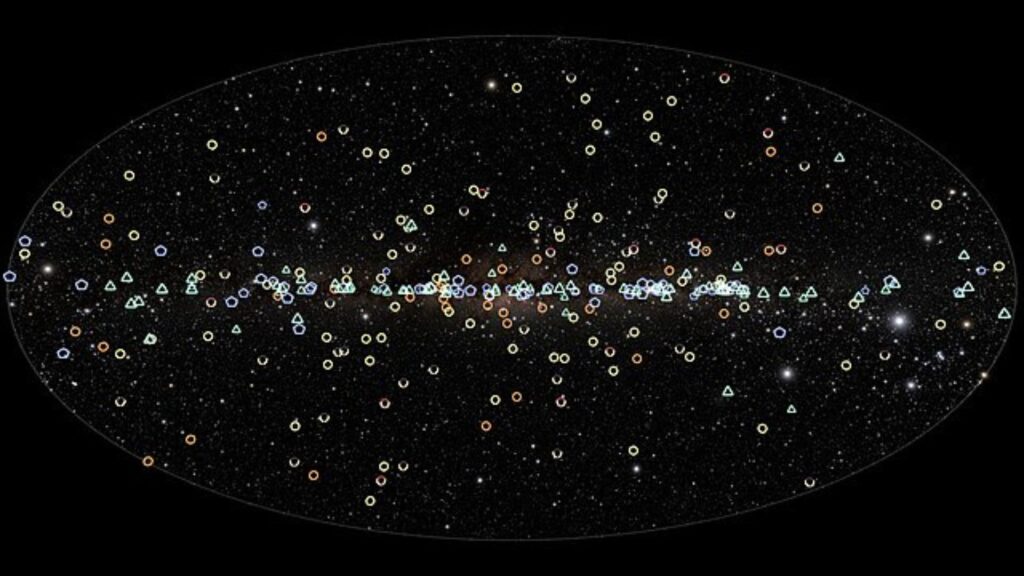
Scientists initially pursued an intriguing hypothesis: perhaps the surplus gamma rays arose from dark matter particles colliding and destroying each other. According to this model, when two dark matter particles meet, the energy released converts into bursts of high-energy radiation. This explanation seemed plausible given dark matter’s dominance in the universe’s total mass. However, a crucial problem emerged, as Muru told Live Science: the observed radiation formed a flattened pattern, while prevailing dark matter models predicted spherical halos surrounding galaxies. This mismatch prompted many researchers to abandon the dark matter premise and explore other candidates.
Millisecond Pulsars Replaced Dark Matter as the Leading Explanation

With the dark matter theory sidelined, researchers pivoted toward millisecond pulsars, rapidly rotating neutron stars capable of emitting gamma rays. These ancient stellar remnants became the favored candidate among astronomers seeking to explain the galactic center’s mysterious glow. Yet even this explanation remained unconfirmed, leaving a fundamental question unresolved: what physical process was actually generating the detected radiation? The scientific community had essentially traded one mystery for another. Muru emphasized the persistent uncertainty: “Different theories compete to explain what could be producing that excess, but nobody has the definitive answer yet.”
Simulations Challenge the Assumption That Dark Matter Must Be Spherical
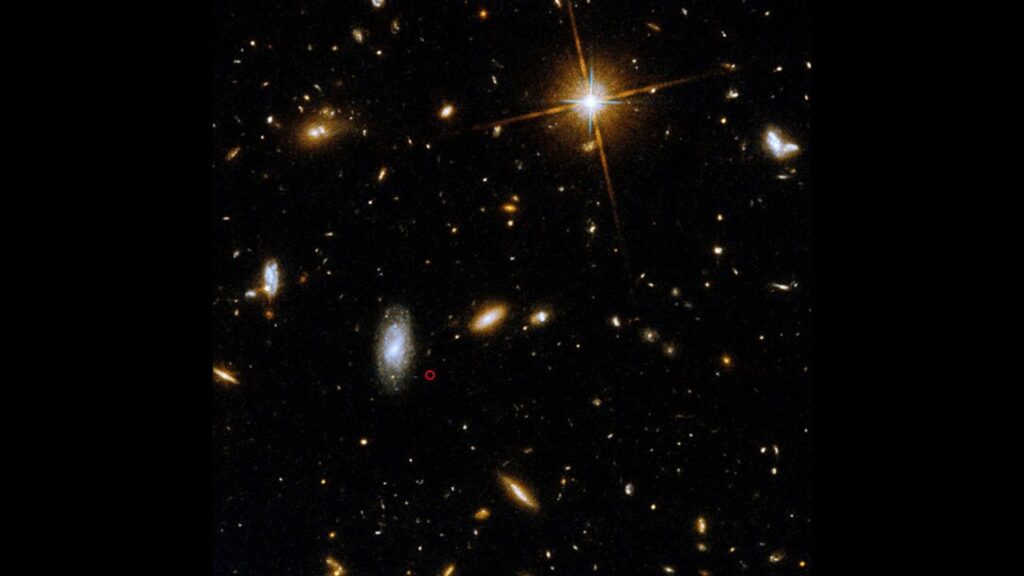
Rather than accept the established consensus, Muru’s team examined whether conventional thinking about dark matter shape might be flawed. They deployed the HESTIA suite, a suite of high-resolution computer simulations that reconstruct Milky Way-like galaxies within realistic cosmic conditions. The researchers investigated how dark matter actually distributes itself near the galactic center, exploring whether gravitational forces and galactic collisions could reshape dark matter in unexpected ways. This methodical interrogation of assumptions proved fruitful, revealing that the prevailing model may have overlooked crucial physics operating at the galaxy’s heart.
Galactic Mergers and Gravitational Forces Distorted Dark Matter’s Shape

The simulations unveiled an unexpected result: past interactions had sculpted dark matter into a distinctly non-spherical configuration. Instead of the assumed round shape, dark matter near the galactic center exhibits an oval or box-like geometry, resembling the visible stellar bulge that dominates the Milky Way’s middle. Gravitational collisions between galaxies and internal dynamical processes had warped dark matter’s distribution over cosmic time. Muru explained the significance: “We found that dark matter near the center is not spherical — it’s flattened. This brings us a step closer to revealing what dark matter really is, using clues coming from the heart of our galaxy.”
The Corrected Dark Matter Shape Naturally Produces the Gamma-Ray Pattern

With dark matter’s geometry now properly understood, a startling realization emerged: the gamma-ray signature expected from dark matter annihilation closely mirrors the astronomical observations. The discrepancy that had previously undermined the dark matter hypothesis may have stemmed entirely from using an incorrect geometric model. Scientists had rejected a valid explanation simply because they applied wrong assumptions about dark matter’s spatial distribution. This finding resurrects the dark matter particle annihilation scenario as a credible source for the galactic center’s persistent glow, suggesting the theory deserved reconsideration all along.
Next-Generation Telescopes Will Determine Whether Pulsars or Dark Matter Wins

The new findings invigorate the dark matter explanation, yet definitive proof remains elusive. Distinguishing between dark matter and pulsars requires observational tools of unprecedented sensitivity currently under development. If the Square Kilometre Array (SKA) and the Cherenkov Telescope Array (CTA) detect numerous discrete point sources at the galactic center, the pulsar theory gains credibility. But if the radiation appears smooth and continuous across the region, dark matter gains the upper hand. Muru stated that finding “enough pulsars to account for the gamma-ray glow” would tip the scales toward the stellar explanation, but current technology cannot yet make this determination.
Dark Matter Remains Invisible, So Scientists Study It Indirectly

The universe’s most abundant form of matter defies direct observation, presenting an unusual scientific challenge. Dark matter comprises the majority of the cosmos’s total mass, yet no instrument has ever detected a dark matter particle directly. Researchers must infer dark matter’s properties through gravitational effects and potential radiation signals. Muru noted this frustration: “As there are no direct measurements of dark matter, we don’t know a lot about it.” This constraint forces astronomers to work backwards, examining observed phenomena like the galactic center’s gamma rays and theorizing what underlying dark matter distributions could produce them.
Testing Dark Matter Theories Beyond Our Galaxy Could Provide Breakthrough Evidence
The gamma-ray mystery, enduring since the Fermi telescope’s initial discovery, represents a classic scientific puzzle where each new finding adds texture without yet providing conclusive answers. Muru’s team proposes expanding the investigation beyond our galactic neighborhood. Examining the central regions of nearby dwarf galaxies offers another testing ground for dark matter models. The ultimate proof, according to Muru, would require “a signal that matches theoretical predictions precisely,” demanding simultaneous advances in computational modeling and observational technology. By reconsidering dark matter’s fundamental properties, scientists move closer to resolving one of modern astrophysics’ deepest enigmas.
PetsFanatic Team
Pet Care Expert & Content Creator
Passionate about sharing knowledge and tips for better pet care. Writing about everything from pet health to training techniques.