
Astronomers Claim They May Have Spotted Mysterious “Great Attractor”

Less than two weeks into 2026, astronomers are already watching a comet that could become the year’s most dramatic celestial sight. The object, officially named C/2025 R3 (PanSTARRS), was discovered in September 2025 using the Pan-STARRS telescopes in Hawaii.
It is currently hundreds of millions of miles from Earth and traveling inward from the outer solar system.What makes this comet especially intriguing is its origin.
Scientists believe it comes from the Oort Cloud, a distant region filled with icy remnants from the formation of the solar system. That suggests C/2025 R3 may not have visited the inner solar system — or Earth’s neighborhood — for tens of thousands of years.
Its Upcoming Path Puts it Unusually Close to Earth and the Sun

C/2025 R3 is racing toward the sun and will reach perihelion on April 20, passing between the orbits of Mercury and Venus. Just a week later, on April 27, it will make its closest approach to Earth, coming within about 44 million miles of the planet.
While that distance is still far by everyday standards, it is close enough for astronomers to closely monitor how the comet behaves under intense solar heat.
As comets approach the sun, they release gas and dust that form glowing tails — the very feature that can turn an ordinary comet into a spectacular one.
Scientists Disagree on How Bright it Will Actually Appear

Whether this comet earns the nickname “Great Comet of 2026” depends almost entirely on brightness. Some estimates suggest it will peak at a faint magnitude only visible through telescopes or binoculars. Other projections are far more optimistic, placing it bright enough to be clearly visible to the naked eye.
One factor that could dramatically boost its visibility is forward scattering — a phenomenon where sunlight reflects off a comet’s dust tail when it lines up between Earth and the sun.
If conditions align just right, the comet could suddenly appear much brighter than expected, even if only briefly.
When and Where Skywatchers Should Look
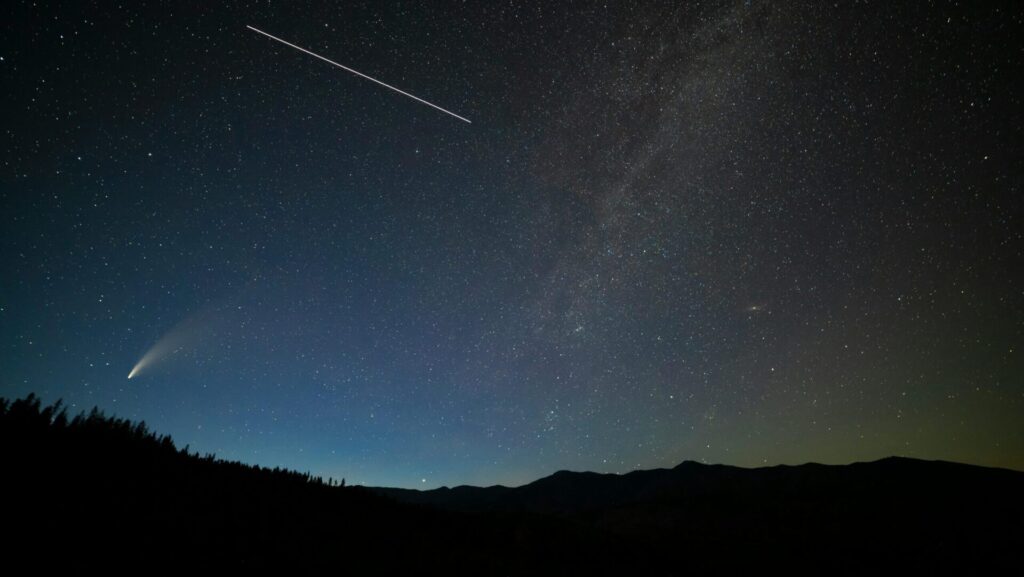
The most promising viewing window appears to be mid-April, especially around April 17, when a new moon will darken the sky and improve visibility. Later, near its closest approach to Earth, the comet may become harder to spot due to its proximity to the sun.
Observers in the Southern Hemisphere may get another opportunity in early May. During its pass, the comet will appear in the constellation Pisces, just below the Great Square of Pegasus.
As with all comets, patience — and a little luck — will play a role in whether it becomes a historic sight or a quiet cosmic visitor.
PetsFanatic Team
Pet Care Expert & Content Creator
Passionate about sharing knowledge and tips for better pet care. Writing about everything from pet health to training techniques.