
Ark of the Covenant Was Built to Challenge Egyptian Gods, New Theory Suggests

For centuries, the Ark of the Covenant has been one of the most mysterious objects in biblical history. According to the Book of Exodus, the sacred chest was built at God’s command after the Israelites reached Mount Sinai. Moses was instructed to construct it from acacia wood and overlay it with gold, creating a portable shrine that would house the tablets of the Ten Commandments. The ark quickly became central to Israelite religion. Biblical texts describe it as a sacred vessel carried by priests and treated with extreme care, since it symbolized the presence of Yahweh among the Israelites. Its golden lid—often called the “mercy seat”—was believed to be the place where God would meet Moses and deliver commands to the people.
However, new scholarship suggests the ark may not have appeared in isolation. Instead, its design may reflect cultural influences from the Egyptian world the Israelites had recently left behind. Archaeologists and historians say the Israelites spent generations exposed to Egyptian culture before the Exodus. That exposure may have shaped how sacred objects were imagined, built, and used in ancient Israelite worship.
In recent years, scholars studying ancient ritual furniture have begun identifying striking parallels between the Ark of the Covenant and sacred objects used in Egyptian religious practice. These similarities may help explain how the ark functioned in its original historical context.
Parallels Between the Ark and Egyptian Ritual Objects

One of the most intriguing comparisons comes from Egyptian temple rituals involving sacred shrines known as barques. These ceremonial structures, often built like small boats, were carried by priests during religious processions and were believed to transport the presence of a god. Scott B. Noegel, a scholar of Near Eastern languages and civilization at the University of Washington, has argued that the Egyptian sacred barque offers one of the closest non-Israelite parallels to the biblical ark. These ritual objects could carry divine statues or relics and were sometimes used in ceremonies believed to reveal the will of the gods.
The Ark of the Covenant shared several similar features. Biblical descriptions portray it as a gold-covered wooden chest with rings and poles so it could be carried by priests. Inside were sacred items, including the stone tablets of the law. Texts also describe the ark as functioning like a divine throne. The golden cherubim on its lid formed a sacred space where God’s presence was believed to dwell, while the chest itself was described metaphorically as a “footstool.”
Despite these parallels, scholars emphasize that the ark was not simply copied from Egyptian religious objects. Instead, it appears to have adapted familiar forms and symbolism to express a radically different religious idea.
Turning Ancient Religious Symbols Upside Down
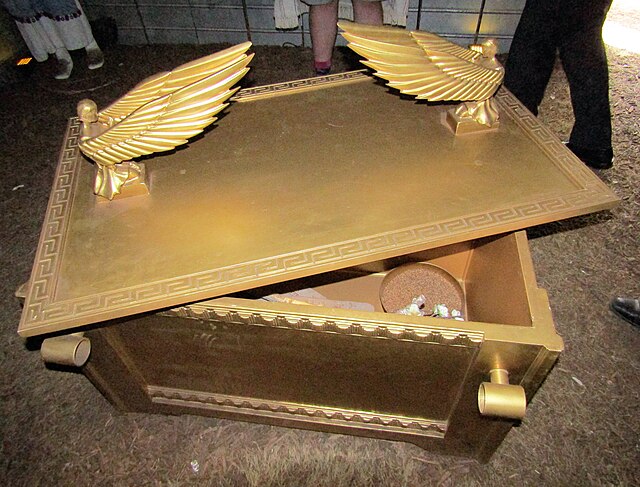
Some researchers believe the Ark of the Covenant was intentionally designed to reshape ideas about divine presence in the ancient world. In the Late Bronze Age, many cultures believed gods were physically tied to statues or idols housed inside shrines. The Ark, however, broke that pattern. Writing for the Biblical Archaeology Society, archaeologist David A. Falk notes that Egyptian ritual furniture, such as sacred chests and shrines often held divine images or relics that represented a god’s physical presence.
Falk points out that Egyptian chests and coffins were often richly decorated and used to store sacred items, sometimes covered in gold and equipped with carrying poles. Some examples, including the famous Anubis chest found in Tutankhamun’s tomb, display features strikingly similar to the biblical description of the ark. Yet the most important difference was what the ark did not contain: an idol.
Instead, the sacred space above the ark which is between the wings of the cherubim was believed to be where God’s presence appeared. By leaving the throne empty, the ark conveyed a theological message: Yahweh was not confined to a physical statue or object.
A Symbol Designed for a New Kind of Worship

Seen in this light, the Ark of the Covenant may have been more than a container for sacred relics. It could also have been a symbolic statement aimed at challenging older religious ideas that dominated the ancient Near East. Falk argues that the ark used the visual language people in the Late Bronze Age already understood, golden chests, sacred iconography, and portable shrines, but reinterpreted those symbols in a new way.
Rather than housing a physical idol, the ark created a sacred space where God’s presence was believed to dwell invisibly. The cherubim atop the lid framed that space, acting as symbolic guardians rather than objects of worship.
For scholars studying the origins of ancient Israelite religion, these insights offer a new way of looking at one of the Bible’s most famous artifacts. Instead of being entirely unique, the Ark of the Covenant may have emerged from a familiar cultural world while simultaneously transforming it.
PetsFanatic Team
Pet Care Expert & Content Creator
Passionate about sharing knowledge and tips for better pet care. Writing about everything from pet health to training techniques.