
Archaeologists Unearth the 2,500-Year-Old Remains of a Lost Roman Society

Archaeologists from the Egyptian Supreme Council of Antiquities and the University of Padua, excavating at the Kom el-Ahmar and Kom Wasit sites in Beheira Governorate, discovered a Roman Period necropolis and industrial complex that had remained undisturbed for 2,000 years. The team unearthed remains of what was once part of a city dating back to the fifth century B.C.E., when Egypt was shaped by Greek and Roman influences.
A blending of Greek, Roman, and Egyptian styles is visible in artifacts such as carvings, pottery, and objects used in funerary rituals. The Roman cemetery contained evidence of several different types of burial practices. The remains of 23 individuals ranged from those buried directly in the ground to some in ceramic coffins. Bodies of children were encased in large, elongated amphorae.
While mummification was still practiced in this era, combining Egyptian elements such as linen wrappings and hieroglyphs with Roman plaster funerary portraits painted with the face of the deceased, no mummies were found at this site. The remains showed that the people who once inhabited the city suffered no violence or epidemic, based on initial examination. Ongoing bioarchaeological analysis of the human remains will reveal more details about how they lived in the region during the Roman Period.
The Industrial Complex Processed Salted Fish for Long-Distance Trade
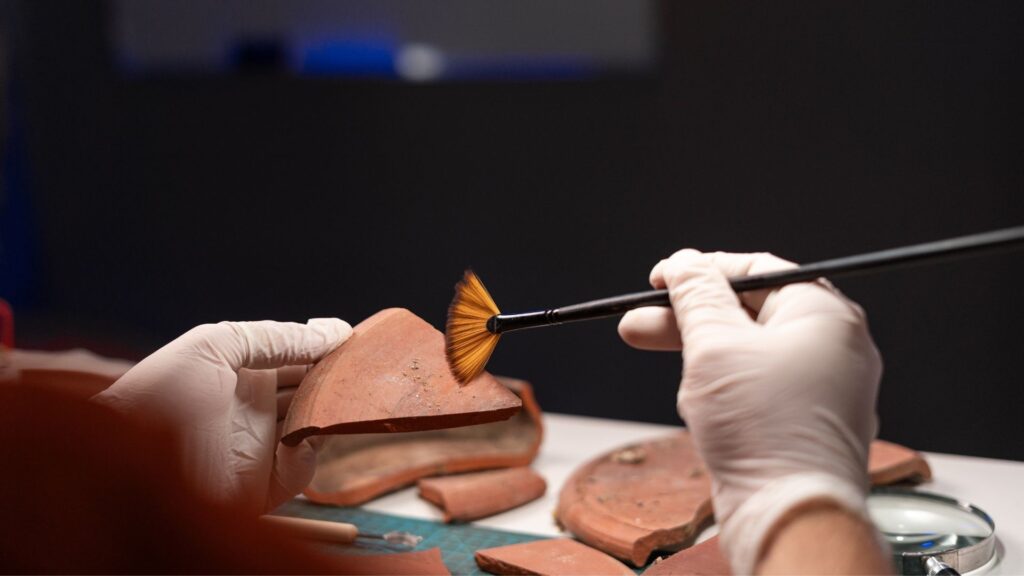
Archaeologists excavated an industrial building with six rooms. Much of that space was used for processing salted fish, which was an important source of revenue, especially when it came to long-distance trade, at a time when there were few methods of food preservation available. Processing operations left behind 9,700 fish bones, which were dug up by the archaeological team, providing concrete evidence of the scale of production.
While the Nile Delta was more fertile thousands of years ago, Roman Egypt was still arid enough for both human remains and artifacts to survive. Imported amphorae from Greece and Rome were found at the ancient facility, along with fragments of Greek pottery. These artifacts reflect the cultural influences of those civilizations on Egyptian manufacturing and trade practices during this period.
In some of the other rooms, craftsmen and artisans had produced tools of stone and metal along with faience amulets. These generally inexpensive amulets were available to anyone, regardless of how grand a tomb they could afford to build. Artisans created objects for daily use, spiritual protection, and burial purposes.
Faience Amulets and Unfinished Limestone Figures Show Craft Production

The faience amulets discovered at the site often took on the form of scarabs or other animals, and sometimes deities. They were made of clay and glazed in bluish-green faience. These amulets were either worn by the living for protection or buried with the dead to secure entry into the afterlife. Mummies have often been found with faience amulets between their wrappings, and sometimes a scarab was placed over the heart to convince the goddess Ma’at of the individual’s purity.
A scarab placed over the heart was meant to convince the goddess Ma’at of the individual’s purity when it came to her final judgment. Someone considered impure was thrown to the jaws of soul eater Ammit. The production of these protective amulets demonstrates how religious beliefs and commercial manufacturing intersected in Roman-period Egypt.
Also found in the ancient facility were unfinished limestone figures, some nearly complete and others that had barely been carved, which remained at workstations when the facility was abandoned. The various stages of carving visible in these limestone figures offer archaeologists rare evidence of ancient sculptural techniques and the production process used by craftsmen more than two millennia ago in the western Nile Delta.
Preserved Artifacts Now Displayed for Modern Audiences

Some of the best-preserved artifacts have been transferred to the Egyptian Museum in Cairo. Among these is a stunning pair of golden earrings thought to have belonged to a woman. The jewelry demonstrates the level of skill metalworkers achieved in this ancient city during the fifth century B.C.E.
The discovery of both the necropolis and industrial complex at a single location provides a comprehensive view of daily life, death rituals, and economic activities in Roman-period Egypt. The combination of burial practices reflecting multiple cultural traditions alongside evidence of fish processing, tool manufacturing, and amulet production shows how communities in the western Nile Delta integrated Egyptian, Greek, and Roman influences during the fifth century B.C.E.
As bioarchaeological analysis continues on the remains of the 23 individuals found at the site, researchers expect to gain insights into diet, health, and living conditions in this ancient city. The absence of evidence for violence or epidemic in the skeletal remains indicates a relatively stable community. The ongoing research at Beheira Governorate will continue to reveal how people lived in this region 2,000 years ago.
PetsFanatic Team
Pet Care Expert & Content Creator
Passionate about sharing knowledge and tips for better pet care. Writing about everything from pet health to training techniques.