
Archaeologists Make Major Discovery in a U.S. Lake That Sheds Light on an Ancient Civilization

Archaeologists have uncovered a remarkable archaeological site in a U.S. lake that is revealing new insights into ancient civilizations that once thrived in North America thousands of years ago, rewriting parts of history that were once lost beneath the water’s surface. The discovery involves the submerged remains of at least 16 ancient dugout canoes found at the bottom of Lake Mendota in Madison, Wisconsin, with radiocarbon dating showing ages spanning from about 700 years old to more than 5,000 years old.
The canoes, which vary significantly in age, were identified by researchers from the Wisconsin Historical Society and allied tribal preservation officers, who have been methodically cataloging the finds since the initial discovery of the first canoe in 2021. Researchers believe these boats represent a sophisticated watercraft tradition and provide tangible evidence of how Indigenous peoples once navigated, fished, traded, and lived across the Great Lakes region long before written history.
This cluster of ancient canoes, sometimes described as a prehistoric “parking lot,” offers a rare glimpse into the daily lives and mobility of early communities, suggesting a level of organization and cultural continuity that challenges previous assumptions about prehistoric North American societies.
How the Canoes Were Preserved and What They Reveal
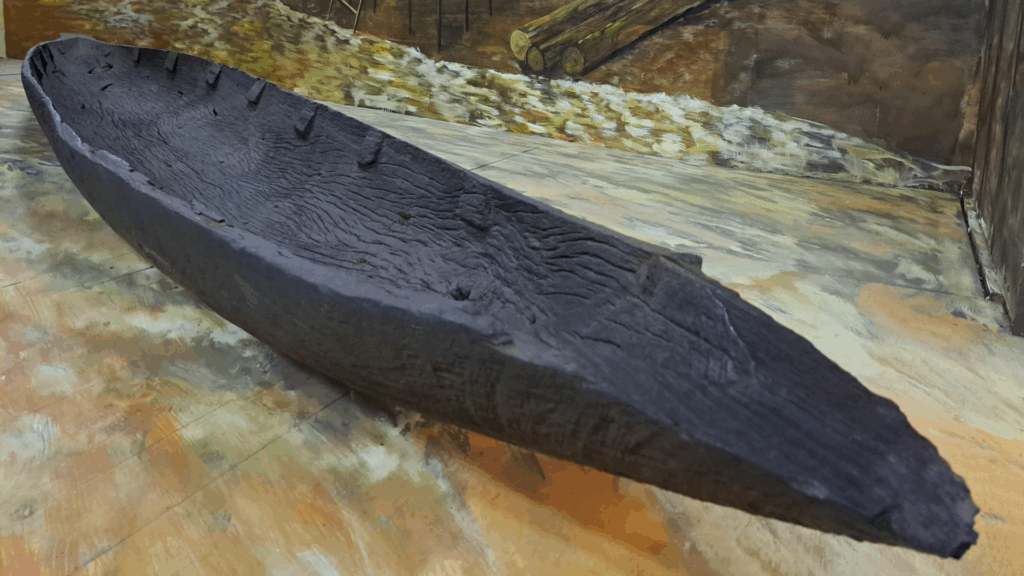
The preservation of these ancient dugout canoes is owed in large part to the cold, oxygen-poor waters and stable sediment at the bottom of Lake Mendota, which helped protect the wooden vessels from decay for millennia. Wood recovered from these canoes has allowed archaeologists to conduct detailed analyses and carbon dating that reveal a remarkable time span of construction, from roughly 5,200 years ago to as recent as 700 years ago, suggesting long-term use of this area by human groups adapted to lakeshore life.
Many of the canoes were intentionally placed in specific shallow depths where they may have been stored for seasonal use or communal access, a practice that appears to mirror modern systems for storing and sharing transportation resources. This intentional placement, combined with evidence of fishing tools found nearby, indicates that these watercraft were not isolated artifacts but integral parts of a highly mobile and interconnected community economy.
Ongoing studies suggest that the techniques used by these ancient boatbuilders were complex and adaptive, drawing on extensive knowledge of wood properties and environmental conditions to craft vessels capable of long use in varying lake conditions.
Why This Discovery Matters to History and Culture

The find beneath Lake Mendota has profound implications for understanding the technological capabilities and social structures of Indigenous peoples in the midcontinental United States long before European contact. With some of the oldest watercraft ever discovered in the Great Lakes region, the site challenges conventional narratives that early North American communities were predominantly land-based or lacked advanced travel networks.
The presence of multiple canoes that span thousands of years also provides evidence of continuity in lake navigation traditions, suggesting that watercraft were central to mobility, trade, and resource gathering for successive generations. Tribal officials and historians note that the discovery reinforces ongoing cultural connections to the land and waters that have shaped Indigenous life ways for millennia, highlighting the deep heritage that persists to this day.
Researchers say this discovery will likely prompt new archaeological surveys at other lakes and waterways across North America, as underwater preservation may hold many more clues about early inhabitants’ lives and movements than previously realized.
What Comes Next for the Underwater Archaeological Site

Now that the collection of ancient canoes has been identified and partially documented, archaeologists and tribal partners are developing plans for more extensive research, preservation, and possibly public education efforts tied to this underwater site. Future work will likely involve careful excavation, mapping of canoe locations, and further analysis that may shed even more light on how these vessels were used and how they relate to broader regional patterns of settlement and movement.
Scientists also hope that more advanced technologies, such as underwater lidar and high-resolution imaging, can enhance efforts to locate additional artifacts or submerged features that might exist nearby but remain hidden under sediment or water.
Local communities and tribal nations are emphasizing that the site should be approached respectfully, with efforts made to balance scientific discovery with cultural heritage preservation, so that this remarkable glimpse into ancient life remains protected for generations to come.
PetsFanatic Team
Pet Care Expert & Content Creator
Passionate about sharing knowledge and tips for better pet care. Writing about everything from pet health to training techniques.