
Archaeologists Discover Structure Beneath Pyramids That Challenges Existing Construction Theories

A stone slab more than 3,000 years old, placed directly between the paws of the Great Sphinx, may have been hiding an answer no one expected. Carved into the Dream Stele are two sphinx figures, side by side, a detail that scholars have long debated. Now, a team of Italian researchers believes that depiction was never symbolic — and that the second figure is still out there, buried.
Radar engineer and signal processing researcher Filippo Biondi presented those findings during a recent appearance on the Matt Beall Limitless podcast, drawing immediate attention across archaeology and media circles. His team used satellite-based radar technology, designed to detect subtle ground vibrations, to scan the terrain beneath the Giza Plateau, which is home to the pyramids of Khufu, Khafre, and Menkaure, along with the Great Sphinx.
What they say they found goes far beyond a second statue. Biondi described vertical shafts and horizontal passages forming what he called an underground megastructure, a network of tunnels and chambers running beneath the plateau. “Down underneath the Giza Plateau, there is something very huge that we are measuring,” he said on the podcast. “There is an underground megastructure.” The claim has since gone viral.
The Geometry Behind the Theory, and What the Scans Actually Show

Biondi’s team did not choose the location of the alleged second Sphinx at random. According to the researcher, lines drawn from each pyramid to the known Great Sphinx, when extended, converge on a specific point beneath a large sand mound on the plateau. Satellite imagery has reportedly captured this dune, which Biondi’s team estimates stands well over 100 feet above the surrounding terrain, standing visibly taller than the surface around it.
Biondi said the mound’s composition matters to the theory. Unlike the dense limestone bedrock found elsewhere on the plateau, he described this formation as solidified sand, a material he argues is soft enough to have buried and concealed a large carved structure over time. Scans of the area reportedly show dense vertical lines beneath the mound, which Biondi interprets as the solid walls of underground shafts, mirroring features detected beneath the original Sphinx.
The geometric alignment, he said, is not approximate. “We are finding precise geometrical correlation, 100 percent of correlation, in this symmetry,” Biondi told the podcast. He added that his team places roughly 80 percent confidence in the conclusion that a second Sphinx lies beneath the mound, and that the underground passages may connect to a broader subterranean complex running beneath the entire plateau.
Egyptologists and Geophysics Experts Push Back on the Interpretation

The claims spread quickly across social media, with one post on X drawing roughly 10 million views, according to Newsweek. But momentum online has not translated into acceptance in academic circles. No excavation has taken place beneath the plateau, no peer-reviewed study has validated the radar findings, and Egyptian authorities have not announced or approved any discovery of a structure matching what Biondi’s team describes.
Zahi Hawass, Egypt’s former minister of antiquities and one of the country’s most prominent archaeological figures, has consistently rejected these kinds of claims. “The rumors suggesting the presence of columns beneath the Pyramid of Khafre are nothing but fabrications propagated by individuals with no expertise in ancient Egyptian civilization or the history of the pyramids,” Hawass said. He has noted that the area has been extensively excavated for decades without uncovering evidence of a buried monument.
Geophysics experts have also raised questions about the methods behind the claim. Ground-penetrating radar and satellite-based remote sensing, they note, can typically resolve features only a few meters below the surface, not massive carved structures buried tens or hundreds of feet underground inside dense limestone. The Dream Stele, meanwhile, is interpreted by most Egyptologists as carrying symbolic imagery, not a literal depiction of a second physical monument.
The Debate Around the Giza Plateau Has a Long History Behind It
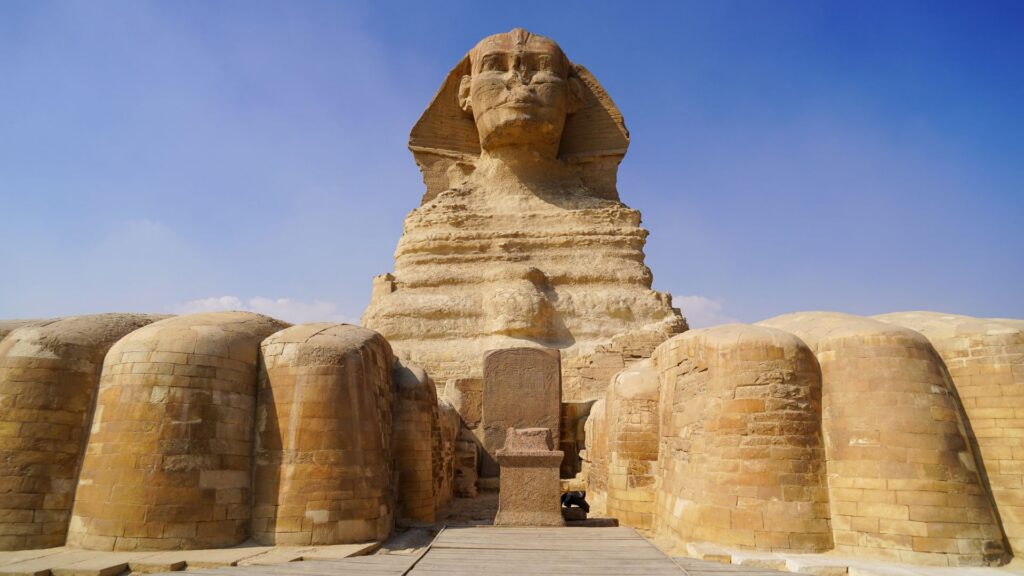
Biondi is not the first to propose that the Great Sphinx once had a twin. Egyptologist Bassam El Shammaa raised a similar theory more than a decade ago, drawing on ancient Egyptian records and mythology that describe a lightning bolt striking the Sphinx. El Shammaa interpreted that imagery as a possible reference to a second monument, one that was damaged or destroyed in antiquity.
The Dream Stele itself has a documented history that adds another layer to the debate. According to ancient hieroglyphics carved into the slab, a young Prince Thutmose IV fell asleep in the shadow of the Sphinx and dreamed the statue spoke to him, promising the Egyptian throne if he cleared the sand that had buried it. Thutmose IV later commissioned the stele around 1401 BC.
Whether Biondi’s radar data ultimately points to something real or reflects a misreading of the terrain, the broader question his work raises, of what remains unexcavated beneath one of the world’s most studied archaeological sites, is one that legitimate researchers continue to pursue through approved, peer-reviewed channels. For now, the claim sits where most unexcavated theories do, disputed by mainstream archaeology, unresolved by the data, and awaiting the kind of peer-reviewed excavation that would settle it either way.
PetsFanatic Team
Pet Care Expert & Content Creator
Passionate about sharing knowledge and tips for better pet care. Writing about everything from pet health to training techniques.