
A Rare Six-Planet Alignment Is Coming

A rare and eye-catching celestial event is set to unfold in late February 2026 as six planets, Mercury, Venus, Jupiter, Saturn, Uranus and Neptune, appear together in the evening sky. Often referred to as a planetary parade, this alignment will allow skywatchers to see an unusual cluster of worlds stretched across the western horizon shortly after sunset. While planetary groupings happen from time to time, seeing six at once is far less common and is expected to draw widespread interest from both amateur astronomers and casual observers.
The alignment does not mean the planets will form a perfect straight line in space. Instead, from Earth’s perspective, they will appear arranged along the same general arc of sky, following the path known as the ecliptic. This visual effect occurs because the planets orbit the sun in roughly the same flat plane, making certain periods especially favorable for multi planet viewing.
Peak visibility is expected around February 28, 2026, though the event will be visible for several evenings before and after that date depending on local weather conditions. Because the viewing window each night will be relatively short, preparation and timing will play a key role in spotting as many planets as possible.
Which Planets You Will Be Able to See

Four of the six planets in this alignment, Venus, Jupiter, Saturn and Mercury, should be visible to the naked eye under clear skies. Venus will likely be the brightest object in the lineup, often outshining nearby stars and making it easy to identify even in lingering twilight. Jupiter will also appear bright and steady, standing out clearly against the darkening sky.
Mercury and Saturn may be slightly more challenging to spot because they will sit lower on the horizon and may compete with the fading glow of sunset. A clear western view without buildings, hills or trees blocking the skyline will significantly improve the chances of catching these lower planets before they set.
Uranus and Neptune, the two more distant planets in the lineup, will require binoculars or a small telescope due to their faint brightness. While they will not be as visually striking as Venus or Jupiter, locating them adds an extra layer of excitement for dedicated observers hoping to see all six planets in one evening.
When and How to Watch the Alignment

To get the best view of the planetary parade, observers should head outside approximately 30 to 60 minutes after sunset. This timeframe offers the ideal balance between a dark enough sky for planets to stand out and enough remaining light to easily orient yourself along the horizon. Waiting too long may cause some of the lower planets to dip below view.
Looking toward the west or southwest will be essential, as the alignment will appear along that portion of the sky. Choosing a viewing location with minimal light pollution can dramatically enhance visibility, especially for fainter planets. Rural areas or elevated spots away from city lights will provide the clearest conditions.
Using a stargazing app or printed sky chart can help identify each planet in sequence along the ecliptic. Even casual observers may find the experience rewarding, as spotting multiple bright planets in one glance is both visually impressive and scientifically meaningful.
Why This Event Is So Special
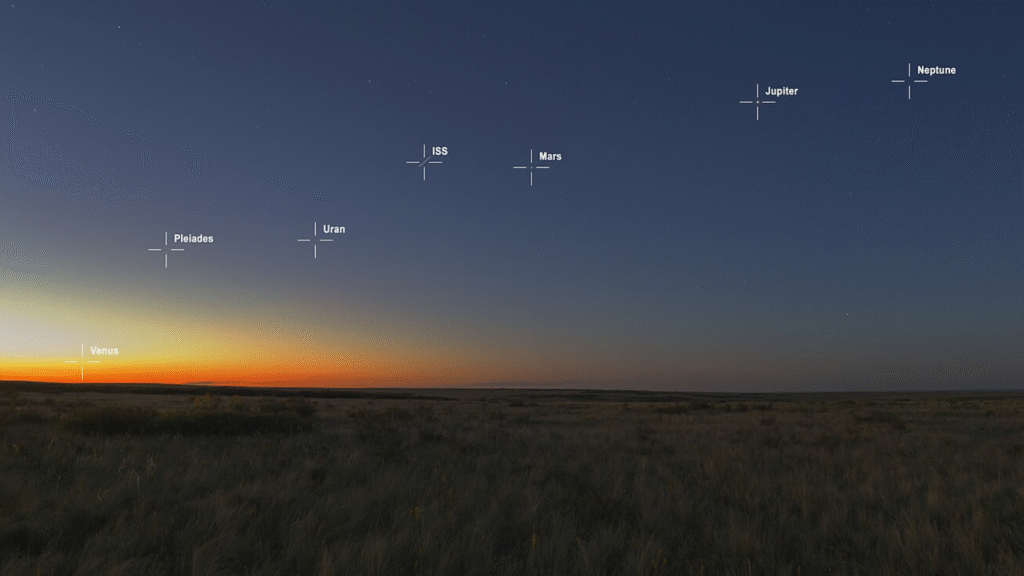
Alignments involving six visible planets do not occur frequently, making this event a standout moment in the 2026 astronomical calendar. While two or three planet groupings are relatively common, the simultaneous visibility of six worlds highlights the elegant timing of orbital motion within our solar system. It is a reminder that planetary movements follow predictable paths, yet occasionally align in ways that create rare viewing opportunities from Earth.
Events like this also connect modern observers with centuries of skywatching tradition. Long before telescopes and digital tools existed, ancient astronomers tracked the wandering motion of planets and noted unusual gatherings in the sky. Today, technology makes identification easier, but the sense of awe remains just as powerful.
As the days pass after late February, the planets will gradually drift apart in the sky as each continues along its orbit around the sun. For those who take the time to look up, this planetary parade offers not just a beautiful spectacle, but a rare chance to witness the dynamic architecture of our solar system unfolding in real time.
PetsFanatic Team
Pet Care Expert & Content Creator
Passionate about sharing knowledge and tips for better pet care. Writing about everything from pet health to training techniques.