
A 92-Foot ‘Godzilla-Like’ Giant Was Just Unearthed Beneath a Construction Site
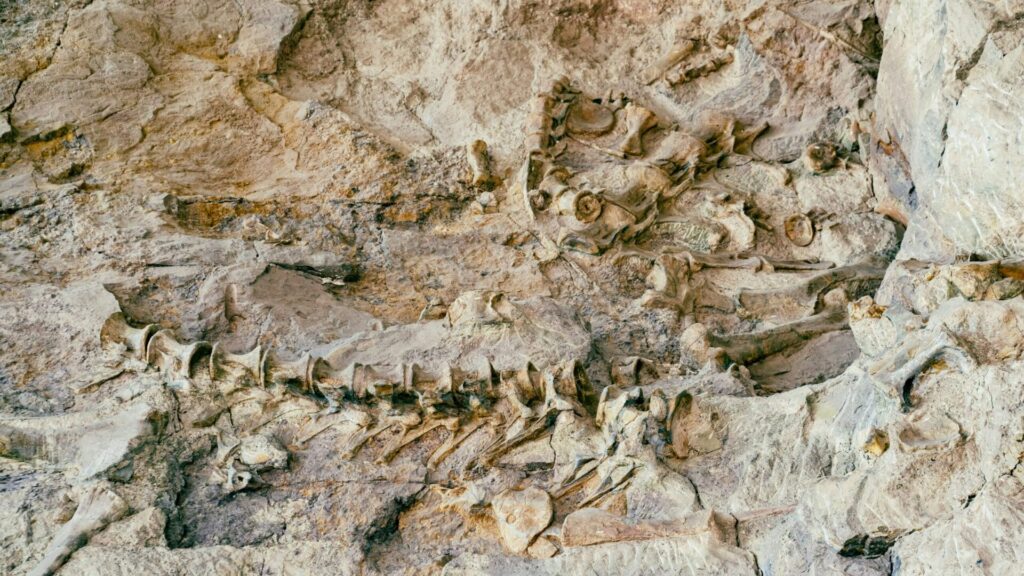
What began as a routine day at a construction site in the Tongnan District quickly turned extraordinary when workers uncovered enormous stone fragments buried deep beneath layers of earth. The site, located within the geologically rich Sichuan Basin, is known for its dense sedimentary history, but nothing quite prepared the crew for what lay beneath. As machinery cut through the ground, patterns emerged that suggested something far older and far more significant than ordinary rock.
Realizing the unusual scale and structure of the remains, workers halted operations and alerted experts. A research team from the China Geological Survey arrived to assess the site. Their findings confirmed that the excavation had pierced through the Suining Formation, a layer dating back approximately 147 million years.
This moment marked the accidental unveiling of a prehistoric giant, preserved beneath layers of sandstone and time. What was once hidden beneath industrial plans now opened a rare window into the Late Jurassic world, shifting the focus from construction to scientific discovery.
Fossils Reveal Life From a Lost Jurassic Landscape

The excavation, led by Xuefang Wei, revealed a partial yet remarkably preserved skeleton embedded in ancient sediment. Geological evidence suggested that the region was once a semi arid environment filled with shallow lakes and seasonal floods. These natural conditions played a crucial role in preserving the remains, rapidly burying the dinosaur before decay or scavengers could take hold.
Among the recovered fossils were dorsal and tail vertebrae, sections of the shoulder girdle, and major hind limb bones including the tibia and fibula. These remains provided enough anatomical detail to classify the creature within the sauropod lineage, a group known for producing the largest land animals in Earth’s history. The structure and scale of the bones hinted at an animal of immense size and strength.
Sediment patterns such as ripple marks and aquatic traces further reinforced the idea of a dynamic prehistoric ecosystem. This was not just a fossil find but a preserved snapshot of an ancient world, offering insight into how massive creatures once thrived in environments that no longer exist.
A Newly Named Giant Rewrites Dinosaur Records

Years after the initial excavation, researchers formally introduced the species to the scientific community through publication in Scientific Reports. The dinosaur was named Tongnanlong zhimingi, honoring both its discovery site and renowned paleontologist Dong Zhiming.
Belonging to the Mamenchisauridae family, the species is notable for its extraordinary proportions. One standout feature was its massive scapula, measuring over 1.8 meters, suggesting powerful forelimbs capable of supporting an immense body. The vertebrae also contained internal air cavities, known as pleurocoels, which allowed the skeleton to remain relatively lightweight despite its size.
These adaptations reveal how evolution enabled such giants to exist. The combination of structural strength and biological efficiency made it possible for creatures like Tongnanlong zhimingi to dominate their ecosystems, reaching vegetation heights inaccessible to most herbivores of their time.
Measuring a 92 Foot Giant and Rethinking Ancient Worlds

Using comparative scaling techniques, scientists estimated the dinosaur’s total length at up to 28 meters, or roughly 92 feet. This places it among the largest land animals ever identified, rivaling the upper limits of sauropod size. Such immense proportions suggest a creature that would have towered over its environment, reshape through its feeding and movement.
Beyond its size, the discovery contributes to ongoing debates in paleontology, particularly the East Asian Isolation Hypothesis. This theory suggests that ancient China evolved in relative isolation due to rising sea levels. However, the anatomical similarities between this species and others found across different continents challenge that idea, pointing instead toward possible migration routes.
Today, the remains are housed at the Chongqing Museum of Natural History, where further research continues. While the bones themselves are ancient, the questions they raise are strikingly modern, reminding us that every discovery has the power to reshape how we understand life on Earth.
PetsFanatic Team
Pet Care Expert & Content Creator
Passionate about sharing knowledge and tips for better pet care. Writing about everything from pet health to training techniques.