
40 Million Lab-Grown Mosquitoes Released Into Hawaii’s Forests

Scientists are deploying a counterintuitive solution to save Hawaii’s vanishing honeycreepers: releasing millions of laboratory-reared mosquitoes into their forest habitats. The Birds, Not Mosquitoes coalition has released more than 40 million non-biting male mosquitoes in Maui and Kauai since November 2023. These males carry a bacteria strain that acts as birth control, producing sterile eggs when they mate with wild females. The effort targets invasive mosquitoes spreading avian malaria, a disease so deadly that some honeycreepers die after a single infected bite.
Just 17 of More Than 50 Original Honeycreeper Species Survive Today

Hawaii’s honeycreepers were once common songbirds with bright feathers and distinctive calls. Of the more than 50 species that once lived across the islands, just 17 remain today. The dramatic collapse stems from avian malaria transmitted by invasive mosquitoes. Several survivors are highly endangered, including the ‘ākohekohe, or crested honeycreeper, the kiwikiu, or Maui parrotbill, and the ʻakekeʻe, or Kauai ‘ākepa. Another species, the ‘akikiki, became functionally extinct in the wild last summer.
Drones Carry 23,000 Mosquitoes Per Flight in Biodegradable Containers
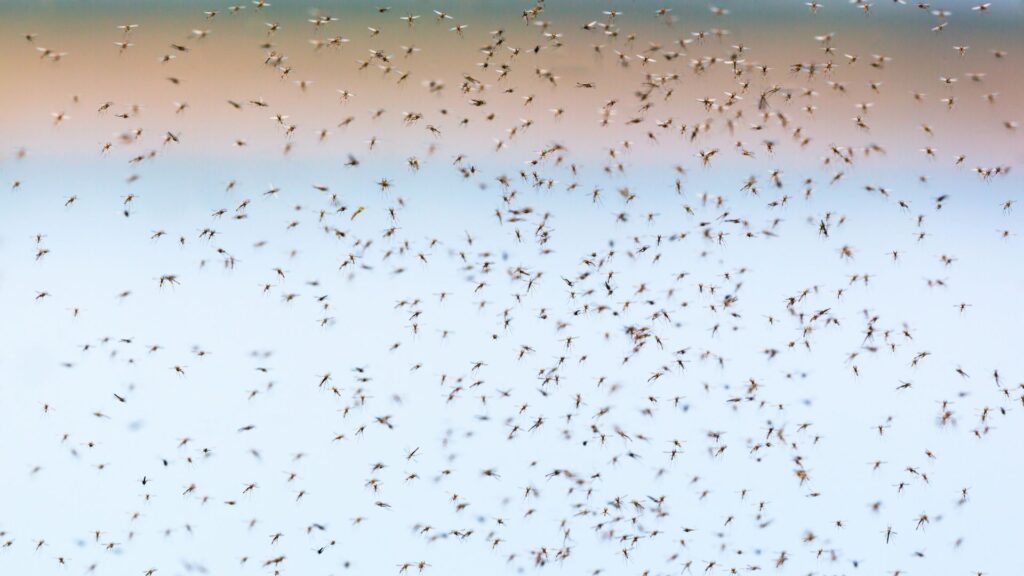
The coalition recently began experimenting with eight-foot-long drones to supplement helicopter releases. While a drone carries just 23,000 mosquitoes compared to a helicopter’s 250,000, it offers critical safety advantages because no humans need to be on board. Drones can also deploy at a moment’s notice, essential in areas with unpredictable weather. The mosquitoes are dropped inside small cylindrical pods made of sterilized biodegradable paper pulp, with roughly 1,000 males per pod kept alive in temperature-controlled transport boxes attached to the drone.
The Containers Decompose After Shielding Mosquitoes on Landing

Once released, the pods fall to the forest floor where they protect until the mosquitoes are ready to fly away, says Adam Knox, a drone pilot managing the project for the American Bird Conservancy. The containers then begin breaking down once exposed to the elements. Organizers started testing the drones in April, and if successful, they hope to integrate the unmanned vehicles into their ongoing mosquito suppression operations across honeycreeper habitats.
A Whaling Ship Accidentally Brought Mosquitoes to Hawaii in 1826

Mosquitoes are not native to Hawaii. After a whaling ship accidentally brought them to the islands in 1826, they proliferated in the warm, humid climate. Hawaii is now home to eight total mosquito species. Wildlife biologists are most concerned about two: the southern house mosquito, Culex quinquefasciatus, which spreads avian malaria, and the Asian tiger mosquito, Aedes albopictus, which spreads avian pox. Both species prefer warmer, lower elevations, but climate change threatens to push them into higher-elevation honeycreeper strongholds.
Wolbachia Bacteria Prevent Mosquito Eggs From Hatching

The male mosquitoes carry a naturally occurring strain of bacteria called Wolbachia, which effectively acts as mosquito birth control. When these males mate with wild females, the resulting eggs will not hatch, reducing the overall mosquito population. “What this does is it erects an invisible barrier so that these mosquitoes can’t get up to the forests where these birds remain,” Chris Farmer, Hawaii program director for the American Bird Conservancy, told Vox. The method gives endangered honeycreepers a much-needed reprieve.
The Method Has Been Deployed in Florida, California, Mexico, and China

The approach, called the incompatible insect technique, has been deployed around the world to control mosquito populations. Similar projects have operated in Florida, California, Mexico, and China. However, those programs primarily target mosquitoes that transmit diseases to humans, not animals. In Hawaii, the collaborators say their work is more urgent than ever, as time runs out for species on the brink of extinction. Climate change is accelerating the crisis by expanding mosquito habitats into previously safe high-elevation forests.
Some Honeycreepers Die After a Single Bite From an Infected Mosquito

Mosquito-borne diseases represent the biggest threat honeycreepers face, even surpassing habitat loss and predation by invasive creatures like rats. The avian malaria parasite is so virulent that some birds die after a single bite from an infected mosquito. The ‘I’iwi, or Drepanis coccinea, is among the endemic honeycreeper species most threatened by the disease. Without intervention, scientists fear the remaining 17 species could follow the ‘akikiki into functional extinction within years.
The Kiwikiu Survives Only in Small Populations on Maui’s Higher Slopes

The kiwikiu, also known as the Maui parrotbill, is on the brink of extinction. This yellow honeycreeper with a distinctive hooked beak survives only in small populations on Maui’s higher slopes, where cooler temperatures have historically kept mosquitoes at bay. As warming temperatures allow mosquitoes to colonize these last refuges, the remaining kiwikiu face an existential threat. Birds, Not Mosquitoes, the coalition behind the effort, considers high-elevation forests the final battleground in preventing complete honeycreeper extinction.
Extinction Without Trying to Stop It Would Be the Greatest Tragedy

“We are in an ongoing extinction crisis,” Chris Warren, forest bird program coordinator at Haleakalā National Park in Maui, told NPR last year. “The only thing more tragic than these things going extinct would be them going extinct, and we didn’t try to stop it.” The coalition continues expanding its drone operations and mosquito releases, racing against climate change and disease to preserve what remains of Hawaii’s unique honeycreeper lineage. Each mosquito drop represents another chance at survival for these irreplaceable birds.
PetsFanatic Team
Pet Care Expert & Content Creator
Passionate about sharing knowledge and tips for better pet care. Writing about everything from pet health to training techniques.