
1,000-Year-Old Viking Grave Reveals a Woman and the Dog That Never Left Her Side

On a quiet field on Norway’s Senja Island, a routine metal detector signal led to one of the most intimate Viking Age discoveries in recent years. Beneath just a thin layer of soil lay a 1,000-year-old boat burial containing a woman of status and the small dog carefully placed at her feet. Dating to around AD 900-950, the grave offers an extraordinary glimpse into status, identity, and companionship in the Viking world.
The discovery began in 2023 when two metal detectorists uncovered a pair of ornate oval brooches and fragments of rib bone near the village of Sand. Recognizing their significance, the artifacts were reported, and archaeologists from the Arctic University Museum of Norway later conducted a full excavation. By May 2025, they had revealed the outline of a 5.4-meter-long burial boat hidden only 20-30 centimeters beneath the surface .
The wooden vessel itself had largely decomposed, but dark impressions in the sand preserved its shape. It had been constructed as a so-called “sewn boat,” joined with wooden pegs and organic fibers instead of iron rivets, a building style increasingly documented in northern Norway during this period. Had the landowner proceeded with nearby construction plans, the grave might have been destroyed. Instead, it survived almost by chance.
A Woman of Status in the Viking North
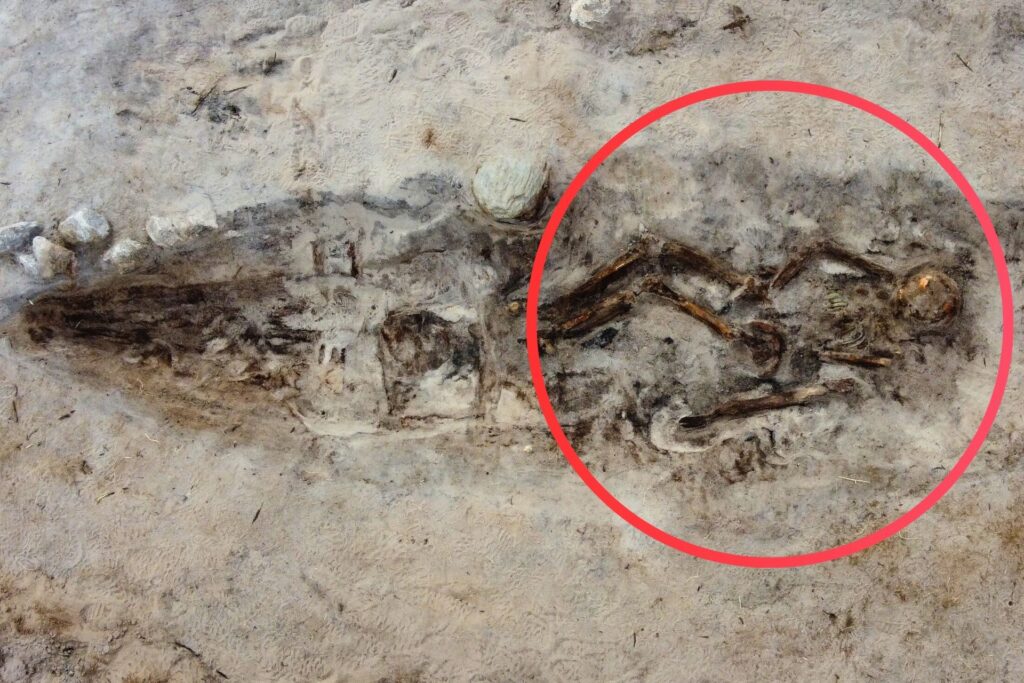
At the center of the boat lay the skeleton of a woman positioned on her side, knees slightly drawn up. Although bone preservation was uneven, archaeologists are confident about her sex due to the presence of two oval brooches, items exclusively associated with women’s graves in the Viking Age. The style of these brooches dates the burial firmly to the early 10th century.
Boat burials were not given to ordinary individuals. In Viking Norway, such graves were typically reserved for elites like chieftains, warriors, and high-status women. Archaeologist Anja Roth Niemi, researcher and head of cultural heritage management archaeology at the Arctic University Museum of Norway, has noted that “only the elite would receive a burial like this,” though the brooches suggest she was an important local figure rather than royalty. Even so, being buried in a boat signified prestige and community recognition.
The Senja burial fits into a broader pattern of richly furnished female graves across Scandinavia. Archaeological scholarship has shown that Viking women could hold significant social and economic influence, sometimes overseeing large households and estates. This grave adds further evidence that power and status in Viking society were not exclusively male domains.
The Objects That Defined Her Life

The grave goods found alongside her help reconstruct her role in life. Archaeologists recovered an iron sickle, a slate whetstone, a spindle whorl, a possible weaving sword made of whalebone, beads of bone or amber, and a metal ring pendant. These were not random objects; they reflect daily responsibilities and social identity.
Textile tools are particularly revealing. In Viking households, the production of cloth was central to survival and status, and overseeing textile work was traditionally the responsibility of the lady of the household. High-quality fabric was needed not only for clothing and blankets but also for sails, a crucial component of Viking maritime culture. The presence of weaving equipment strongly suggests she supervised or directed textile production.
Meanwhile, the sickle and whetstone indicate agricultural oversight and practical management tasks. Together, the artifacts portray a woman deeply embedded in the economic heart of her community. Her burial was not simply ceremonial; it reflected a life of leadership, production, and responsibility within Viking society.
The Dog That Never Left Her Side

What sets this grave apart, however, is the small dog placed at the woman’s feet. When archaeologists uncovered the burial, they found the animal carefully arranged, not dismembered or scattered as horses sometimes were in Viking funerary rites. Instead, it appears to have been laid to rest whole, suggesting companionship rather than ritual sacrifice .
Unlike horses, which were often sacrificed in parts, the dog was buried intact. There is no evidence to suggest the animal was buried alive; archaeologists describe it as carefully placed, consistent with other Viking Age companion burials. In Norse culture, dogs were frequently associated with loyalty and protection, and they appear in both graves and mythology as guides connected to the afterlife.
Whether this particular dog was a household companion, a hunting animal, or a guard remains unknown. Specialists will examine the remains to determine more about its breed and role. But its deliberate placement, resting at her feet inside the boat, suggests something deeply personal. In a burial already marked by status and symbolism, the dog adds a rare and moving glimpse into affection and loyalty in the Viking world.
PetsFanatic Team
Pet Care Expert & Content Creator
Passionate about sharing knowledge and tips for better pet care. Writing about everything from pet health to training techniques.