
Scientists Uncover Giant Snake Fossil That Dwarfs the Enormous Titanoboa
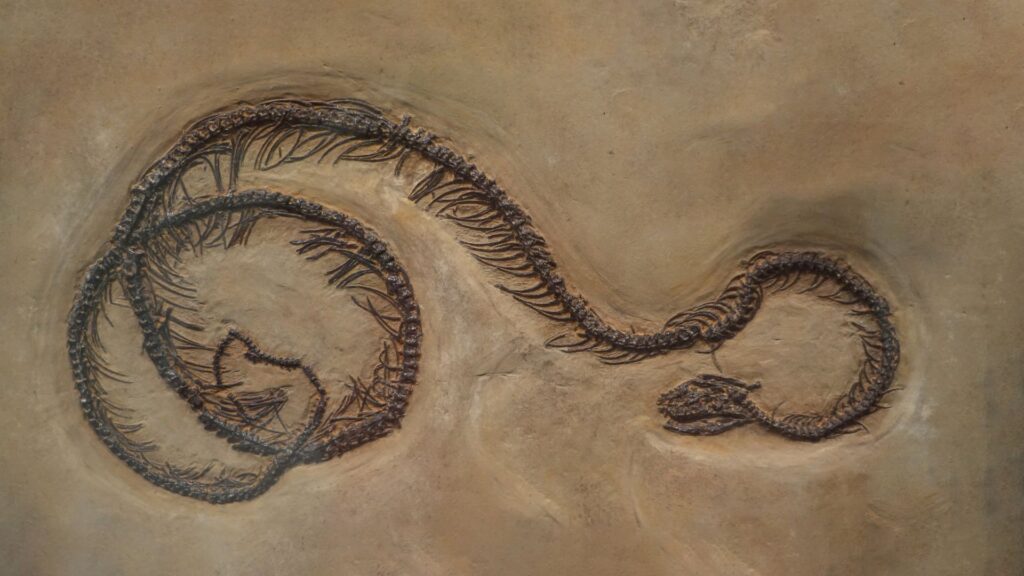
Beneath ordinary ground, discoveries still wait that quietly redraw assumptions about life long before humans paid attention. Fossils tend to arrive in fragments, then patterns start forming, and questions follow close behind. In that space between fragment and pattern, paleontology keeps finding reminders that Earth once supported creatures far outside modern experience.
One of those reminders surfaced in western India, where researchers uncovered fossilized snake vertebrae inside a lignite mine in Gujarat. The remains point to Vasuki indicus, a prehistoric snake estimated to stretch up to 15 meters and weigh about a ton. As measurements came together, the animal began to sit alongside Titanoboa, the South American giant that long defined the upper limits of snake size. With vertebrae measuring up to 11 centimeters across, the body shape suggests a thick, cylindrical form built less for speed and more for ambush.
That physical outline leads naturally to its behavior, since researchers describe Vasuki as a swamp-dwelling constrictor similar to modern anacondas and pythons. The setting places the snake near coastal marshes during a warmer global climate roughly 56 million years ago. From there, the find opens a wider view of how giant snakes spread across continents during the early age of mammals, with India now firmly part of that picture.
Fossil Vertebrae Reveal Size and Body Structure
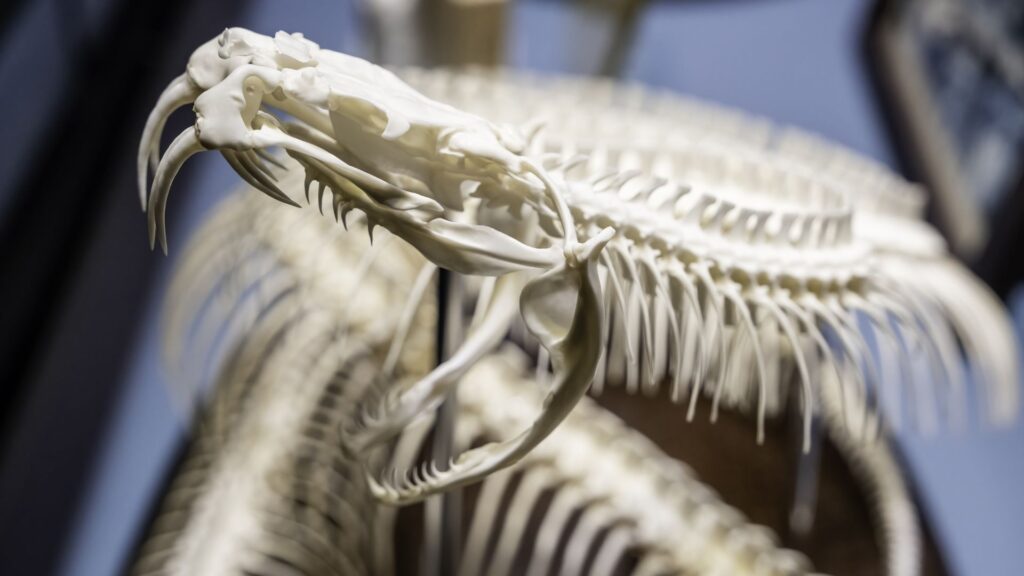
Researchers identified Vasuki indicus from a partial spine recovered in a lignite mine in Gujarat, and the vertebrae immediately set expectations. 27 bones appeared together, with some still aligned, which allowed scientists to estimate length and mass with more confidence. Measurements suggest a snake stretching up to 15 meters and weighing roughly a ton, placing it among the largest snakes ever identified. As those figures came into focus, attention turned toward what the bones revealed about how the animal carried that size.
Individual vertebrae measured up to 11 centimeters across, pointing toward a broad, cylindrical body rather than a narrow frame. That width supports estimates of a body diameter close to 44 centimeters, which suggests a snake built for steady power rather than quick movement. With that structure in mind, researchers linked Vasuki to modern constrictors like anacondas and pythons. The absence of skull material limits behavioral detail, yet the spine alone indicates crushing strength over speed.
Those physical traits also align with the environment where the fossil surfaced. The mine sits near what would have been coastal swamps during a warmer global climate roughly 56 million years ago. In that setting, a heavy-bodied constrictor could rely on ambush tactics and sheer mass to subdue prey. As the vertebrae continue to be studied, they offer a rare look at how extreme size shaped prehistoric snake anatomy.
Vasuki and the Spread of Giant Snakes
Vasuki indicus adds a new geographic chapter to the history of giant snakes, and that location matters. Fossils surfaced in western India rather than South America, which immediately broadens the range where scientists now look for extreme snake size. With that placement, researchers began reconsidering how widely massive constrictors once ranged. The discovery suggests similar environmental conditions supported giant snakes across distant regions during the early age of mammals.
That timing aligns closely with Titanoboa, which lived around the same period after the dinosaurs disappeared. Vasuki dates to roughly 56 million years ago, placing it within a warm global climate that favored large cold-blooded reptiles. As temperatures stayed elevated, ecosystems across continents could support predators of enormous scale. In that setting, size likely followed climate rather than geography.
Comparisons with Titanoboa now focus less on ranking and more on distribution. Vasuki’s vertebrae appear slightly smaller, yet overall length estimates remain comparable. Those similarities raise new questions about how many giant snake lineages developed independently. As more fossils emerge, the picture of prehistoric snakes continues expanding beyond a single continent or species.
What the Fossil Leaves Open

Attention now turns to what remains missing from the record, since Vasuki appears without a skull. That absence limits insight into feeding mechanics and sensory range, and it keeps venom firmly off the table. With that gap in mind, researchers plan to focus on nearby sediment layers that may hold additional bones. Continued excavation in the Panandhro region could clarify how the animal hunted and how often it fed.
That search also ties into broader geological questions surrounding India’s position at the time. During the early Paleogene, the Indian plate sat closer to the equator, and coastal swamps lined much of the region. Those conditions shaped prey availability and water systems that supported massive reptiles. Reconstructing that environment may help explain how snakes reached such extreme dimensions outside South America.
That forward-looking work places Vasuki within a growing effort to map prehistoric ecosystems rather than rank single species. Each new fragment sharpens models of climate, habitat, and animal movement after the dinosaurs vanished. With more data, giant snakes may stop looking like rare anomalies and start appearing as a recurring outcome of ancient environments.
PetsFanatic Team
Pet Care Expert & Content Creator
Passionate about sharing knowledge and tips for better pet care. Writing about everything from pet health to training techniques.