
Scientists Discover a Mysterious Animal Never Before Seen in the US at the Bottom of the Great Salt Lake

Scientists studying the Great Salt Lake have long described it as a place defined by salt and little else, so expectations stayed low when researchers stepped into its shallow margins. The water burned the skin, so life seemed unlikely, and that assumption shaped years of thinking about what could survive there. Even so, routine sampling continued, and that steady work kept attention on the lake rather than closing the book on it.
That focus carried into a lab far from the shoreline, where sediment taken from the lake went under a microscope. At first, the samples looked ordinary, so the work continued with adjusted methods and closer inspection. Soon after, movement appeared in the dish, and the discovery forced a careful rethinking of what the lake supports. From there, researchers tracked the organism’s structure, size, and behavior, which steadily confirmed they were looking at something unfamiliar.
As the analysis deepened, the find raised broader questions about how such a creature survived and how long it had been there. Researchers connected its presence to the lake’s extreme chemistry and to regional history that shaped its isolation. That chain of evidence reframed the Great Salt Lake as more than a harsh environment. It became a site where hidden life can persist in plain sight.
Taxonomic Identification of Diplolaimelloides Woaabi
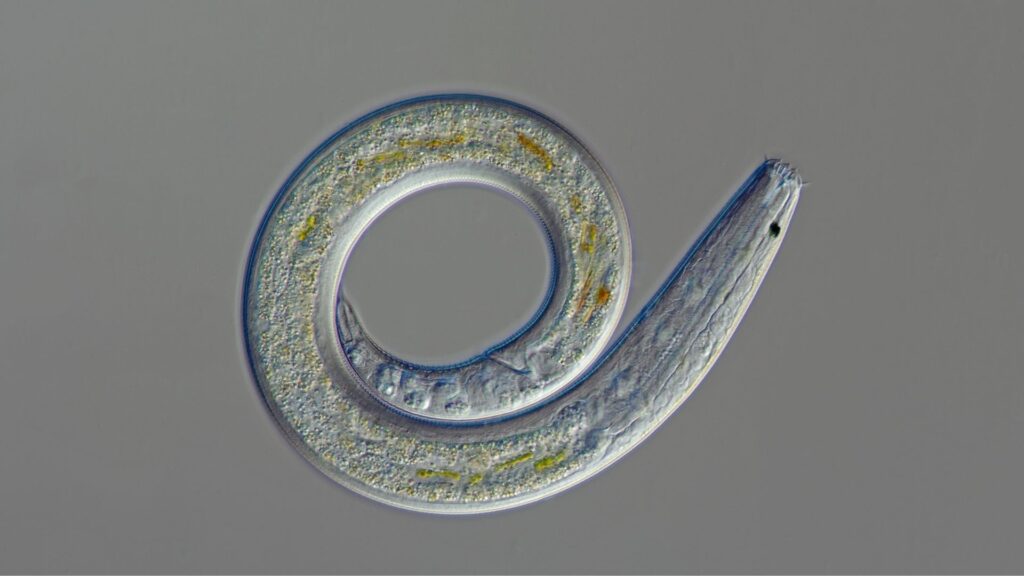
Researchers first confirmed the organism as a nematode after observing its round body shape and movement under magnification. That initial classification guided the next phase of analysis, which focused on comparing its physical traits to known genera found in saline environments. As the examination continued, subtle structural differences began to stand out, leading scientists away from existing species records.
Over time, detailed measurements of body length, feeding behavior, and surface features narrowed its placement within the Diplolaimelloides genus. Those findings aligned with nematodes known to inhabit salty and brackish waters, which helped explain their presence on algal mats at the lake’s bottom. At the same time, genetic comparisons supported the idea that the organism did not match any previously cataloged species in the United States.
After years of verification, the team moved forward with formal naming. Researchers worked with members of the Shoshone community, whose ancestral ties connect closely to the lake region. Drawing from the Shoshone word wo’aabi, meaning worm, the team named the species Diplolaimelloides woaabi. The designation reflects both its biological placement and its geographic roots, grounding the discovery within scientific and cultural context.
Competing Theories on How the Worm Reached the Lake

Researchers began asking how a nematode ended up in an isolated body of water with extreme salinity. That question led them back millions of years to changes in the region’s geology. Tectonic uplift raised the Colorado Plateau, which formed enclosed basins that collected snowmelt and rainfall. Over time, evaporation concentrated salt in those basins, creating conditions where salt-tolerant organisms could persist across long spans of time.
That line of thinking suggests the worm developed within the basin as conditions slowly changed. According to that view, the species remained present as the lake evolved into its modern form. Scientists then examined sediment history and regional climate records to see whether uninterrupted salinity supported that scenario. Some evidence pointed elsewhere, which opened the door to a second explanation.
Another idea focused on migration patterns rather than ancient isolation. Researchers proposed that birds traveling between continents may have carried the worm or its eggs on their feathers or feet. Those birds regularly move between saline lakes in South America and North America, which provides a possible route. That explanation fits with the worm’s ability to survive harsh conditions and persist after arrival, keeping both theories under active consideration.
A Living Signal Beneath the Salt

Attention now turns toward what the worm can reveal about the lake itself. Researchers note that nematodes respond quickly to changes in water chemistry, so their presence offers a way to track environmental conditions over time. As salt levels fluctuate and algal growth changes, the worm’s survival patterns can mirror those trends in real time.
That sensitivity places Diplolaimelloides woaabi among organisms used to measure ecosystem health. Scientists already study similar species in coastal marshes and saline lakes to detect pollution and nutrient changes. In the Great Salt Lake, ongoing observation of this nematode could help document how shrinking water levels affect microscopic life. Data gathered from such monitoring can support broader lake management efforts without disturbing the habitat.
Research teams also plan to study the worm’s cellular makeup to understand how it tolerates extreme salinity. That work may guide future studies on biological adaptation in harsh environments. As sampling continues, the lake no longer reads as an empty basin. It presents itself as an active system with signals waiting to be interpreted.
PetsFanatic Team
Pet Care Expert & Content Creator
Passionate about sharing knowledge and tips for better pet care. Writing about everything from pet health to training techniques.