
Scientists Discover 68-Million-Year-Old Giant Egg With Unusual Remains Inside

Scientists working on Seymour Island near Antarctica recently confirmed the identity of a fossil that puzzled researchers for nearly a decade. The object surfaced during fieldwork as a wrinkled, leathery mass that resisted easy classification, which kept it stored and quietly debated for years. Over time, repeated analysis began pointing toward something biological rather than geological, setting the stage for a closer look at its origin.
Further study revealed the fossil came from a 68 million year old soft shelled egg, now named Antarcticoolithus bradyi. That finding drew attention because the egg measured roughly 11 by 8 inches and preserved a flexible structure rarely seen in the fossil record. As researchers traced its features, questions followed about which animal could produce an egg of that scale.
Nearby fossil remains began to guide those questions. Skeletal evidence from massive marine reptiles appeared in the same sediments, leading scientists toward mosasaurs that once dominated Antarctic seas. From there, the discovery started reframing how prehistoric marine reptiles may have reproduced in environments far colder than expected.
Soft-Shelled Egg Challenges Long-Held Assumptions
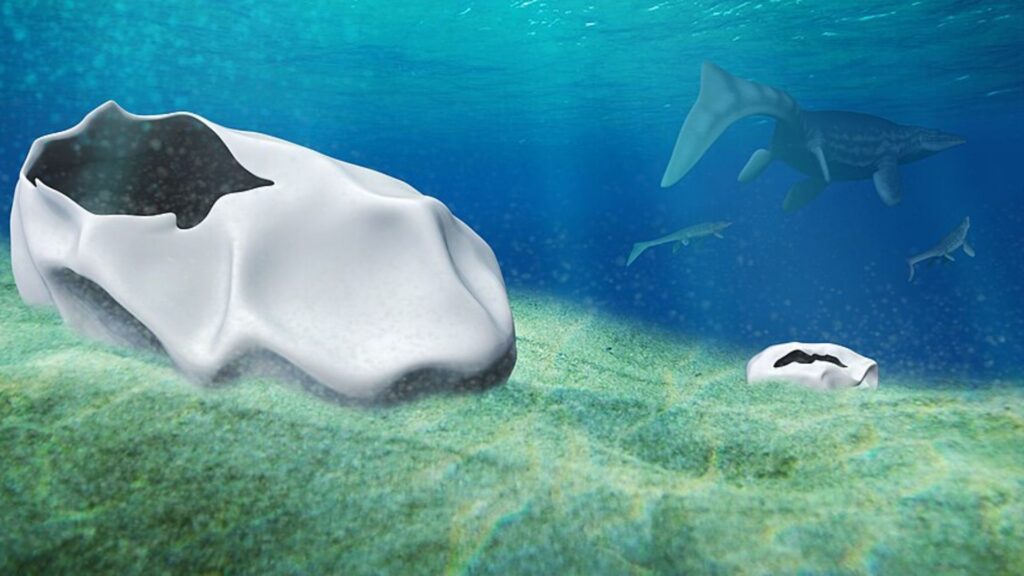
Researchers expected thick mineralized shells when studying eggs linked to large prehistoric animals, so the flexible structure of Antarcticoolithus bradyi immediately stood out. As analysis continued, the egg’s thin membrane showed similarities to modern snake eggs rather than dinosaur fossils. That detail pushed scientists to reconsider how marine reptiles protected developing embryos.
As those observations settled in, lead researcher Lucas Legendre described the egg as coming from an animal comparable in size to a large dinosaur, yet completely unlike any dinosaur egg on record. The statement carried weight because it separated body size from shell type in ways paleontology rarely considers. From there, the egg suggested that soft shells existed across a wider range of species than previously assumed.
As related discoveries surfaced, soft-shelled eggs from Protoceratops and Mussaurus added context to the Antarctic find. Together, these fossils indicated that rigid shells appeared later through independent evolutionary paths rather than defining early reptile reproduction.
Antarctic Fossil Site Reveals Marine Reptile Nursery

Excavations on Seymour Island continued to raise new questions as researchers documented what surrounded the giant egg rather than focusing on it alone. Nearby sediments contained fossilized remains from juvenile marine reptiles positioned close to adults, which immediately suggested repeated use of the same area. As attention widened, the site began to resemble a shared space rather than a single isolated event.
As analysis moved forward, paleontologists identified young mosasaurs and plesiosaurs preserved within the same layers. Their size and developmental stages indicated early life rather than random drift after death. Julia Clarke from UT Austin described the find as “exceptional in both size and structure,” noting how rarely growth stages appear together in one location.
As those details aligned, the site started to resemble a nursery used across seasons. Repeated nesting activity offered insight into how marine reptiles gathered in Antarctic waters during the Late Cretaceous. The pattern pointed toward shared reproductive zones supported by stable environmental conditions.
Preservation Raises New Questions About Fossil Formation

Research teams also focused on how a soft-shelled egg survived long enough to fossilize within Antarctic sediments. Sediment composition and low oxygen conditions appear to have limited decay, which allowed delicate structures to remain intact. Over time, gradual burial protected the egg from disturbance and compression.
As scientists examined the surrounding layers, attention turned toward climate patterns during the Late Cretaceous. Warmer polar seas and stable shorelines likely supported repeated animal presence in the region. Those conditions may explain why multiple growth stages appear preserved together rather than scattered across distant sites.
As future work continues, researchers plan to apply advanced imaging and chemical analysis to similar fossils. Non-invasive scanning could reveal embryonic traces without damaging specimens. Expanded field surveys may also uncover comparable sites hidden beneath Antarctic ice. Each step adds clarity to how rare preservation events record moments that usually disappear without a trace.
PetsFanatic Team
Pet Care Expert & Content Creator
Passionate about sharing knowledge and tips for better pet care. Writing about everything from pet health to training techniques.