
Mysterious 26-Foot-Tall Fossil Doesn’t Belong to Any Known Life-form
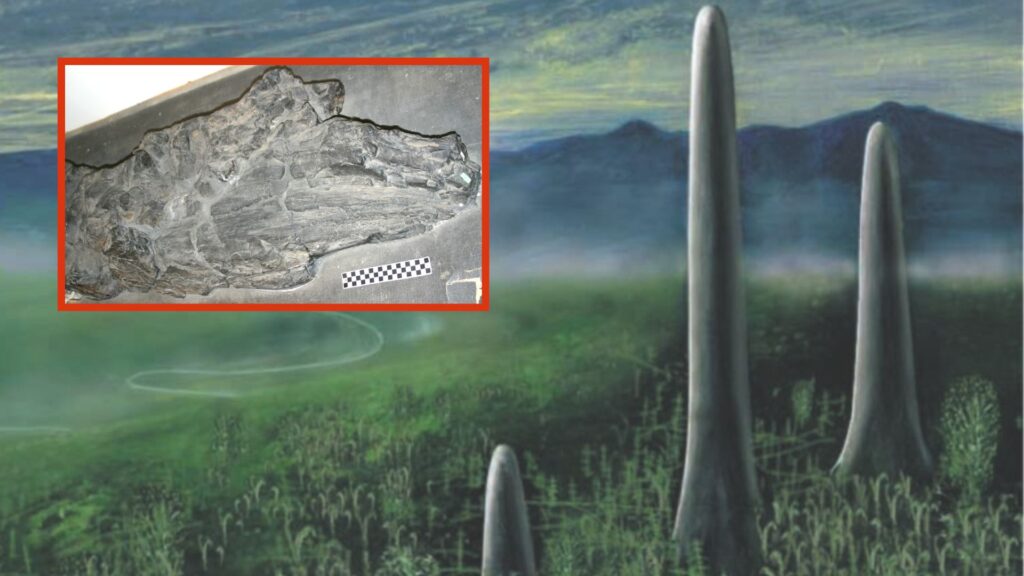
Fossils usually tell a story we already know, but now and then, one rewrites the script. A towering specimen once mistaken for a giant mushroom has left scientists scratching their heads for over a century. Standing 26 feet tall, it doesn’t match plants, fungi, or animals. That mystery has kept researchers circling it with fresh theories. The fossil is known as Prototaxites, and it continues to spark curiosity across generations.
Discovery of Prototaxites Fossil in Scotland

The story of Prototaxites starts in rural Aberdeenshire, Scotland, where it was first uncovered in 1843. Found within the Rhynie chert, the fossil dates back hundreds of millions of years. What stood out was its height, soaring nearly 26 feet, making it one of the tallest organisms of its time. Researchers quickly realized they weren’t looking at a standard plant or animal. So the fossil sparked years of study, and it’s still keeping experts curious today.
Unique Characteristics of Prototaxites

Prototaxites didn’t look like anything familiar, which is why it stood out right away. It grew as towering columns that reached 26 feet, so you can just imagine how it dominated the ancient landscape. Early studies suggested it was a giant mushroom, but later tests showed no match with fungi or plants. The fossil also lacked compounds usually found in both groups. That’s why researchers still see it as something unique and mysterious today.
Early Theories on Fossil Classification

Scientists first thought Prototaxites might be a type of plant, since it grew upright and reached such impressive heights. Later, in 2007, another theory suggested it was a prehistoric mushroom, and that idea caught attention because carbon isotopes supported the link. So for a while, many leaned toward the fungus explanation. Tests later revealed missing traits, just like the absence of chitin, which is common in fungi. That’s why the debate quickly turned back open.
Chemical and Anatomical Evidence Contradicts Fungi

Tests showed Prototaxites didn’t have chitin, a substance usually found in fungi, so that raised doubts about the mushroom theory. Scientists also compared chemical markers and found that the fossil didn’t match known fungi. The structure looked different too, which made the case stronger against a fungal link. So even though the fungus idea once sounded convincing, the details in its anatomy and chemistry just didn’t add up, leaving researchers searching for another answer.
Size and Role in the Early Devonian Period
Prototaxites grew up to 26 feet tall, so it towered over the small plants that covered the land during the Devonian period. It stood out in a landscape filled mostly with mosses and tiny greenery. That kind of size also meant it shaped its surroundings in a way other plants couldn’t. Researchers think it may have served as one of the earliest large organisms on land, giving structure to an ecosystem that was still developing.
Geological Context of Rhynie Chert Formation

The Rhynie chert in Scotland preserved Prototaxites in incredible detail, so scientists could study its structure millions of years later. The formation came from hot spring deposits that trapped plants, fungi, and other life in silica, turning them into fossils. That environment worked like a natural snapshot, also keeping microscopic features intact. Researchers use these fossils to piece together what life on land looked like in the Devonian period, and Prototaxites keeps standing out in that record.
Ongoing Debate on Fossil’s Biological Lineage

Prototaxites has sparked arguments for decades, so researchers keep going back and forth over what it really was. Some thought it was a giant fungus, others suggested algae, and a few even considered a type of early tree. The problem is that evidence points in different directions, so no theory fully settles the question. That uncertainty makes the fossil even more interesting, and it also keeps scientists looking for new ways to explain its place in Earth’s history.
Implications for Understanding Early Terrestrial Life

The presence of Prototaxites during the Devonian hints at how unusual Earth’s early environments were. Towering structures like these would have changed how light, moisture, and nutrients spread across the land, so they may have shaped how early plants and animals adapted. The fossil also raises questions about how life organized itself when ecosystems looked nothing like today. Scientists see it as a reminder that early life had forms we don’t fully understand yet.
What This Fossil Still Tells Us
Prototaxites continues to spark curiosity because it doesn’t fit neatly into any category we know. A fossil that once stood 26 feet tall has left behind more questions than answers, so researchers keep revisiting it with new tools and ideas. That means the story isn’t finished. Each study gives us a chance to see early life on Earth in a fresh way, and that makes the mystery worth following.
PetsFanatic Team
Pet Care Expert & Content Creator
Passionate about sharing knowledge and tips for better pet care. Writing about everything from pet health to training techniques.