
Fossil Discovered in China Reveals Two-Headed Creature That Lived Nearly 120 Million Years Ago

A rare fossil in northeastern China has given researchers a surprise. The remains belong to a tiny reptile with two heads, frozen in stone for nearly 120 million years. Paleontologists say the creature likely hatched with the condition, much like modern reptiles sometimes do. The fossil preserves remarkable detail, letting scientists study one of nature’s rare quirks from deep history. It’s a glimpse into ancient life that rarely leaves such striking evidence behind.
Hyphalosaurus Shows Complete Axial Bifurcation

The fossil belonged to a small aquatic reptile called Hyphalosaurus, and what makes it stand out is the condition known as axial bifurcation. That means the creature developed two full necks and heads from the same spine. Scientists rarely get such a clear case in the fossil record, so this find feels pretty special. It’s not just a partial hint of the condition but a complete example, which makes it even more fascinating to study.
Yixian Formation Preserves Rare Malformation
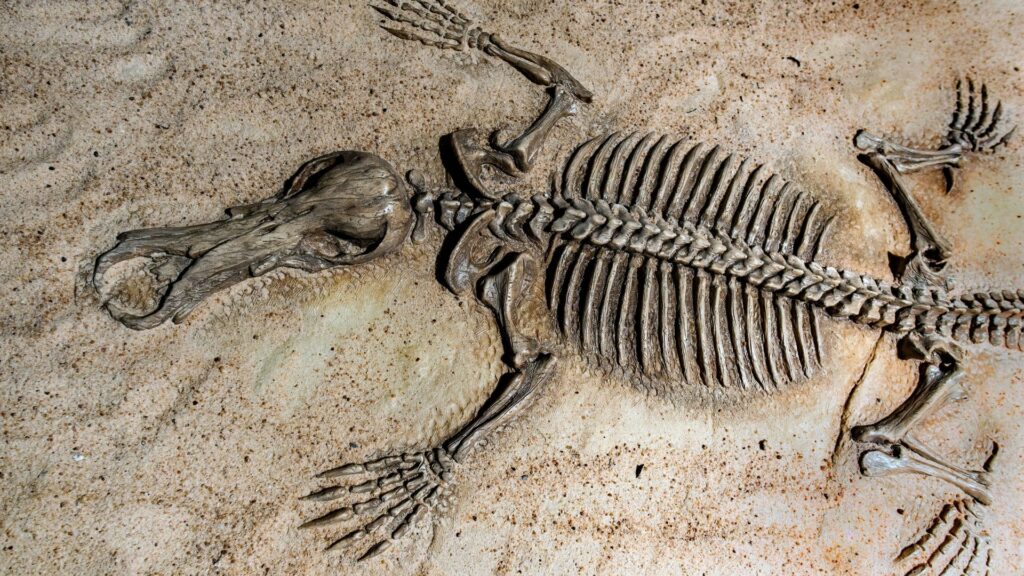
The fossil came from the Yixian Formation in northeastern China, a site that has produced some of the best-preserved fossils from the Early Cretaceous. What makes this one stand out is how it captured a developmental condition rarely seen in the fossil record. The reptile’s two heads and necks were frozen in stone with remarkable clarity, so scientists can study it in detail. Finds like this just don’t come around often, which makes it even more exciting.
70-Millimeter Embryo Survived Incomplete Twin Division

The fossil measures only about 70 millimeters, so we’re looking at a very young Hyphalosaurus. Scientists say it developed two heads after the embryo didn’t fully divide during growth. That rare outcome is seen today in reptiles like snakes and turtles, but finding it in a creature from 120 million years ago feels remarkable. The preservation also shows how delicate features survived in stone, giving researchers a chance to study a condition that rarely leaves such evidence.
Paleontologists Document Oldest Two-Headed Animal

Researchers say the fossil represents the oldest known case of a two-headed animal. That makes it stand out even more, since most examples we hear about come from modern reptiles. The team studied every preserved detail so they could confirm the condition wasn’t just an odd break in the fossil. It’s a rare glimpse into how developmental quirks appeared millions of years ago, and it also shows that these unusual traits go back far deeper in time than expected.
Aquatic Reptile Lived in Freshwater Lakes

Hyphalosaurus thrived in freshwater lakes that once stretched across what’s now northeastern China. The reptile had a long neck, paddle-like limbs, and a slender body built for swimming, so it moved easily through calm waters. Fossils from the region often show delicate features like skin outlines and soft tissues, which also makes this site stand out. The two-headed specimen just adds another layer, showing how unusual conditions sometimes appeared in creatures that lived in those ancient lakes.
Vertebral Column Divides at Pectoral Girdle

Researchers noted that the reptile’s spine split right around the pectoral girdle, so the body carried on with two necks and two heads branching from the same trunk. That detail makes the fossil especially striking because it shows exactly where the division occurred. It’s not a vague impression but a clear separation that just jumps out when you look at the preserved bones. The clarity helps scientists confirm the rare condition with confidence and precision.
Biology Letters Confirms Authentic Sediment Coating

The study published in Biology Letters confirmed that the fossil still carried its original sediment coating, so researchers could rule out any tampering. That detail matters because fossils with unusual traits often face doubts about authenticity. In this case, the natural matrix sealed around the bones gave scientists confidence that the specimen remained intact since burial. It also means the two-headed feature wasn’t created later, just preserved exactly as it appeared millions of years ago.
Statistical Anomaly Represents Ancient Life Fraction

The two-headed Hyphalosaurus represents a rare occurrence in ancient life, so paleontologists treat it as a statistical outlier. Such anomalies just don’t show up often in the fossil record. The specimen also helps scientists understand how unusual traits appeared in prehistoric species. Every preserved detail, from the split spine to the two necks, offers a snapshot of a moment that rarely survived fossilization. It’s a small but striking glimpse into life millions of years ago.
What the Two-Headed Fossil Teaches Us

The fossil gives a rare look at life from nearly 120 million years ago. Scientists can study how unusual traits like two heads appeared in reptiles. It also shows how well certain environments preserve delicate details. Observing the Hyphalosaurus helps paleontologists compare ancient species with modern relatives. The finding encourages curiosity about evolution and development. Anyone interested in prehistoric life can follow updates and see how each discovery adds pieces to the puzzle.
PetsFanatic Team
Pet Care Expert & Content Creator
Passionate about sharing knowledge and tips for better pet care. Writing about everything from pet health to training techniques.